Senate Passes Morrisey’s 10% Personal Income Tax Cut
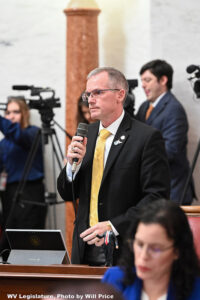
State Sen. Eric Tarr, the former chairman of the Senate Finance Committee, said Friday that cutting personal income tax rates by 10% was irresponsible. (Photo courtesy/WV Legislative Photography)
CHARLESTON – The West Virginia Senate passed Gov. Patrick Morrisey’s bill cutting personal income tax rates by 10% Friday, though not without a warning from the former Senate Finance Committee chairman and the chairman of the House Finance Committee.
Senate Bill 392 passed Friday in a 28-4 vote with two absent or not voting. The bill now heads to the House of Delegates next week.
SB 392 would cut personal income tax rates by approximately 10% retroactive to Jan. 1, returning $250 million to taxpayers when fully implemented. Morrisey first proposed an across-the-board 10% personal income tax cut during his State of the State address at the start of the 2026 legislative session.
Senate Bill 250, with Morrisey’s proposal for the general revenue budget for fiscal year 2027 beginning on July 1, pays for 5% of the proposed 10% personal income tax cut in part through departments and agencies cutting their budget requests by 2%, freeing up around $120 million.
The Senate Finance Committee version of SB 250 passed earlier Friday set the general revenue estimate for FY27 at $5.381 billion, a 2% decrease from the $5.493 billion budget presented to lawmakers by Morrisey.
Part of the 10% personal income tax cut in the committee substitute for SB 392 would be paid for with increased taxes on vape and e-cigarette products, raising an additional $22 million in tax revenue. The bill modifies the current excise tax of 7.5 cents per milliliter to a tiered system based on the type of vaping device. Closed-system vapes, such as cartridge or pods, would be taxed at $1.20 per cartridge. Open system, or refillable vapes, would be taxed at 25 cents per milliliter.
Senate Finance Committee Chairman Jason Barrett, R-Berkeley, said the goal of including the vape tax increase is to send SB 250 over to the House of Delegates and for members there to propose their own revenue offsets to help pay for the full 10% personal income tax cut and raise the revenue estimate back to the governor’s recommended level.
“We’ve built in a 10% tax cut in this budget. And we’ve done that with a little offset through the vape tax,” Barrett said. “The reason for doing that is to send a proposal over to the House to ask them to come to the table on that large tax cut, but also bring in some offsets of their own.”
The House Finance Committee version of the budget bill, House Bill 4027, sets the general revenue budget at $5.463 billion, a 0.5% decrease from the governor’s bill and a 1.5% increase from Senate Bill 250. It also includes no version of the proposed personal income tax cut.
During an interview Wednesday, House Finance Committee Chairman Vernon Criss criticized the tax cut, raising concerns about going around the personal income tax trigger mechanism put in place by the Legislature in 2023 based on a formula tied to positive economic conditions. Criss worried cutting taxes faster than the state was prepared to absorb could create a financial crisis similar to the late 1980s.
“(Morrisey’s) numbers don’t work,” Criss said. “In the long term, we are interested in making sure that we’re here for the long haul. He’s not. When I was here in the beginning in the late 80s, when we had financial distress, we were in a taxing mode … to tax everything that moved, to get dollars to come in. We don’t want to be there again. We want to be responsible.
“We have a tax plan in place,” Criss continued. “We have a formula in place that works … (Morrisey) wants to accelerate that tax cut without the economy growing. Well, bring me the economy.”
State Sen. Eric Tarr, R-Putnam, voted against both SB 250 and SB 392. The previous Senate Finance chairman, Tarr said he could not support a budget that appeared to increase spending while cutting personal income tax revenue by $250 million. Tarr said any cuts that exceeded the 3% rate of economic growth in the state would likely create issues in the near future.
“The way that you do that is you hold a flat budget where you reduce your spending, and then by that, you’re going to increase your revenue reduction, which would be a tax cut,” Tarr said. “When you start going out now, especially with triggers in place that go ahead of 3%, you place us in a position in a future legislature to come back in and have to increase taxes or do cuts that you really, really don’t want to have to cast a vote on.
“I don’t think you chop down the apple tree so you can get a bite at the apple,” Tarr said during discussion of SB 392. “That’s what this does, when you cut ahead of being able to get the revenue to actually afford the tax cut. … We’re going to get a real good bite of the apple here right now, but the apple tree’s gone.”
The tax cut was also opposed by the Senate’s two lone Democratic members, who both said it was irresponsible to reduce personal income tax revenue while there were growing budgetary needs, such as funding for special education in the school aid formula, child welfare and foster care, and reduced federal funding to the state.
“A $250 million tax cut right now is not the right thing to do when we have so many priorities that we’re not going to be able to fund, not just now, but in the future,” said Senate Assistant Minority Leader Joey Garcia, D-Marion. “I think this tax cut is going to have the effect of tying our hands in the future on some of the most important things that could help West Virginians.”
“Who are we really helping? We’re helping the high-income people on our progressive tax rate,” said Senate Minority Leader Mike Woelfel, D-Cabell. “Say the quiet part out loud. We’re helping the donors, the political donors, the donor class. Yes, we’re helping them by cutting the progressive tax rate.”
Top Headlines
Trump EPA Backs Biden-Era Mandate To Replace Lead Pipes
Bill in West Virginia Legislature Could Speed Up Financial Support to Relatives Who Take Care of Foster Children
A new proposal could give kinship caregivers in West Virginia full foster care subsidies within 30 days of kids ...
DENVER L. “BURP” PALMER
Denver L. "Burp" Palmer, 83, of Jacobsburg Ohio passed away February 18, 2026, in Wheeling WV. Arrangements by ...
Hope Scholarship Reform Bill Still Being Worked On

Trump Administration Weakens Limits on Emissions of Mercury, Other Toxins From Coal Power Plants