W.Va. Senate passes bills dealing with school calendar, Hancock County Schools
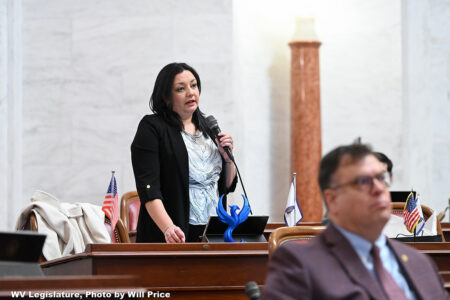
Photo courtesy of WV Legislative Photography West Virginia Sen. Laura Wakim Chapman thanked Senate leadership Saturday for passing a bill to provide a load for Hancock County Schoolsj
CHARLESTON – With just over three weeks left in the 2026 legislative session, the West Virginia Senate held its first Saturday floor session, passing several pieces of legislation, including bills allowing county school systems to make changes to their calendars and funding Hancock County Schools.
Senate Bill 890, changing certain school calendar requirements from days or months to hours, passed Saturday morning in a 23-5 vote with six absent or not voting. The bill now heads to the House of Delegates.
SB 890 would change the traditional 180-day requirement for public school systems, allowing county school districts to change to a minimum of 900 hours of teaching time, while redefining the standard employment term for staff as 1,600 hours.
These adjustments would also affect the state Teachers Retirement System and the calculation of personal leave, which would be standardized based on an eight-hour workday. The bill grants county boards greater flexibility in using alternative instructional methods during school closures and increases the time allocated for staff preparation.
“This bill is … important in doing one major thing that we hear about all the time and that’s providing flexibility to our counties,” said Senate Education Committee Chairwoman Amy Grady, R-Mason. “It’ll allow flexibility for local county school boards to change the calendar to what they see fit. It will allow some innovation when it comes to the school day.”
The bill’s lead sponsor, state Sen. Rollan Roberts, R-Raleigh, said the bill is meant to be an answer to recent requests by West Virginia Board of Education President Paul Hardesty to begin easing regulations placed on public school systems to provide them more flexibility in developing school calendars that best meet the needs of their student populations.
“You will find that many states will use the 180-day model, but there was no reasoning for that other than they just zeroed in on that day. There is no magic formula. There is no study that said 180 days does the trick,” Roberts said.
“If we are going to come in line with what the president of the Board of Education has been asking, and we start streamlining and eliminating the regulations with his stack that he put on his desk … let’s give the teachers, those in leadership with education, the level of trust that they can change things and they can do it right,” he continued.
State Sen. Mike Oliverio, R-Monongalia, opposed the bill, stating it would allow county school systems to reduce instructional time for students by as much as 23 days.
“I want you to think about your last 12 months,” he said. “I want you to think about your interaction with your constituents. Has anybody come to you and said, ‘I’ll tell you what I’d like you to do, Senator. I’d like you to reduce the amount of time that our school children spend in school by 23 days.’ Has anybody asked you to do that? While it provides flexibility for certain, I’m not sure it does anything to help with quality.”
Grady said SB 890 was permissive, with any county school system wishing to continue the traditional 180 days of instruction allowed to do so.
“It doesn’t say that any county school board has to change what they are currently doing,” said Grady, an elementary school teacher in Mason County. “They can elect to continue with as many days, the same calendars they’re doing, the same number of hours they are using right now. They don’t have to change anything they’re doing. This just states that you may.”
“As a classroom teacher, I can tell you that every single hour of my day or every single minute of my day is not spent in the same way all the time,” she continued. “And I can tell you 100% that the more days we are in school does not equate to a better education for students. It all depends on the quality of instruction that you provide during the time that you are in the classroom with the students.”
The Senate also passed House Bill 4575, making an $8 million supplemental appropriation to the state Board of Education for Hancock County Schools, in a 27-1 vote with six members absent or not voting.
The money for the Hancock County Board of Education is intended to prevent a total financial collapse and missed payrolls at the end of the current fiscal year following the state’s intervention in the county’s troubled school system.
State Sen. Ryan Weld, R-Brooke, offered a successful amendment to HB 4575 Friday, changing the name of the line item to “Hancock County Board of Education Financial Stability Loan Program” after concerns were raised earlier this week by members of the Senate Finance Committee that the county might not be required to pay the money back to the state.
“It changes nothing technical about the bill,” Weld explained Friday. “I knew there was discussion in the Finance Committee whether or not this was absolutely a loan being made to Hancock County, and I thought that further clarification could be needed. So, in discussions with members of the Finance Committee, I offered this amendment that we have before us.”
Hancock County Schools is facing a nearly $3.1 million funding shortfall, caused by employing more teachers and staff than it can afford under the state aid formula, questionable financial decisions and purchases, and not recording its accounting in the West Virginia Education Information System avoiding accountability, obscuring its financial condition from state officials. The county is now under the control of the Department of Education, with Hancock County Board of Education authority limited and a state-appointed superintendent and assistant superintendent.
The $8 million would provide a bridge to get Hancock County Schools through June and the start of the next fiscal year on July 1.
Speaking after the Senate floor session, Grady said a companion bill still in the Senate Education Committee – House Bill 4574 – would no longer be needed. That bill would have established a “Temporary Shortfall Supplement Fund for County Boards of Education,” a new fund to provide loans – limited to honoring personnel obligations and other essential operating expenses – for school systems categorized as either financially distressed or in a state of maladministration.
“It’s our understanding in the Senate we don’t need the bill that we now have, the House bill that’s been sitting in Education because we have established that this appropriation is a loan,” Grady said.
State Sen. Laura Wakim Chapman, R-Ohio, has been a vocal supporter of both bills. She thanked the Senate for passing the supplemental appropriation Saturday.
“It’s a terrible situation, but because of you, the innocent teachers, bus drivers, cooks and staff will be paid,” Chapman said. “It was through no fault of their own that they were in this awful situation. I look forward to working with all of you to ensure that this particular situation never happens again. I appreciate you putting people over ideology, and the people of Hancock County thank you.”
Top Headlines

Pittsburgh Pirates Hall Of Famer And Ohio Valley Legend Bill Mazeroski Dies At 89

White House dinner closes a turbulent week for governors in Washington

Crews recover bodies of 9 backcountry skiers days after California avalanche
W.Va. Senate passes bills dealing with school calendar, Hancock County Schools
Trump says he’ll raise tariffs to 15 percent after Supreme Court ruling
WASHINGTON (AP) — President Donald Trump said Saturday that he wants a global tariff of 15%, up from 10% he had ...