West Virginia House Amends Senate Budget Bill
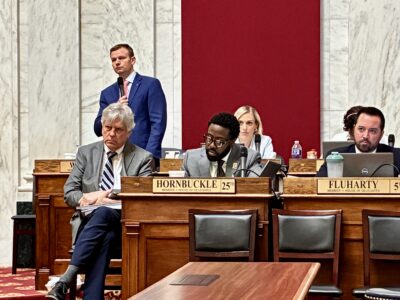
House Finance Committee Minority Chairman John Williams urged House Republican leadership Wednesday to maintain a transparent negotiation process when working with the Senate to craft a balanced general revenue budget for the next fiscal year. (Photo by Steven Allen Adams)
CHARLESTON – The negotiation process between the West Virginia Senate and House of Delegates toward a balanced general revenue budget for the next fiscal year is underway with the House dropping its version of the budget into the Senate’s bill.
The House amended and adopted a strike-and-insert amendment Wednesday to Senate Bill 250 after more than two hours of explanation, votes on secondary amendments and questions by members.
The amended SB 250 passed the House in an 83-14 vote with three absent or not voting. The bill heads back to the Senate, where negotiations will go on behind the scenes between the House and Senate Finance committees to present both bodies with a compromise balanced budget for fiscal year 2027 beginning July 1.
SB 250 is the vehicle this year for Gov. Patrick Morrisey’s budget, presented to lawmakers on the first day of the 2026 legislative session during his State of the State address. That budget proposal set the general revenue estimate for FY27 at $5.493 billion. The Senate amended the bill last week, setting the budget at $5.381 billion, a 2% decrease from Morrisey’s recommendation.
The House version passed Wednesday sets the general review budget at $5.463 billion, a 0.5% decrease from Morrisey’s recommendation and a 1.5% increase from the Senate’s version. The House version leaves more than $30 million unappropriated for the next fiscal year.
When asked to describe the House version of the budget bill Wednesday, House Finance Committee Chairman Vernon Criss used one word: “Responsible.”
“Our budget’s actually lower than the governor’s introduced budget,” said Criss, R-Wood. “His budget was actually unconstitutional because he actually spent more money than he had revenue for.”
Criss explained to House members that the amendment to SB 250 includes the average 3% across-the-board pay raises for teachers, school service personnel, State Police employees and all public employees paid through the general revenue budget. The bill still contemplates a 3% increase in the Public Employee Insurance Agency employer share.
Other notable changes from the introduced budget include funding Medicaid through general revenue instead of the surplus section, where items are funded through available surplus tax collections at the end of the current fiscal year. The bill also includes a proposed alternative funding structure for the Hope Scholarship educational voucher program still being worked on in the House Finance Committee.
Despite concerns raised by Morrisey and other supporters of the Hope Scholarship, which opens up to all eligible children in the state beginning July 1, the House version of SB 250 fully funds the program at the $230 million estimate by the State Treasurer’s Office.
In the House budget, the Hope program will receive $211 million between supplemental appropriations and the FY27 appropriation, along with $20 million in Hope carryover funds available at the end of the current fiscal year. The governor’s recommended budget would have funded Hope at $230 million in FY27, plus another $108.1 million in other supplemental appropriations for a combined $338.3 million covering a year-and-a-half.
“We are funding Hope Scholarship at the level the governor wants for one year, not for a year-and-a-half because constitutionally you cannot force … another Legislature with an obligation from this Legislature,” Criss said. “We’re funding for the full year of what the treasurer has obligated and has told the governor to put in his budget.”
The House version of the budget also does not include the 5% cut in personal income taxes that Morrisey factored into his budget bill, nor Morrisey’s requested full 10% cut in personal income tax rates that the Senate passed in Senate Bill 392 that would return $250 million to taxpayers if approved.
Criss said the House would look at SB 392 and be open to discussing some form of cut to personal income tax rates. During a press conference Tuesday, Morrisey said he was willing to discuss with lawmakers how to get to a full 10% cut, but Criss said he and House Finance Committee Vice Chairman Clay Riley, R-Harrison, have yet to hear from the governor.
“We’ve never had a conversation with the governor,” Criss said. “He has never darkened the door of the vice chairman or myself other than coming to sit on the bench to listen to the Hope Scholarship. But he’s never come to us to talk to us about exactly what he has done on his budget.
“There is a tax cut bill that the Senate has sent over,” Criss continued. “We will take that up at a later time when we start taking up Senate bills.”
The House version of the budget includes several items in the surplus section or the back of the budget. These are items that will be paid out from available surplus tax collections at the end of the current fiscal year in the order they appear.
The House’s surplus section includes $191.2 million in funding priorities, with some projections for an end-of-fiscal year surplus as high as $300 million. The state is sitting on $108.8 million in surplus tax collections eight months into the current fiscal year.
Items in the surplus section of the House budget include: $800,000 for Court Appointed Special Advocates, $250,000 to the Cabell County Commission for Lily’s Place, $100,000 to the Monroe County Commission for the Willowbend Agricultural Innovation Center, $40,000 to the Wirt County Commission for the Little Kanawha River Parkway, $30 million for the Division of Economic Development’s Infrastructure and Jobs Development Council, $10 million for the Department of Environmental Protection-Reclamation of Abandoned and Dilapidated Property Program Fund and $150 million for Division of Highways.
An amendment offered by the House Democratic caucus and adopted Wednesday added a $25 million line item at the end of the surplus section to the West Virginia Flood Resiliency Office Trust Fund.
Created by the Legislature in 2023, the Flood Resiliency Trust Fund is to be used to encourage local governments to work on flood protection and prevention projects, prioritizing low-income geographic areas and the use of the local environment and features to protect against flood damage. However, the Legislature has never appropriated money for the fund.
“I would like to do this together. Again, all of us have been impacted by flooding, and we have that opportunity to help today,” said House Minority Leader Sean Hornbuckle, D-Cabell.
“On Father’s Day, I woke up (in 2025) to a tremendous flood, and we lost a lot of lives. We lost a lot of damaged property,” said Del. Bill Flanigan, R-Ohio. “I’m going to rise in support of this amendment. Just anything we can do to help prevent this, if we’ve got to put more money into it, I think we’ve got to do it.”
The House also adopted amendments to require leftover funds in the aged and disabled waiver programs to roll over to the next fiscal year and not be used for any other purpose, appropriate $150,000 for the Division of Labor to employ investigators, restore a cut to WorkForce West Virginia to the governor’s recommended line item and provide a pay increase for non-uniformed employees of the Division of Corrections and Rehabilitation.
Passage of SB 250 was bipartisan, with the nine-member House Democratic caucus supporting the bill. But House Finance Committee Minority Chairman John Williams, D-Monongalia, urged House leadership to not hide the negotiation process on the final budget package behind closed doors.
“I think it’s evident that this budget is going to be a process over the next few days,” he said. “This probably isn’t the final version that we will have. There are aspects of this proposal … that I greatly prefer to what the Senate proposed and what the governor proposed. So, we’ve got work to do.”
Top Headlines
West Virginia House Amends Senate Budget Bill
Orchard Park Hospital Signs Letter Of Intent To Merge With WVU Medicine Wheeling Hospital
W.Va. 2 In North Wheeling Closed Due To Water Main Break
W.Va. 2 in North Wheeling is currently closed due to a water main break in the area, the City of Wheeling ...
More snow falls on the Northeast US, where huge piles remain from the last storm
Orchard Park Hospital Signs Letter Of Intent To Merge With WVU Medicine Wheeling Hospital