
Bills Allowing For State Police Machine Gun Sales Advances
Bill also eases domestic violence gun prohibitions
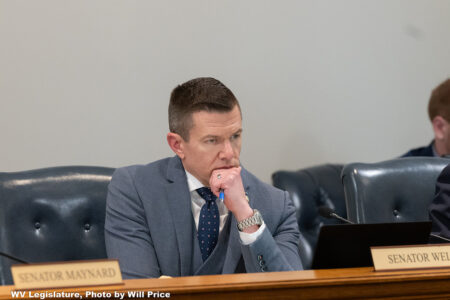
State Sen. Ryan Weld opposed two gun-related bills before the Senate Judiciary Committee Monday. One bill would allow the State Police to sell machine guns to individuals in violation of federal law. The other would allow those under domestic violence protective orders to continue to have firearms under certain circumstances. (Photo Courtesy/WV Legislative Photography)
CHARLESTON — The Senate Judiciary Committee pushed out two bills Monday afternoon: one that could sidestep federal rules governing how machine guns are sold, and one allowing those accused of domestic violence to hold onto their firearms under certain circumstances.
The committee recommended Senate Bill 1071, the Public Defense and Provisioning Act, for passage, sending the bill to the Senate Finance Committee. The bill’s lead sponsor is state Sen. Chris Rose, R-Monongalia.
SB 1071 would create a dedicated state office within the West Virginia State Police responsible for purchasing and selling fully automatic machine guns to eligible residents for the purpose of state defense. The State Police would be required to acquire machine guns common to military or law enforcement use and make them available for sale at every State Police troop detachment in the state.
The State Police would oversee the distribution, background checks, and registration of these automatic weapons. The bill outlines specific fees, record-keeping requirements, and liability protections for the state officials managing the program.
The federal Firearm Owners Protection Act of 1986, also called the Hughes Amendment, bans the transfer or possession of machine guns manufactured after May 19, 1986.
Only machine guns manufactured prior to 1986 and registered with the federal Bureau of Alcohol, Tobacco, Firearms and Explosives (ATF) can be legally owned. Those weapons require an extensive approval process in order to transfer them from one person to another, including a $200 tax stamp and an extensive FBI background check.
Alex Shea, the state director for the Gun Owners of America, told committee members that SB 1071 would not violate federal criminal code that makes it illegal for any person except for licensed importers, manufacturers or dealers to engage in the business of importing, manufacturing, or dealing in firearms.
“West Virginia is not flying in the face of federal law. We’re not trying to create a loophole of any kind. We’re not squinting our eyes or bending the law or breaking the law,” Shea said. “I know government doesn’t run a business, but I would just do it on a by-order basis and not try to hold it in the armories. But I’m sure if you had anything in your armories, you could probably move it pretty quickly.”
But state Sen. Ryan Weld, R-Brooke, pointed to another provision of federal code that limits the transfer of machine guns by state governmental agencies to other state agencies or local governments for law enforcement uses and not to citizens.
“This bill purports to have found some sort of legal loophole that no one else has found, that no one else is aware of, or is pushing, or is interested in, that would allow for our State Police to become arms dealers, and sell machine guns to private citizens,” Weld said in an interview prior to Monday’s committee meeting. “It’s a complete violation of federal law, and therefore, violation of the supremacy clause of the United States of America that states that federal law is supreme.”
During committee testimony, State Police Sgt. Lonnie Faircloth of the West Virginia Troopers Association expressed personal concern that the bill might place troopers in a hard place by forcing them to participate in transfers that could be viewed as federal crimes.
“Personally, I have concerns with it just because of the fact that we’re transferring to a private citizen, then we are possibly now making (a trooper) a felon,” Faircloth said.
The committee also recommended a committee substitute for Senate Bill 963, protecting due process in firearm confiscation, sending the bill to the full Senate. The bill’s lead sponsor is Senate Judiciary Committee Chairman Tom Willis, R-Berkeley.
SB 963 would delay the surrender of firearms in domestic violence cases until a full adversarial hearing occurs. Under current law, firearms can be surrendered following an ex parte hearing, where only the petitioner is present.
SB 963 limits surrender of firearms to three specific circumstances: the accused party fails to appear at a hearing, the accused party agrees to the surrender, or a full adversarial hearing is held where a finding of violence or threatened violence is made by a preponderance of evidence.
Derin Stidd, the mid-Atlantic regional field manager at Young Americans for Liberty, said the current state code on domestic violence firearms bans violates the due process rights of gun owners.
“Right now in West Virginia, people can have their guns taken away on the basis of the issuing of a protective order,” Stidd said. “The problem with that is that a protective order does not require due process. All this bill does is it updates West Virginia’s law to be consistent with the Constitution of the United States of America that before you take a person’s guns away, you have to follow due process.”
Monongalia County Prosecuting Attorney Gabrielle Mucciola, who appeared before the committee virtually, opposed the bill.
“We know that in the United States, nearly half of all women are killed by a current or former intimate partner,” Mucciola said. “And so, we also know that the dangerous lethality assessment and those indicators show that access to a firearm is the number one indicator — the number one evidence-based indicator — that would show that a female or male victim of domestic violence is at risk for homicide by their partner.”
Weld, a former county assistant prosecutor, said he was unsure what problem the bill was trying to solve within current domestic violence laws.
“I fully understand and appreciate the concerns of due process or the restraint of liberty,” Weld said. “However, it’s hard to exercise any liberty if you are the victim of domestic violence and then someone shoots and kills you. And I think that this has a real effect — the real potential, this bill — of costing somebody their life.”
Steven Adams can be reached at sadams@newsandsentinel.com
Top Headlines
Bills Allowing For State Police Machine Gun Sales Advances

Trump says strikes on Iran could last several weeks

US stocks slip and oil prices leap with worries that war in the Middle East will worsen inflation

Hegseth insists the Iran conflict is ‘not endless’ and declares, ‘We fight to win’
Nailers Fall to Komets in Overtime, 3-2
3 U.S. Troops Killed and 5 Are Seriously Wounded During Iran Attacks
WASHINGTON (AP) — Three American service members have been killed and five others seriously wounded during the ...