Crossover Day: House of Delegates Works Through Long List Of House bills
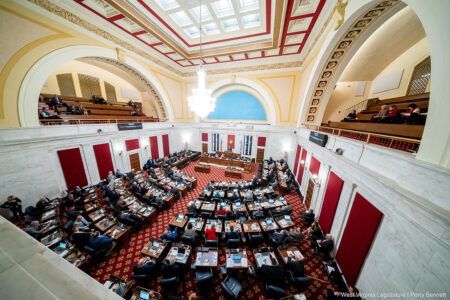
The House of Delegates spent nearly eight hours on the floor Wednesday, passing 56 bills to the state Senate (Photo Courtesy/WV Legislative Photography)
CHARLESTON – The West Virginia House of Delegates slogged its way through a lengthy agenda, staying on the floor from morning through late afternoon to get its bills sent to the state Senate to meet Wednesday’s Crossover Day deadline.
The House voted on 56 bills on Wednesday, the last day to consider bills on third reading in the house of origin in order for those bills to be considered by the end of the 2026 legislative session at midnight Saturday, March 14 – also called Crossover Day.
The House passed House Bill 4001, creating the TEAM-WV corporation, in an 87-8 vote with four absent or not voting.
TEAM-WV would be a private, non-stock, nonprofit corporation designed to modernize and accelerate economic development in the state. It would function as a depoliticized partner to the Department of Commerce, focusing on business recruitment, site readiness and workforce integration while utilizing private-sector expertise.
The program would be funded by allowing the new corporation to manage the state’s wholesale alcohol distribution through a $30 million annual contract, reinvesting profits back into growth initiatives. All grants, loans and tax incentives for business recruitment would remain functions of the Department of Commerce. But TEAM-WV would assist in evaluating the department and formulating economic recommendations. The corporation would be allowed to manage programs, conduct research and negotiate on behalf of the state.
“Incentives are strictly, strictly the decision of the executive and the Department of Commerce. It is prohibited for Team West Virginia to bind the state,” said House Finance Committee Vice Chairman Clay Riley, R-Harrison. “This proposal and this bill is about improving execution, being more competitive. … We here focus on the fundamentals, and economic growth absolutely has to focus on the fundamentals.”
“What I see – just in looking at the state of Ohio on the way that they do their economic development now – is putting us further behind,” said House Finance Committee Chairman Vernon Criss, R-Wood. “This bill will help give us an opportunity to play catch-up. … I’m tired of watching our material and our services go on the other side of the river from me when we ought to be doing them in West Virginia.”
HB 4001 is one of the House Republican caucus’ “Jobs First – Opportunity Everywhere” economic development bills. The House also passed another Jobs First bill Wednesday – House Bill 4010, providing a statutory program for loaning financial assistance to local airports for airplane hangar construction. That bill passed in a 92-3 vote with four absent or not voting.
House Bill 5353, regulating cryptocurrency kiosks, passed in an 89-3 vote with seven absent or not voting.
HB 5353 would create a regulatory framework for virtual currency kiosks – also called cryptocurrency kiosks – and digital wallets. Operators would be classified as money transmitters, requiring them to obtain annual licenses and adhere to strict disclosure and refund protocols.
The bill limits the total fees and commissions a kiosk operator can charge per transaction, with a 15% flat fee limit. It also regulates daily transaction limits for existing customers and new customers, defined as individuals registered with the kiosk operators for 10 days or less.
House Bill 5453, modifying the school aid funding formula, passed in an 89-2 vote with eight absent or not voting. It would overhaul the state school aid funding formula by transitioning to a block grant system.
Effective for the 2029-30 school year, all county boards of education would be funded via a block grant of $6,100 per enrolled student. County school systems with fewer than 1,200 enrolled pupils will receive funding at a minimum level equivalent to 1,200 pupils. An amendment to the bill would ensure no county board receives less total state aid than it received in the previous fiscal year due to changes in the bill.
But two efforts to suspend constitutional rules requiring a bill to be read on three separate days failed in an effort to get House Bill 5669, Raylee’s Law, over the Crossover Day deadline.
Under the bill, custodial parents or guardians accused of abuse or neglect would be prohibited from withdrawing a child from a school setting to begin homeschooling while Child Protective Services conducts its inquiry. The ban would remain in effect until the state determines the allegations are unfounded or a court intervenes.
Reports by mandatory reporters – those legally required to report suspected child abuse within 24 hours – would trigger the provisions of the bill. Child neglect and abuse allegations would need to be substantiated within seven days.
The bill’s lead sponsor, House Minority Whip Shawn Fluharty, made a motion at the beginning of Wednesday’s floor session to suspend constitutional rules so HB 5669, which was on first reading, could be read a second and third time and passed. The first motion, which requires a four-fifths vote, failed 52-40 with seven absent or not voting.
“This is another year where Raylee’s law advances, but doesn’t get across the finish line, and I find it truly pathetic,” Fluharty, D-Ohio, said in an interview Wednesday.
Fluharty offered a second motion to suspend rules at the end of the day, which failed in a 50-41 vote with eight absent or not voting.
“We have the votes to pass it on an up and down vote on its merits,” Fluharty said. “It passed out of committee, yet we waited too long to run it through committee, and as a result, we had to make a procedural motion, which requires 80 votes. And that procedural motion did not get to the qualifying 80. Yet, it still had the majority of House members supporting it.
“Clearly, the support is there for Raylee’s law, and it’s bipartisan support,” Fluharty continued. “Yet, it’s not important enough for the supermajority to make it a priority and get it through the process, knowing damn well what the timelines were when it comes to getting bills out of the house before Crossover Day.”
Top Headlines
Crossover Day: West Virginia Senate breezes Through Agenda
Crossover Day: House of Delegates Works Through Long List Of House bills

New Sheetz Taking Shape in Moundsville

Follansbee-Born College Football Hall Of Fame Coach Lou Holtz Dies At 89

US sinks Iranian warship as Iran warns of widespread destruction in the Middle East