Data Center and Microgrid Project In Mason County Changes Hands
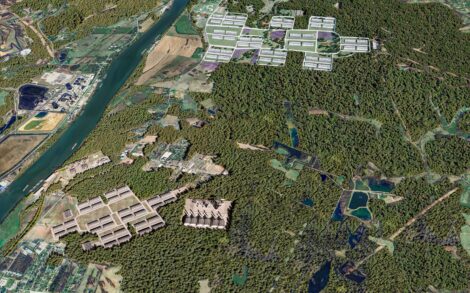
Photo Provided/Fidelis New Energy Cutline: A mock-up of what the Monarch Compute Campus near Point Pleasant could look like when completed.
CHARLESTON – A data center and microgrid project first approved by West Virginia economic development officials in 2023 in Mason County is undergoing a change of hands.
In an announcement Monday, California-based Nscale said it acquired the Monarch Compute Campus, a 2,380-acre data center and microgrid project near Point Pleasant. Nscale acquired American Intelligence and Power Corporation (AIPCorp), which is sponsored by Texas-based Fidelis New Energy and 8090 Industries, an investment firm.
Nscale said it had signed a memorandum of understanding with Microsoft to provide 1.35 gigawatts towards an artificial intelligence data center project using NVIDIA Vera Rubin NVL72 graphics processing units (GPUs).
“This collaboration with Microsoft marks a pivotal milestone both for Nscale and the development of the Monarch Campus,” said Nscale CEO Josh Payne. “By integrating our specialized AI infrastructure with Microsoft’s global platform, we are creating a foundation for innovation that can scale alongside the most ambitious AI models in the world.”
Company officials said acquiring the data center project in Mason County would provide opportunities to scale up and add capacity for additional data center infrastructure, taking advantage of the nearly 8 gigawatts of electric power the proposed microgrid project could produce when completed.
“Microsoft’s datacenter approach is to build the best global infrastructure informed by near-term and long-term demand,” said Jon Tinter, president of business development and ventures at Microsoft. “Our investments blend owned data centers, leased facilities and strategic collaborations. This collaboration with Nscale and NVIDIA is an important step to deliver meaningful AI innovation to our customers.”
In a statement Monday, Gov. Patrick Morrisey praised Nscale’s acquisition of AIPCorp and the Monarch Compute Campus.
“This is another major vote of confidence in West Virginia’s future,” Morrisey said. “A decision to expand the Monarch Compute Campus shows that our state is becoming a destination for the industries that will drive the next generation of economic growth.”
AIPCorp had announced in January a strategic alliance with Caterpillar Inc. and Boyd CAT for a purchase agreement towards construction of a 2-gigawatt fast-response natural gas generator, with equipment being delivered between September 2026 and August 2027.
“This strategic alliance reflects a shared commitment to delivering reliable, scalable and capital-efficient power solutions on an accelerated timeline,” said AIPCorp CEO Daniel J. Shapiro. “By leveraging our existing microgrid designation from the State of West Virginia, we can bring new capacity online quickly while supporting long-term grid reliability and resilience, without increasing rates or adding costs for existing utility customers.”
“This collaboration reflects Caterpillar and our dealers’ continued focus on supporting customers that require primary, continuous-duty power at scale through our broad energy solutions portfolio,” said Melissa Busen, senior vice president of electric power for Caterpillar. “Projects like Monarch demonstrate how Caterpillar’s natural gas generation platforms are being deployed as core infrastructure for data centers and other power-intensive applications where reliability, speed of deployment and life cycle performance are critical.”
In his statement, Morrisey credited House Bill 2014 – last year’s legislation creating data center and microgrid districts – for creating the economic environment for Nscale to invest in the Monarch site. The Legislature recently approved the rules governing how these data center and microgrid districts are certified.
The updated rules would require companies to include in their applications whether their proposed projects would significantly impact property owners, schools, residential areas and historical sites in the vicinity of the project, including possible environmental risks and water usage. Companies would also be required to submit plans on how they would offset these impacts.
Morrisey also said the Nscale project was a sign that companies were responding to his 50 by 50 initiative, to increase the electric production of the state from 16 gigawatts to 50 gigawatts by 2050.
“Our Microgrid legislation … along with our 50 by 50 energy strategy … ensures that West Virginia will have the power capacity needed to support massive projects like artificial intelligence and advanced computing,” Morrisey said. “When companies are looking for reliable energy, skilled workers, and a pro-growth environment, West Virginia is increasingly at the top of the list.
“Taken together with the major investments we’ve announced in recent months, this has been one of the strongest stretches of economic development in our state’s history, and we’re just getting started,” he continued.
AIPCorp is the portfolio company for Fidelis New Energy and its subsidiary, Mountaineer GigaSystem LLC. The state Economic Development Authority approved up to $62.5 million in forgivable loans for Mountaineer GigaSystem through the High Impact Development Project program in August 2023.
Mountaineer GigaSystem began as a project to provide clean hydrogen power to chemical manufacturers, transportation companies, other electric utilities and data centers, using natural gas. The Fidelis project also included carbon capture and sequestration to take the greenhouse gas emissions produced by the natural gas and pump the carbon dioxide underground, as well as a proposed biomass power plant.
According to a memorandum of understanding between Fidelis and the state, the loans were to come in two tranches of $25 million and $37.5 million. The first tranche would be used for preconstruction activities. Fidelis was required to obtain permits, drill its sequestration wells and have air permits in hand within two years (2025) to have the first $25 million forgiven and receive its Class VI sequestration permit and all remaining air permits by year three (2026) of the project.
According to the agreement, Fidelis stated that the Mountaineer GigaSystem facility would create 125 permanent jobs, though the company also estimates the project will involve more than 5,500 construction jobs. The second $37.5 million loan would be forgivable once Mountaineer GigaSystem met its employment and investment commitments. The second tranche would be dedicated to construction and property acquisition.
At the time, Fidelis estimated that its investment in the state for the project would be $2 billion, with $105 million in annual tax revenue through personal income tax income, severance tax income, public property lease income and royalties to the state. Those royalties would come from Fidelis leasing pore spaces beneath state forests, wildlife management areas and other properties owned by the state to store its greenhouse gas emissions.
Top Headlines

Republicans Launching Voting Bill Debate
Egypt Valley Wildlife Area could become Ohioʼs biggest fracking site on public land

Jury Deliberating In Corruption Trial Of Ex-FirstEnergy Executives

Congress Subpoenas Attorney General Pam Bondi Over Epstein Files
County To Spend $1M To Replace Airport tower