House Panel Advances 5% Tax Cut
Amended bill trims tax cut proposal while advancing rural health funding authority
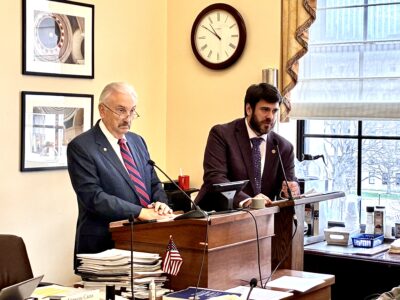
Photo by Steven Allen Adam Deputy Revenue Secretary Pete Shirley (right) explains the economics behind a 5% cut in personal income tax rates Wednesday while House Finance Committee Chairman Vernon Criss conducts the meeting.
CHARLESTON – The House Finance Committee recommended two key bills Wednesday sought by Gov. Patrick Morrisey, amending his 10% cut to personal income tax rates to 5% and giving him spending authority over the state’s $199 million Rural Health Transformation federal award.
The House Finance Committee recommended for passage to the full House an amended version of Senate Bill 392, relating to the personal income tax reduction. The bill cuts personal income tax rates by 5% retroactive to Jan. 1, returning $125 million to taxpayers when fully implemented.
SB 392, as it came over from the Senate, would have cut personal income tax rates by approximately 10% retroactive to Jan. 1, returning $250 million to taxpayers when fully implemented.
Morrisey first proposed an across-the-board 10% personal income tax cut during his State of the State address at the start of the 2026 legislative session. But Morrisey’s general revenue budget proposal for fiscal year 2027 – Senate Bill 250 – only included a lowered revenue estimate that only accounted for a 5% cut in person income tax rates. Morrisey’s revenue estimate for FY27 is $5.493 billion.
Last week, the House and the Senate agreed to a compromise on SB 350, setting the general revenue budget at $5.485 billion, a 0.2% decrease from the governor’s $5.493 billion revenue estimate. The compromise budget leaves $5 million unappropriated. The compromise budget still contemplates a 5% personal income tax cut.
“A 5% across the board reduction in PIT (personal income tax) would be about $125 million in reduced revenues. However, the governor, in his revenue estimates, reduced his estimates to incorporate that,” explained Pete Shirley, deputy secretary for the Department of Revenue. “In the sense of the budget, the budget already accounts for that.”
“Let’s say no tax reduction legislation were to pass, the revenue estimate would stay where it was and we would simply expect to run additional surplus moving forward as a result of baking in that tax cut into the revenue estimate but then not actually passing such a bill,” Shirley continued.
The committee also amended the bill to make changes to a proposed increase in vape and e-cigarette taxes the Senate included in SB 392 to help partially offset the 10% personal income tax originally in the bill. The House version raises taxes on vape products from 5.5 centers per milliliter to 25 cents per milliliter, providing an additional $16 million in tax revenue.
Shirley said the $16 million projected increase from vaping is a “static” number, noting that actual collections might be lower due to “downward pressure on consumption,” where users may quit, switch to traditional tobacco, or purchase products in neighboring states.
“It doesn’t account for maybe some people quit using these products as a result of the increase in taxes,” Shirley said. “Or maybe they switch back to traditional tobacco products, in which case they’re paying the cigarette tax instead of the e-cigarette tax. Or perhaps they go and purchase these products out of state as a result of the increase in tax … This is purely a static analysis. It doesn’t incorporate any of those factors that I just mentioned.”
House Minority Leader Sean Hornbuckle, D-Cabell, offered two unsuccessful amendments. One amendment would have shifted the tax relief toward lower-income residents, creating a 0% tax bracket for those making under $25,000.
“My amendment … is going to adjust the tiers so that we are giving the most tax relief to West Virginia at the lower end of the income pool,” Hornbuckle said. “Everyone still receives a tax deduction, but we’re going to shift the brunt of those dollars to the West Virginians making the least amount in our state.”
“I believe that this Legislature has consistently … put money back into all West Virginia’s pockets – all hardworking West Virginians – and not penalize those who have worked and strived and increased some of their stature or employment and gone back to school and worked after hours,” said House Finance Committee Vice Chairman Clay Riley, R-Harrison, speaking in opposition to Hornbuckle’s amendment.
Hornbuckle’s second unsuccessful amendment would have repealed the state’s trigger mechanism for cutting personal income tax rates included in HB 2526, passed in 2023 and amended in 2024.
“I’m going to do us a favor. I’m just going to repeal the trigger law,” Hornbuckle said. “We’re not adhering to it. That’s what we’re doing today. So, I’m just going to make it a little bit more cleaner for us to operate.”
State Code requires the secretary of the Department of Revenue to determine each August whether a personal income tax cut is triggered based on a formula comparing general revenue collections in a previous fiscal year minus severance tax collections compared to the base year of fiscal year 2019 and tied to the non-seasonally adjusted consumer price index.
If the general revenue collections minus severance tax collections exceed the adjusted base year, a reduction would be triggered for the second taxable year following the determination. Personal income tax rate reductions would be limited to no more than 10% during a fiscal year. The formula triggered a 4% income tax cut that went into effect in 2025.
“With due respect to my colleague, we have, in fact, seen the trigger mechanism work,” said House Majority Whip Marty Gearheart, R-Mercer. “I think we need to be certain that we take those revenue estimates and offer those dollars back to the citizens and to keep that additional trigger that will automatically keep our tax rate going down should we not have the same posture from the executive, or we have a different executive.”
Gearheart also offered an unsuccessful amendment to SB 392 to strike the vaping tax increase from the bill, arguing that combining an excise tax increase with an income tax cut is “illogical” and without historical precedent in the Legislature.
“I think it’s illogical, frankly, for us to consider a tax increase at the same time we consider a tax cut,” Gearheart said. “I don’t want to be too hard on the Senate, but I think it’s a tad insulting to bring a bill to us in this manner instead of separately so that we can consider a tax increase and a tax cut.”
The House Finance Committee also recommended for passage without amendment Senate Bill 570, a supplemental appropriation to the Department of Health giving the department spending authority for the $199 million federal Rural Health Transformation award.
The U.S. Centers for Medicare & Medicaid Services (CMS) announced at the end of last year that all 50 states would receive awards through the $50 billion Rural Health Transformation program made possible through President Donald Trump’s One Big Beautiful Bill Act, now called the Working Families Tax Cuts Act.
West Virginia submitted its Rural Health Transformation application at the beginning of November 2025. States were guaranteed at least $100 million for each year of the five-year program. The remaining funding is awarded through a competitive process.
The state’s application outlined seven core initiatives, including establishing a connected care grid by expanding access to in-person and telehealth options, as well as an EMS “treatment-in-place” program to reduce emergency room visits; creating a unified health mobility platform to increase transportation options for residents needing access to care; forming a Mountaineer Care Force to attract and train clinical talent; and implementing Smart Care Catalyst to modernize technology and shift to value-based care.
“This is historic for our state,” said House Health and Human Resources Committee Chairman Evan Worrell, R-Cabell. “We look forward to seeing how that’s going to actually shape our state. I, not only as a legislator, but also as a citizen, look forward to watching this and seeing how this is done and watching the results happen to see our health outcomes.”
The bill passed the Senate on Feb. 13 and the House received the Senate message on Feb. 16. Morrisey has been putting pressure over the last 24 days for the House to quickly pass the bill, even though federal officials will not begin reviewing state spending until late summer.
“West Virginia has been given a historic opportunity to strengthen rural healthcare,” Morrisey said in a statement Tuesday. “We already have the funding, and we already have the plan. What we need now is legislative authorization so we can put these resources to work for the people of West Virginia.”
Top Headlines
House Finance Committee Moves Amended 5% Tax Cut
House Panel Advances 5% Tax Cut

Tornadoes Kill 2 In Indiana And Raze Buildings In Illinois
Epstein’s Accountant Testifies on His Wealth And Business Ties

Iran War Blocks Vital Middle East Oil Chokepoint