Wheeling Operating Budget to Top $42.3M Next Fiscal Year
Council Slated to Approve City's Proposed 2026-27 General Fund Budget Tuesday Night
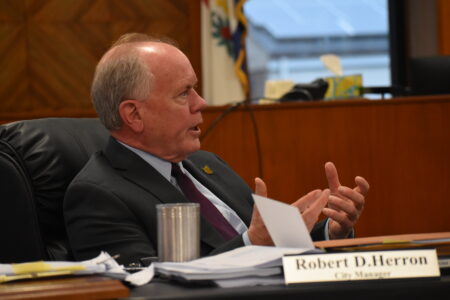
Wheeling City Manager Robert Herron explains details of the proposed 2026-27 budget for the city during a recent budget work session with members of Wheeling City Council. (Photo by Eric Ayres)
WHEELING – Members of Wheeling City Council are set to approve the city’s proposed General Fund Budget for fiscal year 2026-27 – a detailed roadmap of projected expenditures and revenues that is slated to top $42.3 million.
In recent weeks, budget work sessions have been scheduled to give city leaders an opportunity to discuss proposed figures in the draft that has been developed for the next fiscal year’s budget. The proposed General Fund Budget for the next fiscal year, which is available for view on the city’s website, is 300 pages long. The massive document breaks down each line item, department request, revenue source and individual expense projected for the next fiscal year, which begins July 1.
As expected, the overall operating budget is the biggest in Wheeling’s history, surpassing the current fiscal year’s adjusted numbers by around $1.5 million.
“This year’s projected General Fund Budget is $42,379,194, compared to the current budget as amended, which is $40,876,679,” Herron said.
Per West Virginia code, municipalities must submit a balanced budget for the upcoming fiscal year to the state auditor’s office in March of each calendar year. This year’s submission is due to the W.Va. Auditor of State by the March 28 deadline. Wheeling officials noted that this is the process, even though there are still four months left in the current fiscal year.
The city’s revenues have increased on a number of fronts in recent years and the balanced budget must reflect allocations of those incoming monies.
“The increases in revenues can be attributed to strong B&O Tax revenue and sales tax revenue – which has been exceeding expectations, as well as a slight increase in property tax revenue,” Herron explained. “Also, included in the budget are bumps in the Wheeling Park levy as well as the OVRTA (Ohio Valley Regional Transit Authority) levy.”
Officials noted that increased revenues and expenditures for levies that utilize the city as a fiscal liaison for these collections are simply “pass-through” revenues.
“They have no bearing or impact on city services as it’s related to the general fund budget,” Herron explained.
The proposed General Fund Budget is an operating budget for the city, and it does not include capital improvements.
“From a budget standpoint, the city of Wheeling finds itself in a similar situation to many cities throughout the country in that we’ve been able to keep our nose above water financially,” Herron reported. “Some cities, unfortunately, can’t make the same claim. We will always closely monitor expenditures to ensure that, although budgeted, each expenditure is necessary and is in the best interest of delivering municipal services to our community.
“In addition, revenues will be monitored very closely, as there is virtually no margin for error.”
The total estimated amount of sales tax revenue comes in at around $6,845,095.
“There are no fee or tax increases in this proposed budget,” Herron said. “Revenues, I think, are conservatively estimated. They are tight, and expenses are realistically estimated based on what we know, obviously, but also on past history. Unfortunately, we are anticipating an increase in our health insurance expense.”
The total projected cost to the general fund for employee insurance benefits is $4,678,116, assuming that the health insurance costs will increase by about 10 percent from the current rates.
Currently, the city has about $5,547,000 in its Budget Stabilization Fund. Herron said it is the intention of the city to maintain a base of at least $5,200,000 in this rainy day fund and move interest income from this account into the general fund at the end of the fiscal year only if needed. The city manager noted that a solid amount of money in the city’s Budget Stabilization Fund not only provides fiscal stability but also is a useful marketing tool when it comes to issuing city bonds.
The bulk of the General Fund budget’s expenses go toward payroll and operating expenses for the various city departments, and the biggest chunk of those costs go toward safety forces – the police and fire departments. Next year’s budget for the Wheeling Police Department is slated to be $10,803,000, and the budget for the Wheeling Fire Department is set at $10,927,000.
No staff reductions or additions are planned for the police and fire forces next year, Herron said. The recent filling of vacancies in these departments has helped bring down costs incurred for overtime pay from employees needing to cover shifts because of open positions.
City Employee Pay Raises
“From an employee wage perspective, the budget does include an across-the-board, 2-percent pay increase for all full-time employees,” Herron said. “In the past, we’ve looked at that after the fiscal year has ended, but we felt that just based on how things were panning out within the budget and the fact that it is an operating budget – we could squeeze in the 2-percent increase, which costs the general fund $432,000 per year.”
Councilman Dave Palmer, chairman of the Finance Committee of Wheeling City Council, said he was happy to see employee wage increases included in the projected budget. Typically in recent years, city officials have waited until after the end of the fiscal year to examine final numbers and consider pay increases for employees.
“It’s been 20 years probably since we’ve had it added into the budget,” Palmer said, as the city manager noted that pay increases have been included in the draft budget one or two times over the past two decades, but it has not been the normal operating procedure to handle raises. “That’s a big step that shows we’re doing well. We can also revisit that after July if we need to. We would add to it – not take it away.”
Department heads submit requests early in the year and work with the city administration to bring numbers into balance for the draft budget. It requires some cutting to wish lists and a lot of work to bring projected revenues and expenditures in line with each other, officials noted.
“I’d like to thank the department heads for their efforts in putting together this proposed budget,” Herron said. “Their serious approach to the budget process helps ensure that the best possible information is put forth.”
City leaders will have an opportunity to discuss any last-minute tweaks to the proposed budget when the Finance Committee of Council meets at 5:15 p.m. Tuesday before the regular council meeting starts at 5:30 p.m. Once adopted by council, the fiscal year 2026-27 General Fund Budget will be submitted to the state before March 28. City council will lay the levy rates during its April 14 meeting, and year-end departmental reviews for the current fiscal year will take place June 17-26, which will bring an opportunity for any proposed adjustments to the next fiscal year’s budget.
On or about July 14, the Finance Committee of Council will review unencumbered cash carryover appropriations for 2026-27.
City leaders are expected to vote on resolutions to approve both the proposed General Fund Budget and the proposed Coal Severance Budget during Tuesday night’s council meeting.
“I had a chance to spend the majority of a day going through these department requests and budgets,” Wheeling Mayor Denny Magruder said of the 300-page document. “I’m pretty satisfied. I think the city manager has done a fine job in being able to balance this and give us a good budget.”
Capitol Improvements
Although the General Fund Budget is for city operations, there are city funds specifically targeted for capital improvements. Herron explained that outside of the General Fund, around $800,000 per year is generated in regular RCIP (Restricted Capital Improvement Project) account almost entirely out of oil and gas royalties. Additionally, approximately $950,000 per year is available for infrastructure projects in the City Service Fee account.
“About $1,750,000 is available through capital improvements through the city’s RCIP fund and via half of the revenue generated by the City Service Fee,” Herron noted.
Based on departmental requests and general infrastructure needs in the city, Herron recommended that council consider a number of capital expenditures in the coming fiscal year. They included $900,000 for street paving, $97,000 for police technology, $195,000 for elevator repair in the 10th Street Parking Garage and $558,000 in general contingency funds for project engineering, vehicles, money for local matches and other expenses.
Capital improvements on the horizon also include roof replacement at Centre Market, which is currently out to bid, and completion of the new Police Department Headquarters facade on the unfinished side where the building was exposed as a result of the Center Wheeling Market Garage demolition. This will include the addition of the sally port at the police department.
Top Headlines
Divisions On Display In W.Va. Senate
U.S. orders 2,500 Marines And An Amphibious Assault Ship To Mideast
House Passes Tax Cut, Senate Approves Pay Raises
Local Governments Address Budgets, High Gas Prices
Wheeling Operating Budget to Top $42.3M Next Fiscal Year