Behind the Curtain: How Team At WesBanco Arena, Capitol Theatre Helps Fuel Wheeling’s Revitalization
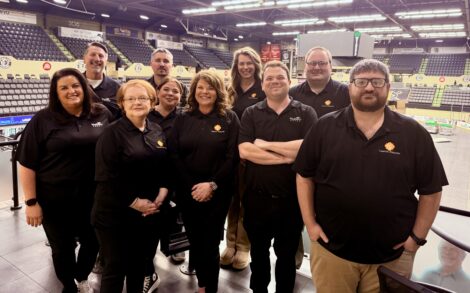
Photo provided There has been a notable increase in events, attendance, and revenue at WesBanco Arena and Capitol Theatre in Wheeling since Kelly Tucker became executive director of the Greater Wheeling Sports and Entertainment Authority. Members of the GWSEA management staff met recently at the arena. Front row, from left, Sonya Fedorko, office manager, Cindy Johnson, event manager, Casey Beila, ticketing director, Ryan Tucker, food and beverage manager and Justin Malarkey, production manager. Back row, from left, Howard Karnell, sales and sponsorships, Scott Griffith, operations manager, Jeanette Spencer, marketing manager and Dalton Jones, assistant food and beverage manager.
In Wheeling, “they” are always supposed to be doing something.
They should book better shows. They should bring in bigger acts. They should invest more.
“They” get the credit when something succeeds and the blame when it doesn’t.
But “they” aren’t faceless. “They” have names.
And at the center of the resurgence at the Capitol Theatre and WesBanco Arena is Executive Director Kelly Tucker — and a team whose work most people never see.
The Growth Is Measurable
Before the pandemic, the Capitol Theatre hovered in the mid-20s to low-30s in annual events:
2015 – 28
2016 – 25
2017 – 31
2018 – 27
2019 – 32
Then came 2020 — five events.
The rebuild began cautiously:
2021 – 14
2022 – 42
2023 – 50
2024 – 62
2025 – 74 events
Attendance followed the same trajectory — growing from roughly 24,000 annually to more than 55,000 in 2024.
That’s not a slight bump. It’s a fundamental shift in activity.
At WesBanco Arena, momentum returned as well. Following its first concert in over a decade in 2022, the venue has once again become a stop for major touring events. In 2024, arena attendance reached an all-time high of more than 270,000 guests.
What Most People Don’t Understand
More shows do not simply mean “better booking.”
They mean risk. They mean negotiation. They mean calendar chess. And they mean financial exposure.
“There are different ways shows come into a building,” Tucker said.
That’s where the public conversation often oversimplifies.
Rental Shows
In a rental, a promoter or artist rents the venue, assumes the ticket risk, and pays the building for staffing, services, and use of space. The venue’s revenue comes from facility fees, staffing, and concessions.
“It’s secure for us,” Tucker said. “We know we’re going to make money on it.”
Promoter-Booked Shows
In this model, an outside promoter books the artist and takes the primary financial gamble.
Co-Pro (Co-Promoted) Shows
This is where the strategy — and the risk — increase.
“Co-pro is basically us taking the risk alongside the promoter,” Tucker said.
In that arrangement, both parties invest. If ticket sales perform well, both benefit. If they don’t, both absorb the loss.
This is not theoretical. It is calculated gambling.
“You’re rolling the dice every time,” Tucker said. “What sells today might not sell tomorrow.”
And in a market the size of Wheeling, the math matters.
“The local community can’t support everything by itself,” she said. “We depend on regional attendance.”
Columbus. Morgantown. Clarksburg. Cumberland. Pittsburgh. A successful night often pulls from well beyond city limits.
Calendar Reality at the Arena
WesBanco Arena has an additional layer of complexity: scheduling.
The Wheeling Nailers are the primary tenant, occupying at least 36 home games and other long-standing annual events like the annual Toughman competition, OVAC wrestling championship, Symphony on Ice, and other productions occupy traditional dates.
That means prime weekends are limited.
“We try to carve out time,” Tucker said. “But a lot of that content has historically always been there.”
Planning now stretches years ahead. This isn’t about simply calling an artist and picking a Friday night. It’s about finding a date that fits routing, tenant schedules, staffing capacity, and economic viability.
Why It Matters Beyond the Marquee
Frank O’Brien, Executive Director of the Wheeling Convention and Visitors Bureau, sees the ripple effect.
Tucker and her team work hard managing events at the WesBanco Arena and the Capitol Theatre. The result has a significant economic impact on both Wheeling and Ohio County.”
He points directly to the strategy Tucker described — the co-pro fund and risk/profit sharing with outside promoters — as tools that have increased both variety and volume.
Tourism impact is measurable.
“If 50,000 people attend events in a market,” O’Brien said, “those visitors spend between $3 and $5 million at restaurants, hotels, and retail stores.”
Multiply that across a full calendar year — especially when combined with events at Heritage Port — and the impact becomes substantial.
“WesBanco Arena and the Capitol Theatre are in great hands,” O’Brien added.
A Constant in a Changing Valley
Coal mines once defined the Upper Ohio Valley. Steel mills shaped its skyline.
Those industries faded. The Capitol Theatre remained.
Through economic swings and cultural shifts, it has stayed woven into the fabric of the region — adapting, reopening, reinventing itself.
That kind of continuity doesn’t happen by accident.
It happens because someone keeps doing the work — even when the outcome isn’t guaranteed.
Leadership — and the Team Behind It
Denny Magruder, Wheeling’s mayor and longtime executive director of WesBanco Arena and the Capitol Theatre, said “I am so proud of the job Kelly and her team are doing. They continue to elevate the performance of the Arena and the Theatre. These venues are so important to our community.”
Tucker is quick to redirect credit.
“Every single person on the team plays an important role,” she said.
She names them: Casey Biela – ticketing and box office; Howard Karnell and Jeanette Howard – marketing strategy and execution;
Sonya Fedorko – payroll, HR, accounting, ice scheduling, and artist hospitality; Cindy Johnson – event management and staffing;
Justin Malarkey – production and show advancement; Ryan Tucker and Dalton Jones – food, beverage, and POS systems; and Scott Griffith, operations manager, whom Tucker calls “Superman” — transforming the arena, handling maintenance, and driving the Zamboni for every Nailers game.
A sold-out night isn’t one person’s achievement. It’s orchestration.
So Who Is “They”?
“They” are the ones splitting risk with promoters.
“They” are the ones negotiating routing schedules.
“They” are the ones flipping an arena overnight.
“They” are the ones willing to gamble on a Tuesday announcement.
It’s easy to say “they” should do more.
It’s harder to ignore 74 shows, 55,000 guests, and a record 270,000 at the arena.
In Wheeling, “they” have names.
And the lights are still on.
Top Headlines

Two U.S. Aircraft Shot Down As War In Iran Escalates
W.Va. Citizens Action Group Files Motion Against DOJ Effort To Obtain Voter Records
CHARLESTON - An advocacy group is seeking to intervene against efforts by the U.S. Department of Justice (DOJ) to ...
One Dead Following Incident At Marshall County Mine
A miner was killed after suffering head and neck injuries in an incident at a Marshall County mine Friday ...
Wheeling Superintendent Turns Family Visit Into Harvard Lecture
Behind the Curtain: How Team At WesBanco Arena, Capitol Theatre Helps Fuel Wheeling’s Revitalization