‘Red Shoes’ Sheehan Case To Block Rules Limiting Judicial Candidate Statements Fails
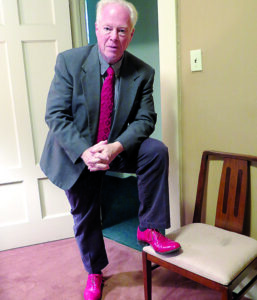
File photo Wheeling attorney and West Virginia Supreme Court of Appeals candidate Martin P. Sheehan, also known as "Red Shoes" and "Red Hat."
CHARLESTON — A Wheeling attorney who has yet again thrown his name in the hat for a seat on the West Virginia Supreme Court of Appeals lost a federal case this week seeking to overturn state rules that put limits on what judicial candidates can say during elections.
U.S. District Judge Thomas E. Johnston issued a memorandum opinion and order Wednesday denying motions for a temporary restraining order and preliminary or permanent junction against the West Virginia Judicial Investigation Commission (JIC) being sought by Wheeling attorney Martin P. Sheehan, a candidate for the state Supreme Court.
“As the State notes in its judicial handbook for candidates and judges, ‘[p]ublic confidence in the independence and impartiality of the judiciary is eroded if judges or judicial candidates are perceived to be subject to political influence’ … The Court agrees,” Johnston wrote. “West Virginia is assuring its citizens that West Virginia judges will ‘apply the law without fear or favor[.]’ Thus, West Virginia has a compelling interest in preserving the judicial impartiality of its courts.”
Sheehan, who previous went by the nickname “Red Shoes” and now is running under the name “Red Hat,” filed his lawsuit on March 9 in the U.S. District Court for the Southern District of West Virginia against the JIC and JIC Counsel Teresa Tarr. Sheehan is one of five candidates seeking to serve the remaining term of the late Justice Tim Armstead.
Sheehan asked the federal court to declare that two specific sections of the state Code of Judicial Conduct violated his constitutional First Amendment rights, inhibiting his ability to communicate with voters during the campaign period culminating with the Tuesday, May 12, primary election.
Canon four of the Code of Judicial Conduct places prohibitions on candidates for judicial offices from engaging in political or campaign activities “inconsistent with the independence, integrity, or impartiality of the judiciary.”
Rules 4.1(A)(10) and (A)(11) of the code prohibit judicial candidates from making “…any statement that would reasonably be expected to affect the outcome or impair the fairness of a matter pending or impending in any court,” or ” in connection with cases, controversies, or issues that are likely to come before the court, make pledges, promises, or commitments that are inconsistent with the impartial performance of the adjudicative duties of judicial office.”
In his March filing, Sheehan argued that these rules — along with the sanctions that could be brought by the JIC against a judicial candidate — constitute a “threat” against judicial candidates and limits their ability to inform voters about who they are.
“Were enforcement of these rules not enjoined, the Plaintiff would suffer a striction on his ability to communicate with voters before a statewide election,” Sheehan wrote. “The Plaintiff should not have to face the risk of any sanction for exercising a well-established First Amendment right to campaign free of the threat of such sanction.”
In a response filed on March 20, attorneys for the JIC argued that the rules within the Code of Judicial Conduct do not prohibit candidates from expressing themselves. Instead, the rules are narrowly focused on prohibiting judicial candidates from commenting on cases pending before the state’s courts and making pledges that could harm a potential judge’s impartiality while on the bench.
“Those Rules bar, for example, a candidate’s promise to resolve a case (winding) its way through the appellate process a particular way if he or she is elected to the tribunal soon to hear the case,” wrote attorney Christopher Smith. “There is nothing unconstitutional about ‘prohibiting judicial candidates from promising particular rulings once elected.'”
Sheehan is on the May primary ballot, which serves as the general election for judicial races, seeking election to the state Supreme Court Division 1. The winner of that special election will serve the remainder of Armstead’s 12-year term when the seat is up in 2032.
Armstead died last August following a battle with cancer. A former member of the House of Delegates and House Speaker, he was appointed to the state Supreme Court by former governor Jim Justice in 2018. Armstead won election in a 2018 special election to continue to serve the remainder of the term of former justice Menis Ketchum. Armstead won re-election to the Supreme Court in 2020 to a full 12-year term. During his tenure, Armstead served in the rotating position of chief justice twice in 2020 and 2024.
Gov. Patrick Morrisey appointed Gerald M. Titus III, previously an attorney with Spilman Thomas and Battle, in November to fill Armstead’s vacancy until the May special election. Titus is running in the special election to continue to fill that vacancy. Other candidates include Raleigh County Circuit Judge Todd Kirby, former Raleigh County circuit judge Kirk Kirkpatrick, and Berkeley County and Morgan County Circuit Judge Laura V. Faircloth.
Top Headlines
‘Red Shoes’ Sheehan Case To Block Rules Limiting Judicial Candidate Statements Fails
One Dead In Marshall County Mining Accident
One miner died after suffering head and neck injuries Friday morning at a Marshall County mine, according to ...
Trump budget seeks $1.5T in defense spending alongside cuts in domestic programs

Artemis II’s Toilet Working Again To Astronauts’ Relief
Morrisey Finishes Work On Legislation With 12 Vetoes, 10 Bills Not Signed