
Hardesty Warns School Funding Headed For ‘The Rocks’
Trending
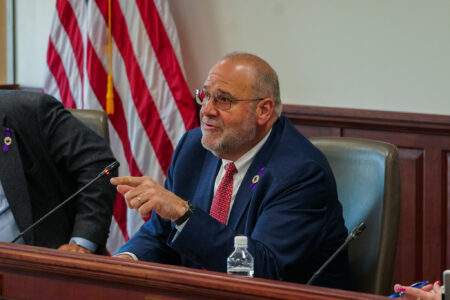
CHARLESTON – West Virginia has lost the enrollment equivalent of six full counties in a single year, a crisis that state Board of Education President Paul Hardesty warns will lead to financial disaster unless state leaders modernize the school aid formula.
In a conference call Wednesday morning, West Virginia Board of Education President Paul Hardesty said continuing declines in student enrollment, an antiquated school aid formula providing less funding to county school systems, and an increase in number and costs of special education students has accelerated the closure of schools and other hard financial decisions in counties.
Hardesty said if the Legislature and the Governor’s Office continue to kick the can down the road, the possibility of another state lawsuit, similar to the 1982 Recht decision, could mandate needed changes in how the state funds county school systems.
“The boat’s getting ready to hit the rocks, and I can’t make anyone in two of the branches of government to understand that,” Hardesty said. ” Therefore, it might (take) the third to get some clarity to the situation, just like it did 40 years ago.”
According to this year's October headcount report, which is used by county school systems to develop budgets for the following school year, there were 234,957 students enrolled in the state's 55 county school systems, a 2.52% decrease from fall enrollment this time last school year of 241,024 and a 15.32% decrease from the 277,452 fall enrollment number in 2015.
According to data released Wednesday by the state Department of Education, county school systems have seen an additional reduction of approximately 5,000 students as of the end of the 2025-26 school year earlier this month. Hardesty said that loss is the equivalent of losing all the students in Calhoun, Gilmer, Pendleton, Pocahontas, Tucker, and Webster counties combined.
“Those six counties’ enrollment is 4,900,” Hardesty said. ” So, since the (October) enrollment, we have basically lost the equivalent of six of our counties.”
Counties are required to submit a 10-year Comprehensive Education Facilities Plan (CEFP) to the Department of Education. The CEFP includes evaluations and inventory of all existing school facilities, whether a county expects to construct new school facilities, and whether the county expects to close and consolidate school buildings.
According to the Department of Education, counties have already closed all the schools in their proposed 10-year CEFP plans six years in, with between 10 and 20 public schools likely to be closed by counties in the 2026-27 school year.
“What if I told you here today in 2026 that every county in the state has exhausted and already closed every school projected for a 10-year period six years into the cycle,” Hardesty said. “I think it’s very telling.”
“While we’ve done all the closures that were projected through 2030, we’re already aware of probably eight to 10 – and that’s probably a low number – schools that will be going through the closure process this coming school year,” said State Superintendent of Schools Michele Blatt.
While county school systems receive local funding through property tax revenue, bonds and levies, the school aid formula plays a large role in setting their budgets. However, the school aid formula is reliant, in part, on student enrollment data.
The school aid formula was borne out of a 1982 decision by former Ohio County Circuit Court Judge Arthur Recht after a parent brought a class action lawsuit against Lincoln County Schools arguing that poorer rural counties were being disadvantaged over larger, wealthier counties.
The state Department of Education finalizes student enrollment numbers every October, which then determines how much money county school systems get from the formula the next school year. Enrollment numbers also factor into the county’s CEFP.
“Most counties have already seen their enrollment projection that they had for 2030 already occur,” said Michah Whitlow, director of school facilities for the Department of Education. “Just talking to (county school officials), people are kind of looking forward and thinking, ‘what am I going to have to do to maintain that budget? Am I going to have to close a school or two schools?’ As I’m out and about and talking to people, those wheels are turning.”
Lawmakers have been told the last several years that the state's seven-step school aid funding formula needs either scrapped or reformed. County school financial officials briefed lawmakers last week on the complexities of the school aid formula and the challenges both rural and urban county school systems are facing.
Hardesty said he has faith in Senate Education Committee Chairwoman Amy Grady, R-Mason, and House Education Committee Chairman Joe Statler, R-Monongalia, but he remains skeptical that the Legislature as a whole will address public school regulations and the school aid formula before it is too late.
“I’ll be honest with you, I don’t think they’ve got their arms around the gravity of the situation,” Hardesty said of the Legislature. “There was talk by some members of the Legislature during the regular session saying we ought to have a special session to address this issue, and this issue only, so we can focus on it. I’ve not seen any movement towards that.”
According to the Department of Education, Pocahontas, Randolph and Roane counties are under states of emergency, while Hancock, Logan, Upshur, Mingo, Nicholas, Tyler, and Boone) counties are under immediate intervention by the Department of Education, some for financial issues. Hardesty said the number of counties requiring state intervention for financial issues could increase.
“I think we’re going to see some of our 55 business units run the risk of financial insolvency at some point in time here in the near future,” Hardesty said. “This can’t continue.”
According to a RAND Corporation study commissioned by the Legislature and released prior to the start of the 2026 legislative session, while overall state education spending is near the national average, the system fails to adequately account for the higher costs associated with low-income students and those with disabilities.
The Legislature attempted to move a bill – House Bill 5453 – which would have introduced weighted funding for special education, providing additional financial resources for students who require intensive instructional support or assistive technology. The House bill was amended by the Senate but died without the House concurring with the Senate’s changes.
But Uriah Cummings, school financial officer for the Department of Education said the bill, as amended, would not have been helpful. According to the department, special education numbers increased as a percentage of the total student population from 20% to more than 25% over a 10-year period, creating a $224 million deficit in special education funding.
“To me, that bill in itself would have just continued to increase the inadequacy for those counties that President Hardesty had mentioned, like Lincoln and Clay and Calhoun and those that struggle already to be able to meet ends meet,” Cummings said. “To me, that would have hurt those districts and would have really only benefited those more in a better fiscal stability state, such as Berkeley and others.”
Cummings said the school aid formula ratios for how many educators the state funds is inadequate and hasn’t been meaningfully updated since the formula was first put in place over the last 30 and 40 years.
“The ratios that exist in State Code surrounding the school aid funding formula haven’t changed in 30-40 years,” Cummings said. “The number of personnel it takes to educate 1,000 students hasn’t changed in 30 or 40 years. it’s just impossible to think that that’s accurate.”