
Legislators Urged To Overhaul Enrollment-Heavy School Aid Formula
Trending
CHARLESTON - Financial officials from four county school systems once again warned West Virginia lawmakers that the funding formula that sends state dollars into classrooms is too reliant on enrollment and not providing enough funding for students with special needs.
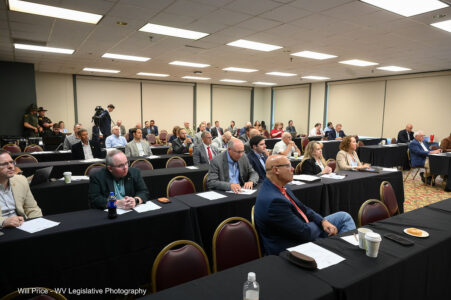
Financial officers with Pendleton, Ohio, Kanawha and Berkeley County Schools testified Monday during a Joint Standing Committee on Education meeting at Canaan Valley Resort State Park in Tucker County during June traveling interim meetings.
Lawmakers have been told the last several years that the state's seven-step school aid funding formula needs either scrapped or reformed. While county school systems receive local funding through property tax revenue, bonds and levies, the school aid formula plays a large role in setting their budgets.
However, the school aid formula is reliant, in part, on student enrollment data. The state Department of Education finalizes student enrollment numbers every October, which then determines how much money county school systems get from the formula the next school year
According to this year's headcount report, there were 234,957 students enrolled in the state's 55 county school systems, a 2.52% decrease from fall enrollment this time last school year of 241,024 and a 15.32% decrease from the 277,452 fall enrollment number in 2015.
The decrease has forced county school systems to make tough choices about closing and consolidating schools. While the formula provides a foundational structure for school operations, local education officials report a widening gap between state funding and actual operational requirements.
Melanie Meadows, the director of finance and chief financial officer for Kanawha County Schools, said operational expenses do not decrease proportionally with enrollment declines, leaving counties to maintain facilities and bus routes with reduced revenue.
"Even though we are experiencing such a high rate of declining enrollment, we still have 900 square miles that we're serving ... we still have 62 active learning facilities," Meadows said. "We’re facing increasing utility rates, increasing maintenance costs, the parts, the labor, the upkeep. And if we defer maintenance, then obviously that’s causing shorter equipment lifespans and increasing those day-to-day operational disruptions, specifically with HVAC."
"Our enrollment has decreased almost 10% since fiscal year 2022 ... (but) our expenses do not go down," said Ohio County Schools Business Manager Steven Bieniek. "So, we may be down 100 to 150 students. But that doesn’t mean that we can eliminate a classroom teacher. ... All of those high-performing counties, they’re all over the formula to varying degrees. And the point is that we need to offer a robust system so that students can be prepared when they leave our high schools."
“It's not just like a business where we can just stop selling a product and stop buying a product," said Pendleton County Schools Business Manager/Treasurer J.P. Mowery, who participated in Monday's meeting remotely. "Expenses do not always decrease at the same rate as enrollment does."
The officials said the system frequently fails to cover the actual costs of special education, transportation and administrative personnel, with all 55 counties affected differently. Large counties face unique challenges with bus driver shortages and vast facility maintenance, while smaller, rural districts struggle with strict staffing ratios that penalize efficiency.
"I think the funding formula is not broken. It just needs to be updated for what the reality is," said Berkeley County Schools Treasurer James V. Butts.
"We’re required to provide services. We are a business at the end of the day, but many of our support services, like our HR, finance and IT are not supported," he continued. "And then we also have direct student needs for athletic trainers that are also not funded but we're required to supply. And again, we have all talked about special education students. The formula does not weigh one student over another when it comes to special ed."
Lawmakers discussed school aid funding formula issues leading up to the 2026 regular legislative session. According to a RAND Corporation study commissioned by the Legislature, while overall state education spending is near the national average, the system fails to adequately account for the higher costs associated with low-income students and those with disabilities.
One bill aimed at the school aid formula and special education funding failed to pass during the most recent legislative session. But Del. Joe Statler, chairman of the House Education Committee and co-chair of the Joint Standing Committee on Education, said Monday there would be more meetings between now and the next legislative session.
"We want to find the answer. This is an ongoing issue that we’re going to be working on well into the other interim meetings," Statler said. "I’m telling you, as we’re exploring this - not only the funding formula, especially special needs - we’re going to turn every stone over."
Steven Allen Adams can be reached at sadams@newsandsentinel.com.