
Small Group of W.Va. GOP statehouse lawmakers urge Capito, Justice to support ending greyhound racing
Ohio County lawmakers oppose greyhound racing prohibitions
Trending
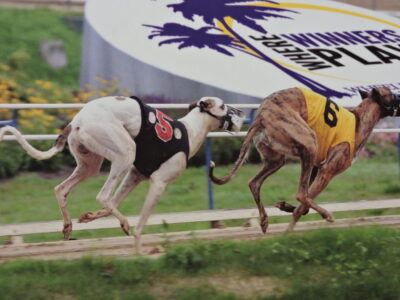
CHARLESTON - Several Republican members of the West Virginia Legislature are encouraging the state's two U.S. senators to back a ban on greyhound racing included in the latest version of the federal farm bill, while two lawmakers from Ohio County expressed support for the industry.
In a letter sent Monday to U.S. Sens. Shelley Moore Capito and Jim Justice, both R-W.Va., eight members of the West Virginia Legislature urged the senators to endorse the Greyhound Protection Act within the Farm, Food and National Security Act of 2026. The letter was first reported by West Virginia Public Broadcasting.
The Greyhound Protection Act would amend the Animal Welfare Act to ban greyhound racing in the country and make gambling on greyhound racing illegal. The bill would outlaw remote gambling on greyhound races and prohibit the transport and sale of greyhounds across state lines for the purpose of racing. Anyone violating these provisions would be fined and possibly imprisoned for up to seven years.
Eight state lawmakers signed the letter: Senate Majority Leader Patrick Martin, R-Lewis; Sen. Chris Rose, R-Monongalia; Sen. Mike Azinger, R-Wood; Sen. Vince Deeds, R-Greenbrier; Sen. Anne Charnock, R-Kanawha; House Deputy Speaker Matthew Rohrbach, R-Cabell; Del. Jonathan Pinson, R-Mason; and Del. Jarred Cannon, R-Putnam.
"As members of the West Virginia Legislature, we write to ask for your support of the Greyhound Protection Act and to urge its inclusion in the upcoming Farm Bill reauthorization," the lawmakers wrote. "Federal action on this issue would help West Virginia follow the path that all other states have already taken, and most importantly, it will free up significant state tax revenues for unmet needs in our state."
Since 2020, West Virginia has the only remaining greyhound tracks in the nation at Mardi Gras Casino and Resort near Charleston and Wheeling Island Hotel Casino Racetrack. Both are owned by Delaware North. Voters in Ohio and Kanawha counties approved table games at Mardi Gras and Wheeling Island in 2007, but only as long as the casinos had racing. Wheeling Island will celebrate 50 years of greyhound racing in August.
The two casinos employ more than 900 workers combined according to Delaware North, not including the number of businesses and support services that support the greyhound industry in West Virginia and other states.
The farm bill, which is renewed roughly every five years, is awaiting action in the U.S. Senate. The bill passed the U.S. House of Representatives 224-200 with Rep. Carol Miller, R-W.Va., and Rep. Riley Moore, R-W.Va., voting for it. Moore offered an unsuccessful amendment to the farm bill - supported by Miller – that would have exempted West Virginia's two greyhound tracks.
According to the National Greyhound Association, the handle - the total amount of money - wagered on greyhound racing at West Virginia's two tracks in 2025 was $353.4 million, a $5 million increase over 2024. Of that $353 million, more than $211 million was wagered at Wheeling Island and more than $142 million was wagered at Mardi Gras.
West Virginia's two greyhound tracks benefit from table game revenues. The West Virginia Lottery receives a privilege tax of 35% of adjusted gross receipts from each licensed racetrack, which is deposited weekly into the Lottery's racetrack table game fund. From the gross amounts deposited into the table games fund, the Lottery on a monthly basis retains 3% of the adjusted gross receipts for administrative expenses.
The Lottery then transfers 2.25% of adjusted gross receipts from all thoroughbred and greyhound racetracks participating in licensed table games to the special funds established by each thoroughbred and greyhound racetrack table games licensee for the payment of regular racetrack purses to be divided equally among each licensee.
A transfer of 1.8% of the adjusted gross receipts is made from all licensed racetracks to the thoroughbred development fund and the greyhound breeding development fund. Thoroughbred horse racing takes place at Mountaineer Casino Racetrack and Resort in New Cumberland and Hollywood Casino at Charleston Town Races.
According to the West Virginia Lottery's annual comprehensive financial report covering the 2024 and 2025 fiscal years, $2.08 million was distributed by the Lottery to racetrack purse funds in FY25, down from $2.107 million in FY24; while $1.664 was distributed to thoroughbred and greyhound development funds in FY25, down from $1.686 million in FY24. Past distributions to the West Virginia Greyhound Breeding Development Fund have ranged from $15 million per year to $17 million per year.
This revenue from table game wagers is sometimes described as a subsidy. In the letter, the state lawmakers refer to studies from Ball State University and Spectrum Gaming Group that question the financial benefits of greyhound racing for West Virginia.
"Every dollar that is diverted to greyhound purses is a dollar that does not flow to the state’s general revenue fund, lowering our citizens’ tax burden, paving state roads, or ensuring that local schools stay open," the lawmakers wrote. "This arrangement is fundamentally inconsistent with the conservative principles we all share."
"The West Virginia greyhound program is, in plain terms, a government mandate paired with corporate welfare, and it has produced exactly the result one would predict: an industry that has collapsed everywhere it was allowed to compete on its own merits, kept on life support here only by force of law and support of subsidy," the letter continued.
State Sen. Laura Wakim Chapman, R-Ohio, disagreed with her fellow GOP lawmakers. In a statement Tuesday, Chapman compared federal involvement in ending greyhound racing to federal regulations on coal and coal-fired power generation.
"This is just another example of federal overreach into West Virginia industries," she said. "We saw it with the war on coal. This is a state issue under the separation of powers and must be addressed on the state level."
House Minority Whip Shawn Fluharty, Chapman’s Democratic opponent in the 1st Senatorial District, agreed, saying that support by state lawmakers for the Greyhound Protection Act was not an example of conservativism but an example of Republicans using the levers of big government to take away local control.
"The irony is hard to miss," said Fluharty, D-Ohio. "Many of the same politicians who routinely preach about states’ rights and keeping Washington out of West Virginia are now asking Congress to override our state’s authority and eliminate an industry that supports jobs and pensions for our police and fire in communities in the Northern Panhandle. They can’t even do it on facts."
State lawmakers attempted to push through a bill during the 2020 legislative session that would have eliminated the greyhound breeding development fund in hopes of hastening the industry's demise in West Virginia. It would have eliminated the transfer of wagers on table games and video lottery machines to the fund and instead sent that money to the Excess Lottery Revenue Fund for distribution by the Legislature. But the legislation failed in the Senate in 2020 by an 11-23 vote.
The bill would have also used the remaining money in the Greyhound Breeding Development Fund to retrain workers in the greyhound industries in the state, promote adoption of greyhounds used at the two racetracks, and provide a one-time $500 tax credit for West Virginians who adopted greyhounds.
Fluharty said it was wrong to call table game revenues used for the Greyhound Breeding Development Fund “subsidies” when those funds are generated by casino patrons, not through taxes.
"Zero taxpayer money is part of greyhound racing funding, yet they continue to call it a subsidy," he said. "Bottom line, this is a West Virginia decision, not a Washington, D.C., decision and I find it embarrassing my colleagues want to delegate their duties. Maybe they should find a new line of work or move to D.C."
Chapman criticized members of Congress for sneaking the Greyhound Protection Act into the farm bill and inserting themselves into a local issue.
"People are tired of these federal omnibus bills that are hundreds of pages long and do more than the title of the bill suggests," she said. "Perhaps Congress should focus more on balancing budgets and lowering inflation than on an issue that only affects West Virginia."
Steven Allen Adams can be reached at sadams@newsandsentinel.com.