
Citizens Urge City to Place Moratorium on Data Centers
Trending
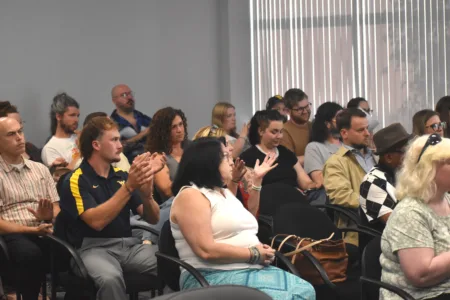
WHEELING -- Concerned citizens packed council chambers during Tuesday night’s meeting of Wheeling City Council, with many city residents urging officials to place a moratorium on the development of data centers within the city limits.
For the second regular City Council meeting in a row, a room full of people gathered to protest data centers in the wake of Silicon Foundation’s recent acquisition of the former Centre Foundry & Machine Co. site in Warwood. The company plans to redevelop the brownfield industrial site along W.Va. 2 into a “phased GPU data center and energy technology campus built around existing power, cooling, fuel, BESS (battery energy storage system) and modular power infrastructure.”
A total of 13 individuals signed up to speak on the topic of data centers at the end of the meeting. Following council’s procedure for public comment, each speaker was given three minutes at the microphone to address council. While city leaders listened to their concerns, they did not answer questions or respond during the public forum, in keeping with the council’s standard procedure.
Before citizens approached the podium, some council members told the crowd their voices were being heard.
Councilman Tony Assaro, who represents Ward 1, read a prepared statement calling for sound measurements to establish current noise levels around the former Centre Foundry property.
“I’d like to begin with making a request that we take some sound readings in Warwood -- both regular sound and infrasound -- to be taken from around Third Street in Warwood, the area around Warwood School and also Clifton Avenue,” Assaro said. “I’d like them taken at regular daytime hours and also at nighttime hours when people would be sleeping so we have a baseline setting of what sound levels currently are in these areas.
“To those speaking with their concerns with these data centers, I just want you to know that you are being heard.”
Councilman Dave Palmer echoed those sentiments.
“We are listening,” Palmer said. “We are hearing. Just understand that we also have rules, laws and ordinances that we must follow. So I just want to let you know, we do care and we are listening.”
Andrew Mull of Elm Grove urged city leaders to beware of a “wolf in wolf’s clothing,” raising concerns that outside investors are looking to take advantage of the local water and electric grids.
“The history they have is in bitcoin mining,” Mull said. “I don’t know if this is someone that we want to have control of industrial-zoned property with an industry that has very little regulation -- 1,000 feet away from homes, down the street from a school and across the road from another school.”
Citizens noted that Silicon Foundation officials had scaled back the plan originally posted on the company’s website for an eventual 100-megawatt facility at the Warwood site. West Virginia lawmakers passed House Bill 2014 last year, placing state oversight on high-impact data centers, defined as those with a capacity of 90 megawatts or more.
Since the proposed campus in Warwood would not be considered a high-impact data center, concerned citizens said the development would be exempt from state oversight and instead fall under the jurisdiction of local officials because it is located within city limits.
Lindsay Edgington of Wheeling said it was disheartening to hear responses from public officials indicating there is nothing that can be done to stop the AI industry from “invading our communities.”
“We know that’s false,” Edgington said. “In the first quarter of 2026 alone, data center projects collectively worth $130 billion were stopped or delayed due to opposition from concerned citizens across the country. About 70 percent of Americans oppose the AI industry.”
Edgington said that regardless of whether the Warwood project becomes a data center or a facility that manufactures components or modules for the AI industry, it should be opposed because of its potential impacts on this community and others affected by the expanding technology sector.
Several speakers proposed that the city take action like other communities across the country by imposing a moratorium on new data center development. Others proposed banning data centers within city limits that exceed 5 megawatts in capacity.
Polly Barks of Warwood said a moratorium would buy time for city leaders to gather more information about the proposed project and the impacts data centers are having on other communities.
“Follow the will of the people and stop letting things happen to Wheeling without a fight and calling it an inevitability,” Barks said. “There is something you can do. Pass a moratorium on data centers in Wheeling that you have jurisdiction over. We refuse to let you pretend that your hands are tied on this.”
Heather Hines of Warwood said she believes the proposed data center would put the health of local students at risk.
“The health risks -- including respiratory and cardiovascular -- that come with a data center would not only affect the residents of Warwood, but we will also be putting approximately 580 students’ health at risk,” Hines said. “Imagine sitting on your front porch, walking the trail with your furry friend, spending time with your children in your backyard, or sleeping -- all while listening to a constant, debilitating white noise that can be heard for up to two and a half miles away.”
After each speaker, the crowd erupted in applause, with many offering cheers and standing ovations for those who delivered pointed criticism of city leaders. Some described data centers as bringing “devastation” to communities through utility rate hikes, constant noise, air pollution, stillborn calves and neighborhood decline. Others pointed to online videos showing what they claimed were the effects of living near data centers, including discolored tap water.
Joshua DeShong of Wheeling said the city needs to be proactive, creative and willing to act.
“I don’t want to hear that the city is unable to do anything,” DeShong said. “It’s probably more likely that you in fact just don’t want to try to do anything. This city put more opposition to a car wash being built than it is currently with this data center. I’m no expert, but I’m sure the car wash will create more jobs than that data center.”
Kara Baum of Wheeling said residents still have many unanswered questions.
“It’s completely unacceptable,” Baum said. “I’m asking you to do something while you still can do something about it.”