
Rabbi Lief Talks Role Of New Homelessness Task Force
Trending
Rabbi Joshua Lief of Wheeling’s Temple Shalom said Tuesday afternoon that the plight of the city’s homeless population is a problem that no one in Wheeling can ignore.
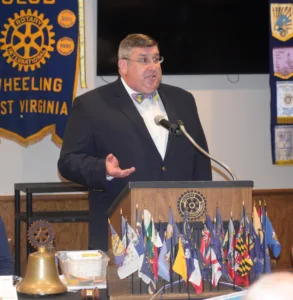
“All it takes for problems to endure is for good people to pretend that it’s not their problem, walk on by and turn a blind eye to the struggles of our neighbors living on the streets, to the problems of our downtown businesspeople wrestling with how best to respond, with the struggles of our city government trying to manage a problem that cannot be managed,” he said to those in attendance at Tuesday’s Wheeling Rotary Club meeting.
Lief said he couldn’t just walk past, which is why he agreed to become the chair of the city’s new homelessness task force. And it’s why he hopes that not just other task force members, but the Wheeling community at large, will join in the process of making the city safer and more hospitable for everyone within its limits.
“I would rather live in a community that is trying to do some good, even if it isn’t succeeding entirely, than a community that turns a blind eye to those in need,” he said.
The task force, created by Wheeling Mayor Denny Magruder, will see members of the local clergy serve as its executive committee, with representatives of several other groups populating the larger task force. Such groups will include members of City Council, public safety forces, mental health and addiction professionals, general health professionals and social service agency representatives.
Lief said that among the keys to seeing any measure of success with this task force is for everyone to keep their minds open and their expectations low. There is no magic wand to solve a problem of homelessness in Wheeling that has affected the city for years, he said. Immediate, sweeping change is unrealistic. What will be most beneficial is to have those with differing opinions on solutions sitting at the same table and listening to the other side’s perspective. That, Lief said, may allow for incremental change to happen.
“If we could all be talking with each other instead of past each other or, even worse, about each other, as all too often happens on the internet, maybe we could become not just collaborators around some shared solutions, but also really friends and neighbors committed to making our community a better place for all with whom we share it, housed and unhoused alike,” he said.
While the first meeting has yet to happen, Lief offered some ideas for how to start those incremental changes. He has heard people in the city complaining about others relieving themselves in public areas. One way to fix that, he said, is to increase the availability of public restroom facilities and perhaps give members of the homeless community jobs to keep those facilities clean and stocked.
Lief acknowledged the “serious challenge with mental health in our community and a profound dearth of mental health care and help available for those who are in need.” He already has reached out to WVU Medicine North Region President Douglass Harrison and WVU Health System President and CEO Albert Wright, who said WVU Medicine is committed to expanding and is already working on bringing more mental health professionals into the area.
Lief also acknowledged there are some in the homeless community who refuse to accept the help that’s offered, and no task force or city can force people into making decisions. Yet he also said the city will never be able to “arrest ourselves out of this problem,” as the jails don’t have enough room and state mental health facilities already return patients back to the street quickly.
“There’s going to have to be some conversation,” he said. “And that conversation will be more productive if, instead of having it as disparate groups fighting for attention and control, you could have it as one unified community -- city and state citizenry alike, county officials with local officials talking to people on the state and federal level to say, ‘Here’s what we, as Wheeling, want.’
“My ideal hope is that the discussions that start with this task force will lead to people hearing each other across a broader spectrum to break down some of the silos that exist to galvanize community support for shared visions of what we could do together,” Lief added.