
Silicon Foundation Official Answers All Questions Offered by Local Leaders on Proposed Warwood Data Center Project
Multimillion Investment in Data Center Module Facility Eyed in Warwood
Trending
WHEELING - Local officials met for an informational session Wednesday to learn about Silicon Foundation’s plan for the former Centre Foundry & Machine Company property in Warwood, which over the past week has generated an avalanche of public speculation and concern over data center development.
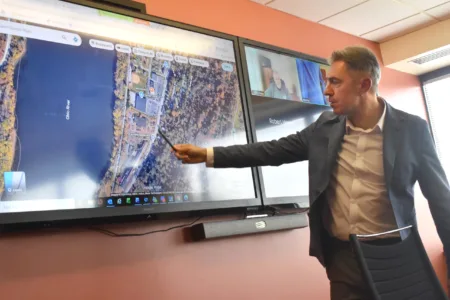
Andrii Garanin, chief energy and infrastructure officer for Silicon Foundation, returned to the United States from a conference in Germany last week to explain the current state of the project and to answer all questions that local officials had about the venture in light of controversy that arose last week. Information about the project spread after a third-party - Stokes Inc. - put out information on a LinkedIn page that gave the impression that a high-impact data center was planned for the Warwood site.
Attorney David Croft of Spilman Thomas & Battle, who represented Silicon Foundation in the acquisition of the former industrial site earlier this spring, organized and facilitated Wednesday’s meeting. The informational session with Garanin was attended either in-person or via video conference by Wheeling Mayor Denny Magruder and Vice Mayor Jerry Sklavounakis; Wheeling City Manager Robert Herron; city council members Tony Assaro, Ben Seidler, Connie Cain, Ty Thorngate and Dave Palmer; Ohio County Commissioner Don Nickerson; W.Va. Sen. Laura Wakim Chapman (R-Ohio); W.Va. Sen. Ryan Weld (R-Brooke); and attorney Molly Aderholt, also of the law firm.
"This is easy because it’s an absolute win for the city. It’s a significant investment by Andrii and his partners," Croft said. "The purpose here is to provide transparency of where we are and where Silicon Foundation wants to go with this project."
Setting the Record Straight
Information on the company’s website - which initially indicated a 100 megawatt data center development was being planned in Warwood - was described by Croft as a marketing embellishment that has since been corrected online. The Stokes LinkedIn page has also been taken down. Garanin described Stokes as a potential partner on the venture - particularly in the battery storage component of the project - which apparently used big numbers in the premature release to tout their company’s resume in online marketing efforts. The Stokes release was not coordinated with or authorized by Silicon Foundation.
"It’s really stirred the community up for what otherwise is a pretty nice project," Herron said of the public push-back generated by the impromptu announcement. "I think the release of that information - which was premature and completely out of our control - has done a lot of damage, and it’s going to take a lot of time to recover from."
City Councilman Dave Palmer echoed those sentiments.
"The release of the information or the false information really put us behind the eight ball here," Palmer said. "A lot of public officials have been damaged - in terms of our view from the public. It made us look like we were somehow hiding something or that we didn’t know anything."
Croft and Garanin noted that the Centre Foundry site is simply not capable of accommodating a high-impact data center, which by definition utilizes at least 90 megawatts of power.
"Community attention came here before we had a chance to have any say," Garanin noted.
"It’s not big enough for 90-100 megawatts, and there’s no intention for this site to be a high-impact data center," Croft said. "They will not seek to be certified, they’re not going to seek to hide behind any favorable laws for data centers."
Sklavounakis said city leaders have been taking the heat over the fallout from the sudden announcement.
"We’re in the crosshairs," he said.
"We’re not the ones making the announcement, but we’re the ones taking the (heat) because of it," Herron added, noting that only three city officials met with Garanin this spring after the sale of the property was made, and a general outline of the company’s plan was discussed.
Croft said the first meeting with Garanin and his team took place back in May of 2025. On May 22, shortly after Silicon Foundation closed on the property, Garanin met with officials from the city and also officials from RED and others.
Seidler noted that since news broke of the plans for a data center at the site, council members have been getting a myriad of questions thrown at them.
"I fully understand a lot of it is kind of ridiculous, fear-mongering type of things - some of them are legitimate in the areas that they’re happening right now," Seidler said. "I don’t want to minimize the experiences some individuals are having in those areas. But I agree that this is very different from what you’re presenting here."
Cain asked Garanin to share plans with the community and show the public exactly what is going to go into the facility.
"It doesn’t matter whether you’re putting a Petco in there when everybody has something negative to say," she noted, explaining the importance of transparency. "Just show everyone that you’re not hiding what’s going in there - it makes people feel a little bit better. I’m just thinking about the residents and how they feel."
Garanin said social push-back about data centers has typically been focused on the impacts of huge 1 gigawatt rural facilities.
"It’s a pretty massive facility," he said of the data centers that take up acres of land, noting that this is not what is coming to Warwood.
Croft said they plan to come to a city council meeting in the future and asked to be put on the agenda to publicly answer any questions, then if need be, go before the city’s planning commission, as well. But he noted that the property is zoned I-2 Industrial and does not need air permits, water permits or other authorizations.
"Keep in mind that everybody is very excited about the WVU investment of the cancer center," Croft said. "The amount of money that Andrii and his investors are going to put in Warwood will exceed that number. There’s going to be manufacturing jobs, there’s going to be the data center jobs. It’s not going to be a foundry again - those jobs aren’t there, and they’re not coming back. But I guarantee there are going to be more jobs there than there are right now, which are zero."
Croft stressed the importance of the community’s messaging to potential investors for future economic development.
"We have an organization that wants to put $100 million into this community," he said. "This is the first chance they’ve had to present anything of a plan. They’ve only had the property for 60 days. We’re going to send a chilling message to anyone else who wants to do business in Wheeling if we’re not a little more inquisitive and welcoming. Everybody has come to the door with pitchforks and torches without talking to him or talking to me, and it’s not a secret that I’m the representative - I’m legal counsel."
Officials noted that the venture has become fodder for a campaign season political tug of war centering around the passage of West Virginia House Bill 2014, which sets forth statewide regulations regarding high impact data centers in the state. Garanin indicated that HB 2014 rules would not apply to the Warwood project because it is not intended to be a large data center.
"I don’t want to step into some kind of political debate," Garanin said. "We had no idea when we made the decision to invest here about the debate about the legislation."
What Is Planned
"The whole idea is to build out a mixed-use or hybrid facility with manufacturing in place. We have the right skillset for that," Garanin said. "We are a group of investors in different areas. My history is quite transparent. Most of my career has been in the energy sector. We’re a small group, but we work in what’s happening now in the world. It’s something which is amazing."
Garanin, originally from the Netherlands, has international ventures but has shifted much of his focus to developments in the United States, where the boom in the tech industry and its supporting energy systems is unfolding and blazing a new trail globally.
"We recognize there is massive investment in development happening in this country - and other countries, as well, but it’s primarily in the U.S. because the U.S. is leading in technology," he said. "All of the software is developed here. There is a demand - and we are in this market, not just for the compute itself, but for the modules, for the racks and for the other systems."
There is a widespread fear of the unknown when it comes to data centers and artificial intelligence, but there is no turning back from this reality in 2026, Garanin indicated.
"In terms of AI - we cannot deny it’s already here," Garanin said. "It basically comes down to where the technology will be built and who will benefit from it. We believe that distribution will be the new venture with the amount of investment going into the sector, and I think this community deserves to benefit from it as well."
The Centre Foundry facility is sitting vacant now and would likely remain empty and deteriorating if a company like Silicon Foundation had not arrived to bring a new life to the facility.
"We want to use the manufacturing history of the place and to effectively recycle it," Garanin said. "There are some technical limitations to this facility. But we’re waiting for the engineering part to be concluded. To be honest, we were expecting that to be concluded before we had planned to make any public release of information about what we’re going to build there, because it was really fundamental for us."
The building is suited for the planned assembly of modules, he explained, noting that they plan to use about ¾ of the long foundry building and plan to demolish some other smaller buildings on the four-parcel property.
Plans call for a facility that produces modular data center units which will be deployed across the region. This will include a production floor at the former Centre Foundry facility - not just a server room.
In Phase 1 of the project, a modular data center is to be constructed at the site which will connect to the existing electric grid and will be approximately 10 megawatts. This will not create the need for any additional infrastructure that would result in ratepayers receiving higher electric bills, officials said, adding that HB 2014 explicitly prohibits the project’s energy costs from being passed to existing utility customers. It will involve "closed-loop cooling" that will not involve any water discharge into the river.
Silicon Foundation also plans to develop a training academy to provide hands-on training for local electricians and technicians in energy and compute infrastructure. This training will be accessible to local residents interested in developing skills in this growing sector of the data industry.
"We will only build what the grid can support," Garanin said.
Battery energy storage systems or "BESS" on site will actively stabilize the local grid.
"It’s a net asset for the neighborhood, not a liability, as it will be integrated with the local grid - stabilizing it, not straining it," Garanin noted, adding that this facility will be "quieter than the foundry ever was" before it ceased operations. There will be no diesel or other liquid fuel on site, and no on-site fuel storage. The site has an existing natural gas connection, but the facility will run on power from the existing electric grid, plus the on-site battery energy storage.
All equipment will be factory built and enclosed. The facility is already screened and set back from the neighboring homes.
Construction traffic and disruption will be kept to a minimum, Garanin added. On-site work will primarily be the assembly of units that include "pre-built containerized modules."
Local trades will be prioritized whenever possible, officials noted, with construction jobs for local workers. The work will involve contractors, suppliers and trades across multiple disciplines.
"We are using an idle industrial site on land already zoned for industry," Garanin noted. "We are not developing open land, scenic land or green space. A secured, landscaped, modern industrial site is an improvement over a vacant foundry lot."
The data center itself is expected to create around 10 permanent jobs. Around 50 to 100 construction jobs with as many local workers as possible will also be required during development. The Phase 2 module assembly system will eventually have about 30 employees working per shift.
A maximum power capability of the current line at the site is theoretically 50 megawatts, Garanin noted.
"Otherwise, we would have to build a new power plant, which we don’t have the space for," he said. The company is currently working with AEP to determine precisely how much power will be available there. This will help determine the scope of the project, officials indicated.
Development of the first phase is expected to take place over the course of the next six months with hopes of beginning operations in January.
"We look forward to working with Andrii to make this progress successful," Herron said.