
Attorney General Intervenes in Suit Against Warwood Data Center Project
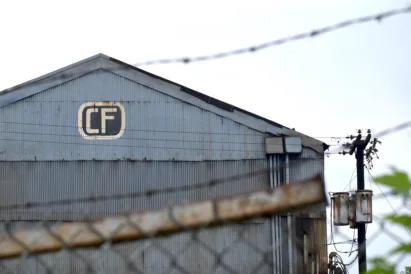 Photo by Eric Ayres
 Trending
WHEELING - West Virginia Attorney General J.B. McCuskey has intervened on behalf of the state in a civil lawsuit filed by a group of Warwood residents against the Silicon Foundation in response to constitutional questions raised by the plaintiffs.
Last month, a civil complaint was filed in Ohio County Circuit Court in an attempt to halt the development of a data center on the former Centre Foundry & Machine Company property along W.Va. 2. The suit was filed by attorney J. Anthony Edmond Jr. of the local law offices of Edmond & Baum, PLLC against Silicon Foundry Energy LLC, doing business as Silicon Foundation.
The suit seeks declaratory judgment from the court, a temporary protection order and preliminary and permanent injunctive relief to prevent the construction, development, operation and maintenance of a data center in Warwood by the company. The case was filed under the court docket of Ohio County Circuit Judge David Sims.
Among the assertions contained in the complaint are allegations that House Bill 2014 - passed by the West Virginia Legislature last year to establish state regulations over high-impact data centers - is unconstitutional.
Because the complaint "challenges the validity of a duly enacted statute," the state filed a motion to intervene.
"The constitutionality of a recently enacted statute lies at the heart of this case. And this motion, filed barely a week after the complaint itself was filed and only four days after the attorney general received notice, is timely," McCuskey wrote in the state’s motion filed July 31. "Because the constitutional question presented is likely essential to the resolution of this case and the state has promptly indicated its desire to participate, this court should grant the state intervenor status to defend the constitutionality of the Power Generation and Consumption Act (HB 2014)."
Last week, the court agreed, issuing an order granting the state’s motion to intervene.
McCuskey also issued a proposed answer of the State of West Virginia in the matter, noting that the state intends to "limit its participation to the defense of HB 2014 against constitutional attack," not to take a position on any factual allegation concerning the proposed Warwood Data Center or address whether the defendants have satisfied or otherwise complied with the requirements of HB 2014.
The state’s defenses argue that the plaintiffs have failed to state a claim upon which relief can be granted "because HB 2014 is constitutional" and that they "failed to carry their burden of defeating the presumption of constitutionality" that duly enacted statutes carry.
"Because the Warwood Data Center has not yet been constructed - and may or may not ever be constructed - any constitutional injury the plaintiffs may suffer is purely speculative," McCuskey wrote.
The attorney general requested that the court enter a judgment for the state on any count or claim on a determination that HB 2014 violates the constitution, reject the plaintiff’s requests for relief that are predicated on a determination that HB 2014 is unconstitutional and grant the state such other relief as the court considers just and proper.
HB 2014 applies to high-impact data centers - with an information technology load of 90 megawatts or more - and shifts regulatory powers to the state, limiting the ability of local municipalities to intervene. According to Silicon Foundation officials, the Warwood project is expected to launch as a 10 megawatt facility with the potential to expand to no more than 50 megawatts, thus excluding it from the state’s regulatory threshold as a high-impact data center.
Because it lies within city limits, such a facility would still have to comply with various city codes, including noise ordinances and other local regulations.
Individual plaintiffs listed as parties in the complaint are Polly Barks, Joe DePaulis, Owen Dobreynski Hines, Savannah Fedczak, Elizabeth Hannah, Albert "Marc" Hannah, Heather Hines, Heidi Kossuth, Betinna Makley, Natalie Miniard, Liz Stephens and Randy Stephens. All plaintiffs were listed in the civil action as residents of Warwood.
During recent meetings of Wheeling City Council, a number of the plaintiffs have appeared to voice their concerns and opposition to the proposed data center in Warwood. They have been joined by several other city and county residents in their efforts, which have grown to include websites, yard signs, T-shirts and organized events promoted online - via the internet.
A small handful of vocal anti-data center activists attended this week’s city council meeting. Among them was one of the plaintiffs in the lawsuit - Miniard of Richland Avenue.
"We don’t want this data center - so we’re just here to remind you of this," she said. "At bare minimum, this is the wrong location."
Miniard told city leaders that when this site was zoned Industrial many decades ago, data centers were not part of the scope of possible uses when the neighborhood maps were planned.
"Data centers are a new thing that we’re all kind of learning about together," Miniard said, noting that Warwood was a mostly residential community where children play and seniors on a fixed income can afford to live. "If property values go down and this becomes something that is really unbearable, where are they going?
"I’ve seen a lot of for sale signs go up since this was announced."
Wheeling is among many communities across the country that are bracing for potential impacts that data centers could bring to rural and small town neighborhoods, Miniard indicated.
"This is not good for us," she said. "We’ve heard all of the negatives and we’ve heard all of the bad stuff, including health issues that will affect people. And we can’t trust this company."
Opponents of the Warwood data center have noted that the company’s own website originally called for the eventual expansion to a 100 megawatt facility. In the wake of a public backlash about the project, the number was changed online, and officials have maintained that it is not possible to host such capacity at the Centre Foundry site.
"We don’t feel very confident in what they’re telling us," Miniard said. "At best, they are sloppy and disorganized, which doesn’t bode well for this project. At worst and honestly most likely, the lack of transparency and mixed messaging is intentional. This community deserves more, not gaslighting or empty promises or misinformation."
City leaders in Wheeling have also expressed frustration with the way the information about the proposed project became public. Council members have noted that they have to obey the laws, cannot legally approve a moratorium on data centers and cannot obstruct a business - a proposed $130 million investment - from operating in a properly zoned building which a company legally purchased.
"We understand that legally, your hands may be limited, but it doesn’t erase your responsibility to stand with us," Miniard told council members this week. "We need your voices to be heard, to oppose and challenge it and ask all the hard questions and fight for every protection that is available.
"We’re not going away. Obviously, we’re going to keep showing up and telling you how much we care about this. It’s important, and we are hoping that you just kind of stand with us and start working with us."