
Governor’s Office, Treasurer Trade Barbs On Aid Program
Trending
CHARLESTON - A spokesperson for Gov. Patrick Morrisey said West Virginia’s Temporary Assistance for Needy Families program is spending far more than it receives in federal grants, but the state’s chief banker said it’s within the governor’s power to address.
Lars Dalseide, communications director for the governor’s office, released a statement Monday morning providing an update on the state’s ongoing review of TANF spending and the recent halting of the TANF-funded School Clothing Allowance initiative due to running out of allotted money.
Morrisey first announced a potential $43 million structural deficit for the TANF program, also called WV WORKS, in May. The Governor's Office estimates TANF carryover funds will be exhausted within the next 13 months or less.
"When this Administration began reviewing West Virginia's TANF-funded programs, the first data we received described a program in crisis," Dalseide said. "The state was spending far more each year than the federal grant provides, and the savings that had covered the difference were nearly gone.”
Dalseide said Morrisey was directing the state Department of Human Services to maintain normal spending levels for TANF-funded programs through the end of the current fiscal year. The Governor’s Office also plans to ask the Legislature in the near future for between $10 million and $15 million through a supplemental appropriation to help through June 30, 2027, when the fiscal year ends.
TANF is a federal block grant that distributes more than $16 billion nationally, with states providing a certain percentage of matching funds called "maintenance of effort." In West Virginia, the federal TANF block grant is traditionally $110 million, with the state’s maintenance of effort for the current fiscal year budgeted at $25.8 million.
However, the Governor’s Office claims it only receives $98.8 million in its federal TANF block grant. According to Dalseide, 10% of the $110 million grant is transferred to a social services block for child welfare, adult protective services and assistance for individuals with disabilities programs.
The Legislature amended and approved the governor's recommended general revenue budget line item for TANF for fiscal year 2027 for $177.1 million. The budget for the previous fiscal year was $176.7 million. But the fiscal year 2025 budget for TANF during the final year of former Gov. Jim Justice’s second term was $134.7 million, $42.4 million less than the current fiscal year.
Dalseide accused media outlets of being misleading in explaining the TANF line item in the general revenue budget, which merely represents the amount the Legislature authorizes the Department of Human Services to spend if federal awards and expenditures occur as estimated.
"That is a ceiling the Legislature sets - the most the state would be allowed to spend if it had the money in hand," Dalseide said. "It is not money."
According to Governor’s Office estimates, the state is spending $137 million on TANF-funded programs with only $98.8 million in federal TANF block grant dollars (not including the state’s $25.8 million) creating a $38 million gap, which is being filled with available TANF carryover funds from previous fiscal years.
"That gap - about $38 million a year - has to come from somewhere, and it has been coming from those savings," Dalseide said. "The account has fallen from roughly $141 million three years ago to about $41 million today. It is almost gone."
West Virginia’s TANF program provides monthly cash assistance to eligible families, as well as funding for the School Clothing Allowance program, family support centers, child care subsidies, West Virginia 211, assistance for low-income college students, assistance with purchasing used vehicles, healthy lifestyles programs and more. Since May, Human Services has conducted reviews of TANF-funded programs.
"Every dollar still in it is already committed to child care for working parents, cash assistance, family support centers and the other programs paid for out of this same grant, so money spent on any one of them is money taken from the others," Dalseide said. "When those savings are exhausted, all of these programs are in jeopardy - and the West Virginians who rely on them are the most vulnerable people in our state."
According to media reports, family support centers are only funded through the end of September, when the federal fiscal year ends. The application period for the School Clothing Allowance was delayed until July 20 but closed seven days later due to available funding being exhausted.
According to the Governor's Office, Human Services spent approximately $11.4 million in the previous fiscal year that ended on June 30 on the School Clothing Allowance, with nearly 55,000 applicants benefiting from the program that distributes $200 per eligible child to purchase clothes and back-to-school items.
Approximately 52,000 applications were received between July 20 and July 27 this year, though the Governor's Office stressed that that number could increase as DoHS processes additional applications received by midnight July 27 and determines eligibility.
"Our goal was to keep support consistent with last year while making sure the state's capped federal TANF funding can still cover the other programs that depend on it," Dalseide said. "Applications for this year are still being processed and verified, and we expect this year's program to match or exceed last year's level of support."
The Morrisey administration has placed the blame for the projected TANF structural deficit on an influx of federal dollars that came into the state during the COVID-19 pandemic, with previous state officials using the one-time funding to expand spending and temporary TANF carryover balances masking the problem.
Another problem cited was the West Virginia People's Access to Help system, an online management system used to determine the eligibility of families applying for TANF assistance and other programs. The nearly $400 million system was begun under the Justice administration but has been criticized for not working properly.
"The eligibility system the state depends on - a system that has cost West Virginia nearly $400 million and still does not work properly - cannot tell us reliably what is being spent while it is being spent," Dalseide said. "A state cannot manage what it cannot measure. That is why the governor ordered a comprehensive review: not to reduce support for families, but to establish what West Virginia actually spends, what it actually receives and what it can sustain."
Dalseide did not mention former Gov. and current U.S. Sen. Justice by name, but he did single out State Treasurer Larry Pack, who served as Justice’s Department of Revenue cabinet secretary during the last year of his second term in 2024.
"The prior administration committed West Virginia to permanent, long-term obligations using one-time, temporary federal money in the savings account the state was only ever going to have once," Dalseide said. "Larry Pack was that administration's acting revenue chief when those commitments were made. He kicked the can down the road, and it landed on these children."
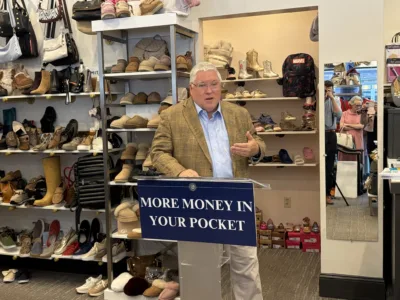
In a statement last week after news of the closing of the School Clothing Allowance first broke, Pack criticized the pause and called on Morrisey and the Legislature to work on a fix to ensure that TANF-funded programs are fully funded.
In a statement released Monday in response to Dalseide, Pack said the Morrisey administration has the resources it needs to address TANF issues. The state has available surplus tax dollars left over from the fiscal year that ended June 30, and Human Services has the authority to move funds around within its budget to address short-term needs.
"The governor can cast all the stones he wants to put blame elsewhere, but at the end of the day, this is his administration," Pack said. "As governor, he has the opportunity to make needy children a priority. So do it. We will never stop fighting for supporting children and families who need it most. We look forward to (continuing) dialogue with state leaders to better serve West Virginia's most vulnerable families."