
Tensions Rise As Morrisey, Lawmakers Dispute Management Of Federal Aid
Trending
CHARLESTON - Gov. Patrick Morrisey’s kickoff to a two-day southern West Virginia listening tour on water issues was overshadowed Tuesday by his handling of the Temporary Assistance for Needy Families program.
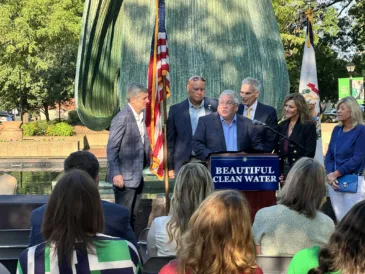
Morrisey was at Marshall University in Huntington Tuesday morning to begin his listening tour of water systems in the southern part of the state. But most of the questions from the press were about TANF, the Temporary Assistance for Needy Families program also called WV WORKS.
In May, Morrisey announced a structural deficit for TANF for the new fiscal year that began July 1. The Governor’s Office estimates there is a $38 million gap between available federal TANF dollars and approximately $137 million in TANF-funded expenses, with less than 13 months left in TANF carryover funds from previous fiscal years.
"I think a lot’s been misconstrued, quite frankly, in the media, and I want to take the opportunity to address that," Morrisey said Tuesday when asked about TANF. "I started asking questions because we know that there were some challenges fiscally that go back decades for Human Services. And so, we asked the question, 'Well, what’s going on here?' And as we look deeper into it, what we found is a program that was in crisis."
West Virginia receives approximately $110 million for the state’s federal TANF block grant. According to the Governor’s Office, 10% of that TANF block grant goes towards certain social services, leaving $98.8 million in federal TANF funding for monthly cash assistance, as well as funding for the School Clothing Allowance program, family support centers, child care subsidies, West Virginia 211, assistance for low-income college students, assistance with purchasing used vehicles, healthy lifestyles programs and more.
Morrisey has said the state used federal COVID-19 funds to increase spending on TANF programs. When those one-time monies went away, TANF spending did not decrease, causing the state to use TANF carryover funds to bridge past structural deficits, decreasing those funds from $141 million three years ago to $41 million available for the current fiscal year.
"If you have that $98.8 million ... you have to make sure you’re sticking within that budget," Morrisey said. "More resources came from the federal money repeatedly ... Over a period of time, since they were relying solely on federal money and there wasn’t a close review, that number got down to about $40 million."
The Governor’s Office estimates that a $38 million gap exists between the $98.8 million in federal TANF dollars and $137 million in expenses, causing the Department of Human Services to tap into TANF carryover funds.
"It does appear that we have been spending more than we’ve been bringing in, and that is what’s led to this using reserve funds and now running out of reserve funds," said Senate Finance Committee Chairman Jason Barrett, R-Berkeley. “A decision has to be made: Do we go back to pre-COVID level spending? Because we’re now not receiving all those additional COVID dollars. So that’s a decision that I think is ultimately on the Governor’s Office, on the administration, and on the Department of Human Services.”
This gap does not include the state’s share ($25.8 million) of TANF spending, called maintenance of effort, which brings total TANF dollars to $124.6 million, shrinking the gap from $38 million to $12.4 million.
House Finance Committee Chairman Vernon Criss, R-Wood, questioned the governor’s understanding of the state general revenue budget.
"I believe that when they start looking at the numbers, and they create this quote unquote structural deficit … I don’t believe that he understands the budgeting process, and I welcome him to attend the tutorial that we do for incoming freshmen delegates … on how the budgeting process works in the Legislature," Criss said. "If he would like, we could set up a private tutor for him to understand how we do our process so that he can understand how he can be more effective in his spending towards running the administration."
The Legislature amended and approved the governor’s recommended general revenue budget line item for TANF for fiscal year 2027 for $177.1 million, which represents the amount the Legislature authorizes the Department of Human Services to spend if federal awards and expenditures occur as estimated.
"That’s an authorization. That’s what you’re allowed to spend for the federal program,” Morrisey said.
"Those are federal dollars that come in, and the Legislature’s role is to grant spending authority on those federal dollars," Barrett said. "And this year in the budget, it was in the governor’s proposed budget request of the Department of Human Services to give them spending authority in the $170 million range. We granted that spending authority request from the agency and from the governor."
In a press release Monday, the Morrisey administration directed DoHS to maintain TANF program spending levels through the end of fiscal year 2027, June 30. The Governor’s Office will also seek between $10 million and $15 million through the Legislature in a supplemental appropriation for TANF programs.
According to the Department of Revenue, the state has $175 million in unappropriated surplus balances across the General Revenue, Lottery and Excess Lottery funds as of the end of fiscal year 2026, following back-of-the-budget surplus expenses. July general revenue fund tax collections of $388 million was 3% more than the $377.6 million revenue estimate, providing an additional $11.4 million in surplus for the current fiscal year.
"If the governor wants to do a supplemental appropriation to backfill some TANF dollars ... then that’s certainly something that I think the Legislature would give a lot of consideration to," Barrett said.
Since May, the Governor’s Office has been reviewing TANF-funded programs, including the $11.4 million School Clothing Allowance program, which did not open for applications until July 20 and was shut down seven days later on July 27, before the Aug. 15 deadline. The program - which provides $200 per eligible child for clothing and back-to-school supplies - served approximately 57,000 families last year. As of Monday, more than 52,000 applications had been processed.
"We all know as parents and grandparents that some of the most important days that a child goes through is their first day of school," Criss said. "Being able to have proper clothing and shoes and supplies that they need to start school gives them a better attitude towards that first day of school. What has happened to these 5,000 kids that did not get involved simply because (the Governor’s Office) changed their artificial deadline from Aug. 15th to July 27th? I don’t understand."
"I don't understand why this governor is manufacturing a TANF crisis on the backs of children when any potential issues are premature and relate to next year's budget," said Senate Assistant Minority Leader Joey Garcia, D-Marion. "The governor's math and rationale do not add up or justify the knee-jerk decision to cut off the clothing voucher program after just one week."
Morrisey said he believes TANF programs, such as the School Clothing Allowance program, need further review to root out waste, fraud and abuse. Morrisey alleged Tuesday that School Clothing Allowance funds, which is distributed to families through EBT cards, are being used for unauthorized purchases, such as tobacco and alcohol, but presented no evidence for this claim. Unauthorized purchases are blocked on EBT cards, though the cards can be used at certain ATMs to withdraw cash.
"This program for school clothing allotment, we want to make sure that the money goes to the kids for clothing," Morrisey said. "One thing we’re doing is we’re trying to ascertain the exact amount of money that’s in cash. Because I don’t want a penny of the money that should go for school clothing to be spent for cigarettes, to be spent for beer, to be spent for all these things.
"I want to work with the Legislature to change that. I want the money for school clothes, not for beer or cigarettes," Morrisey continued. "I’m sorry, but I’m going to push for that and I’m not going to let people change the topic ... I want the kids to get the clothing allotment, but I want to make sure we’re tightening up our systems."