
WV Leaders Pledge Ratepayer And Water Protections In New Data Center Principles
Trending
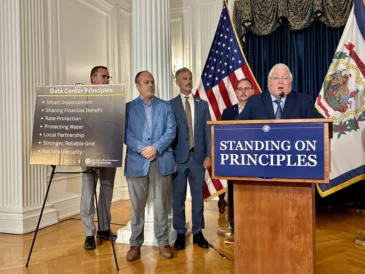
CHARLESTON - While several states are rushing to place moratoriums on data center development, Gov. Patrick Morrisey and legislative leaders unveiled a seven-point set of principles to guide the state data center program.
Morrisey, officials with the Department of Commerce, and leaders of the House of Delegates and state Senate held a press conference Tuesday afternoon in the Governor's Reception Room to unveil the West Virginia Responsible Data Center Development Plan
"I think it marks a defining moment for the future of the great State of West Virginia," Morrisey said. "Today, as the world stands on the cusp of a new digital and economic frontier, West Virginia is once again stepping forward to be a technology leader."
The Responsible Data Center Development Plan is a framework outlining seven core principles to ensure that the expansion of data center infrastructure in the state does not compromise the West Virginia's natural beauty or the well-being of its residents over the next 20 years.
The plan is meant to go hand-in-hand with the passage last year of House Bill 2014, establishing the Power Generation and Consumption Act. The law is aimed at attracting data centers to West Virginia along with microgrids to power the facilities using both fossil fuels and renewable energy generation.
HB 2014 streamlines development of data center and microgrid projects, offers regulatory exemptions within designated microgrid districts, establishes a special valuation for property taxes and a new tax distribution framework for high-impact data centers, and creates a fund for electric grid stabilization.
Principle one focuses on comprehensive planning and oversight for proposed data center projects. Morrisey said developers must provide proof of financial capacity, estimated power loads, and firm capital investment commitments. Projects would only be approved if the projected benefits to the state and local communities clearly outweigh the infrastructure and environmental costs.
"This can’t be a fly-by-night operation," Morrisey said. "This has to be done the exact right way. And we need to make sure that we’re attracting responsible hyper-scale data centers."
Principle two: data center revenue must provide a net increase in tax collections for every level of the state. HB 2014 already requires developers to file tax returns with the Board of Public Works annually.
According to a formula in HB 2014, 50% of property tax collections from these projects would go to a personal income tax reduction fund, 30% would go to the county or counties where the data centers are, 10% would go to all 55 counties on a per capita basis and 5% would go to the state Economic Enhancement Grant Fund.
Principle three focuses on electric ratepayer protections to ensure that data center growth does not increase electricity prices for West Virginia families or small businesses. Under a “Ratepayer Protection Pledge,” developers must build, bring, or procure their own energy resources, and developers assume full responsibility for funding their own electrical capacity needs and infrastructure upgrades.
HB 2014 already protects regulated utility customers from bearing any costs associated with electricity generation, transmission or distribution facilities serving a microgrid district, with those costs borne by the generator or consumers within the district.
Principle four focuses on water protections, mandating strict adherence to the Water Resources Protection and Management Act. All data center facilities remain subject to the reporting and discharging rules of the West Virginia Department of Environmental Protection.
Much of the concern across the state about HB 2014 revolves around local control. The law prohibits counties and municipalities from enacting or enforcing ordinances, regulations or rules that would prohibit or hinder these data center/microgrid districts.
To address local control concerns, principle four involves the creation of a Data Advisory Council comprising experts from academia, conservation groups, industry, and local government. The council will set requirements for property setbacks, noise mitigation, aesthetic integration, and site security. Strict proximity rules will be established for schools, places of worship, and other sensitive areas.
Morrisey said state certification of data center projects does not bypass existing federal, state, or local laws regarding public health, safety, or historic preservation.
"We want to make sure ... that the applicants are submitting explicit mitigation strategies for any of the impact on any neighbors," Morrisey said. "That's critical. We have to take into account our communities and our neighbors when these are being built."
Principle six involves the Department of Commerce coordinating with electric utilities, PJM Interconnection, and the Federal Energy Regulatory Commission to evaluate electrical grid capacity and stability before any data center project moves forward. Principle seven focuses on national security and the need to develop data center capacity to better protect financial networks, healthcare diagnostics, and municipal 911 centers.
West Virginia's embrace data center growth is beginning to set itself apart from other states. According to the National Conference of State Legislatures, 15 state legislatures have considered data center bans and moratoriums, with New York passing a one-year moratorium on data centers that use more than 20 megawatts of energy.
The West Virginia Legislature's two leaders have expressed differing opinions on data centers. Senate President Randy Smith expressed regret last year at pushing for HB 2014. House Speaker Roger Hanshaw has been a vocal supporter of data centers, including representing two proposed data center projects through the law firm he works for, Bowles Rice. But both said they supported the Responsible Data Center Development Plan.
"This is the first step and a good step going forward," said Smith, R-Preston. "There’s not a date that goes by that I don’t talk about data centers with someone and sometimes multiple times a day. I just want people know that we’re listening. It is our job to listen to the citizens of West Virginia and make sure that not just data centers, any projects, any businesses that come to West Virginia, that they’re good players."
"We are good at not only working with industrial partners as friends and allies to grow and diversify an economy, but also to regulate appropriately industries that are important to the communities in which they’re situated to the people of West Virginia and to the residents that we all collectively represent," said Hanshaw, R-Clay.
"What you see unveiled today, what the principles that the governor outlined for all of us today show us, is that we know how to implement the law," Hanshaw continued. "We know how to bring certainty to the law. We know how to simply give clarity to the regulated community that’s seeking to do business in West Virginia with respect to how we will simply enforce and apply the law."
Jennie Smith, the executive director of the West Virginia Rivers Coalition, said she was "cautiously optimistic" about what she heard Tuesday about the Responsible Data Center Development Plan. But she hopes state officials will welcome advocates for responsible water use and local control to the table to ensure the principles are enforced.
"I think for us, we’re glad to see that there’s guiding principles to help them make decisions that can protect our communities, but we want to make sure that they follow through with them, and that our communities still have a voice in this, and that transparency occurs, and that our resources are really protected," Smith said. "So it’s not just industry that is being considered, but our voices, and our resources are protected too."