
Data Center Opponents Say MOU Is Not Enough
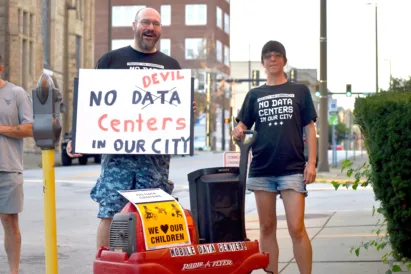 Photo by Eric Ayres
 Trending
WHEELING - A majority of Wheeling City Council members voted Tuesday night to move forward with a memorandum of understanding between the city and Silicon Foundry Energy LLC, despite hearing dozens of data center opponents urging them against the action and insisting that the agreement is not a strong enough stance.
More than a dozen citizens signed up to speak during Tuesday night’s meeting of Wheeling City Council, and the vast majority of them once again voiced concerns over the proposed data center Silicon Foundry Energy LLC - also known as the Silicon Foundation - plans to build at the former Centre Foundry & Machine Company site in Warwood.
City leaders have framed the MOU as one legally binding action the city can take to prevent the company from seeking certification to develop a high-impact data center at the site. Silicon Foundry representatives have agreed to the proposal. Under W.Va. House Bill 2014, data centers with a capacity of 90 megawatts or more must be certified by the state and their operations will largely be regulated by the state. The bill also states that no Tax Increment Financing, or TIF, District can be in place where high-impact data centers are operating.
In the Wheeling MOU with Silicon, the company would agree to operate under the 90-megawatt capacity, thus keeping regulatory jurisdiction within the city. The city intends to establish a TIF District in this lower section of Warwood where Silicon plans to operate its data center and energy technology campus, and under the MOU, the company would agree to compensate the city for lost tax revenue in the event that its operation exceeded the 90-megawatt threshold for high-impact data centers.
While the MOU was intended to put safeguards in place and maintain local control of the looming Warwood data center, most of the vocal opponents on hand during Tuesday night’s council meeting scoffed at the proposal. Many of those who spoke out expressed distrust of Silicon Foundry and the international investors heading the company. Although a number of speakers maintained decorum and urged city officials to embrace their views on data centers, others were brimming with emotion - expressing a lack of faith and trust in the city’s leadership.
"There seems to be a lot of confusion about why citizens don’t want to trust what City Council says and what Silicon Foundation says," said Wheeling resident Andrew Mull, who noted that the MOU does not address many of the same concerns citizens have been expressing for months. "So by signing it, I see that as a deepening of the mistrust when I see this as an opportunity to gain some of that trust back."
Liz Stephens, who said she lives two blocks from the site where the data center is going, urged council members to vote against the MOU.
"It’s obvious that nobody really cares what we have to say," she said. "If anybody on this council - after talking to one of you - is being forced to vote because the mayor wants this for the city, I ask you to step down."
Many opponents painted the MOU as more of a concession to Silicon to allow it to operate a data center of up to 89 megawatts. Several cited communities in other parts of the nation that are in legal battles over the noise that drones from 30-megawatt data centers in their neighborhoods.
Citizens on hand Tuesday night reiterated their stance that they do not want a data center of any size in their community. They repeatedly urged council to pass a moratorium to pump the brakes on the development of data centers in the city, but Wheeling officials have said they have no legal grounds to do so. Many opponents disagree.
Aiden Kosol of Wheeling asserted that City Council should not only pass a moratorium on data centers - despite the potential of legal challenges to it - but also take other suggested actions such as forming a Data Center Task Force - like the city did in creating a new Homeless Task Force - and pass a resolution simply stating that the city is against data centers to show that they stand with their citizens on this issue.
"We’re being told to trust a company that didn’t exist before January of this year," Kosol said, indicating that Silicon has no proven track record of success or demonstrated experience in building data centers. "This company was created to tap into a market that may not exist in two or three years. Then what will we be left with? A strained utility grid? A polluted environment? Horrendous property values? And for what? This is a volatile market that is unregulated with a national 70 percent of Americans saying that they are in opposition to it."
Megan Ondeck indicated that the potential fines and financial ramifications set forth in the MOU should the company violate the agreement are not likely a deterrent to the company if expansion proved to be profitable.
"A fine is not acceptable and will not stop them," said Ondeck. "I don’t stand here to make personal attacks. This is my sincere effort to ask you for your help. I feel sorry that you’re in this position being publicly taken advantage of and outplayed by Silicon Foundation. Wheeling needs protected from them and any other company that thinks they can come in and exploit us."
Members of Wheeling City Council voted 6-1 to approve the MOU. Councilman Tony Assaro, who represents the Ward 1 neighborhood of Warwood, voted against the measure to echo the sentiments of his constituents.
"I don’t ignore my residents," Assaro said. "I work for them. It’s as simple as that."
Assaro said the MOU was actually better than nothing, indicating that the action does help maintain local control and limits the size of the project.
"This comes with some extra guardrails - they’re not great - but there are some there," Assaro said of the MOU before casting his vote. "I see that as damage control. We’ve got a choice here - they’re either going to operate with these extra guardrails or they’re going to operate without them. What do you want me to do?"
The crowd answered that he should still vote "no."
Assaro did just that, although the resolution still passed. He noted that residents in Warwood do not want the noise, water pollution, high energy bills and other potential consequences that neighborhoods across the country are reportedly experiencing when data centers operate in their communities.
"There’s nothing good about this entire situation," Assaro said. "I haven’t been happy about this since news of it came. It’s just - how do you mitigate it? We’re all working on it the best way we can to do that. I’m going to just keep doing what I can do."
City officials stressed that by assuring local control over the data center through the MOU, they will have the ability to bring forth legislation to address many issues. Council members said they are working on developing an ordinance that addresses the concerns and focuses on data center operations in the city.
"I hear you," Councilman Ty Thorngate told the capacity crowd Tuesday night. "We as a council hear you. The concerns you shared with us are the same concerns that most of us up here have. But I think it’s important to note that the MOU is for creating a TIF District and not so much to address the concerns you guys brought up today.
"We are working on a data center-specific ordinance to address things like light pollution, water, noise, general pollution, electricity … that is coming, but that’s not what the MOU is for."
Councilman Dave Palmer noted that not only is the city working on an ordinance to address data centers, but the West Virginia Municipal League is also working on efforts to take back local control of matters related to this industry. Palmer was appointed as treasurer of the West Virginia Municipal League last month.
"The MOU is a start, and we’re working on the ordinance," Palmer said, adding that the statewide effort will take some time. "It’s something that’s going through a process. We hope to have it ready before the 2027 session begins."
Until then, officials noted that Wheeling’s MOU will take HB 2014 out of play in the case of Silicon Foundation.
"It keeps control local so that council can work on this," Wheeling City Manager Robert Herron said. "To me, that’s a big benefit of this MOU."
Wheeling Mayor Denny Magruder said critics have accused city officials of failing to do their research, but he noted that this could not be further from the truth. Magruder said they still have a lot to learn on the topic, but they have had conversations with officials in other impacted communities, including New Albany, Ohio - where more than 40 data centers operate - including the massive 200-megawatt Meta campus - and 28 others are planned.
"We want to make sure we’re talking to all folks - not just people who oppose it or support it," Magruder said.