
GOP Lawmakers Discuss Economic Development At W.Va. Chamber Business Summit
Trending
WHITE SULPHUR SPRINGS – The final day of the West Virginia Chamber of Commerce 90th Annual Meeting and Business Summit at the Greenbrier wrapped up Friday morning with Republican lawmakers talking about the state’s economic future.
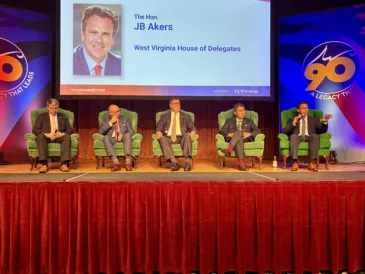
House Speaker Roger Hanshaw, R-Clay, moderated a panel discussion with House Judiciary Committee Chairman JB Akers, R-Kanawha; state Sen. Tom Takubo, R-Kanawha; state Sen. Mike Oliverio, R-Monongalia; and Del. David McCormick, R-Monongalia.
“For two-and-a half days, we’ve heard about a lot of exciting things that should make everyone proud to be a West Virginian,” Hanshaw said. “What I hope is impressed upon each of you is the extent to which policy can make those things happen. That good policy can drive success, and that bad policy can drive failure.”
Akers praised the passage earlier this year of Senate Bill 1, the West Virginia First Small Business Growth Program, which was a combination of the provisions in House Bill 4003 and a legislative priority of Senate President Randy Smith, R-Preston.
“It’s probably hard to believe sometimes, but it could be easier for a large business to get a loan for $50 million than it can be for a small business to get a loan for $2 million or $3 million,” Akers said. “We’re trying to figure out ... how do we bring capital to our small businesses who are successful, but they’re just having barriers to growth? They could do so much more if they just had a little more capital to push them over the edge.”
Under SB 1, specialized growth funds collect capital from investors to provide financing to eligible small businesses that maintain the majority of their operations and workforce within the state. In exchange for these investments, growth investors receive non-refundable tax credits that can be applied against their state tax liabilities starting in 2029.
“I’m proud of a lot of the things that we’ve done over the course of the past 12 years as a governing majority in the legislature in West Virginia, but very few things am I prouder of than Senate Bill 1,” Hanshaw said. “We spend a lot of time preaching the gospel of West Virginia outside our borders ... But too often, we focus our attention outwardly without giving sufficient attention to those of you who’ve been here, who’ve done it, who’ve made it happen over that long haul.”
Takubo, a pulmonologist and an executive with WVU Health, said more focus needs to be placed on building a healthy workforce. West Virginia’s labor force participation rate remains the lowest in the nation, with an aging population and a population with some of the highest rates of chronic disease.
“You can’t have a strong economy, strong jobs, without strong healthcare. It’s just like a fighting force in the military. If you don’t have a strong, healthy fighting force, you don’t have a fighting force,” Takubo said. “We have untreated mental health disorders. We have substance abuse disorders. We have childcare issues. Too many times, legislators will say they’re for jobs, but then they’ll actually fight us on so many of these other things that is going to change the variable ... and get people back to work.”
Oliverio, who first served in the legislature as a Democrat and later switched to Republican, said the foundation for much of the state’s improved economic picture came about to a focus by the previous Democratic majority and current Republican majority in improving the state’s workers compensation system and public pension systems, reducing long-term liabilities.
“We’ve come through some great turmoil, and we have great opportunity now ahead of us,” Oliverio said. “Today, West Virginia has earned, based on calculations by the Investment Management Board, an additional $10 billion in our trust funds and pension accounts. Today, I can inform you that our Public Employees Retirement System has now crested 100% funded.”
“When grandma goes to the mailbox, there will be a check in her box. And it’s because of the efforts of legislators back then, you, the citizens, and others who shepherded this change,” Oliverio continued. “And those are the kinds of things we need to do going forward.”
McCormick talked about the passage earlier this year of House Bill 4007, which would increase the annual financial limits for projects funded through the Industrial Access Road Fund, effectively doubling the available unmatched and matched funding for individual counties.
The bill mandates that the Division of Highways provide a formal response to project requests within 90 days and clarifies that these funds are only for economic development sites, such as manufacturing hubs and airports.
“We’ve had a lot of big announcements this week which are awesome, and we’re all happy about them ... but there’s also around the state a lot of small industrial sites, business parks ... and many are not accessible,” McCormick said. “To some of these smaller locations and business parks dotted around the state, this could be a very useful tool in having a pad-ready site for a company that’s not a data center or that requires a lot of land but just need to get to somewhere where you can build a 100,000 square foot building.”
House Bill 4005 would create the Workforce Development Act of 2026, aimed at expanding vocational opportunities for students in West Virginia. The bill establishes a youth apprenticeship program for students age 16 and older, allowing them to earn secondary credits and professional certifications through a combination of classroom instruction and on-the-job training while outlining safety standards.
“We all know how hard it is to find employees,” McCormick said. “I think getting younger kids interested in working at an earlier age keeps them off drugs … They start making money. That’s always a motivation for young people. And learning a trade, possibly ... so when they graduate, not only do they have a high school diploma, but they also have an apprenticeship certification.”