
West Virginia Lawmakers Receive Reports On Water Infrastructure, Flood Recovery On First Day Of Interim Meetings
Trending
CHARLESTON – While West Virginia continues recovery efforts from recent flooding and storms, state officials are working on ways to bring more water in the form of infrastructure projects.
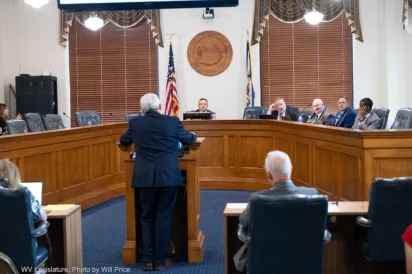
Lawmakers were at the Capitol Sunday for the first day of three-day September legislative interim meetings.
Members of the Joint Standing Committee on Technology and Infrastructure heard testimony Sunday afternoon regarding the state of water and wastewater systems in West Virginia.
In August, Gov. Patrick Morrisey went on a two-day listening tour in Southern West Virginia counties focused on local water and wastewater needs. Following that tour, Morrisey announced he would leverage $145 million in state funding for water and wastewater infrastructure projects across the state in order to pull down additional federal and private investment.
Also in August, Morrisey announced the appointment of former Glenville Mayor Mark Sarver, a professor in the College of Business at Glenville State University, as the new executive director of the West Virginia Water Development Authority.
“I have only been doing this job for five weeks, but five weeks traveling around West Virginia has reinforced something I already believed,” Sarver said. “There are communities across the state working extraordinarily hard to provide basic service with very limited resources. There are operators keeping aging systems running purely through ingenuity and determination. There are local leaders trying to solve problems that have accumulated over decades.
According to Sarver, the state’s investment during the first 18 months of Morrisey’s first term was $174 million, which will secure approximately $500 million in total infrastructure investment. Sarver said the goal is to reach $1 billion in total water and wastewater infrastructure investment over the next two years.
“There are tremendous opportunities before us. West Virginia has committed significant resources to infrastructure, but there’s much more to be done,” Sarver said. “Our responsibility now is to make certain those resources produce results.”
Sarver said the WDA is implementing a six-month reform plan focused on: technical and grant support for cities, counties and public service districts; project accountability through 60-day and 90-day check-ins to identify barriers such as permitting issues, engineering delays, or easement acquisitions; and the creation of a public transparency dashboard to be launched at the end of October.
The state is tapping available WDA funding, funding and loans through the Infrastructure Jobs Development Council, and Clean Water and Drinking Water state revolving funds administered by the Department of Environmental Protection.
Over the last 18 months, more than $324 million in Clean Water SRF closing fund agreements have been made with $8.3 million in binding commitments, along with $18.8 million to fund delivery systems with an additional $44.4 million in binding commitments for Drinking Water SRF. Much of those funds have gone to replace lead service lines, PFAS remediation, and residential loans.
However, DEP Cabinet Secretary Harold Ward expressed concern regarding a “continual decline” in annual base SRF allotments from the EPA. This is attributed to Congressional Directed Spending grants being taken from the top of federal funds, which reduces the amount available for principal forgiveness and administrative costs needed for Safe Drinking Water Act compliance.
“This decline that we’re seeing is due to being the funding source for the congressional directed spending grant as they take these off the top of the established SRF eligible monies,” Ward said. “Before the monies are distributed to the states, the CDS has come off the top of those monies. That’s a reduction in funding available for the revolving funds, and it’s a reduction in the amount of principal forgiveness available for projects that we’ve identified of need here in West Virginia.”
While lawmakers were being briefed on water infrastructure, members of the Joint Legislative Committee on Flooding were being updated on the state’s response to flooding events over the last several months. West Virginia Emergency Management Division Director Matthew Blackwood said that major flooding events in mid-June, July, and mid-August have required continuous state and federal coordination.
“This summer has been very busy. We’ve had storm after storm, but we’ve had kind of three major events,” Blackwood said.
The state is still awaiting approval of a federal disaster declaration for the substantial rains that hit Kanawha, Fayette and Harrison counties the weekend of Aug. 15-18. To date, the Federal Emergency Management Agency has paid out more than $13 million in individual assistance for those affected by flooding and tornado damage that hit Lewis, Upshur, Pleasants and Ritchie counties in July. The state is appealing the denial of individual assistance and hazard mitigation requests for flooding that hit Boone and Logan counties in June.
Blackwood said state emergency managers are preparing for changes in aid being made by new FEMA Administrator Cameron Hamilton and Department of Homeland Security Secretary Markwayne Mullen, though it was unclear what those changes might be.
“Over the last several months, we have been taking steps to better understand what the potential changes are that are coming to FEMA,” Blackwood said. “I can still say that there is more that we do not know than that we know. And to be clear, no state knows all of the changes that might be coming.”
“... FEMA administrator (Hamilton) ... continues to say change is coming, but even FEMA staff do not know what changes are coming to them,” Blackwood continued. “Because so much is unknown, we are taking a range of steps to ensure that we remain best positioned to respond.”
Blackwood said that since January 2025, the state has paid $1.2 million in FEMA hazard mitigation matches and over $10 million in FEMA public assistance matches. The state, through the Governor's Civil Contingency Fund, pays 100% of the non-federal share for public assistance projects, between a 10% and 25% match. The state covers the 25% non-federal share for individual assistance projects.