
West Virginia Takes ‘Significant Step Forward’ In Campaign To Host Federal Nuclear Campus
Trending
CHARLESTON - After a campaign led by Gov. Patrick Morrisey, West Virginia is now being added to a list of states up for consideration for a nuclear lifecycle innovation campus, though environmental advocates have concerns.
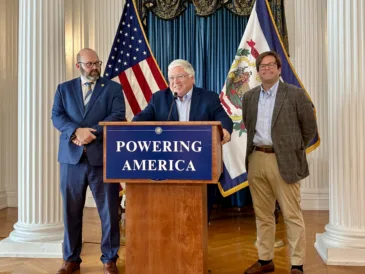
Morrisey - flanked by state Office of Energy Director Nicholas Preservati and Thomas Mapes, chief of staff for the federal Department of Energy's Office of Nuclear Energy - announced Tuesday afternoon that West Virginia was now joining five other states up for consideration for a nuclear lifecycle innovation campus. The other states under consideration are Idaho, Tennessee, Utah, Oklahoma and Louisiana.
"West Virginia wasn’t originally part of that group, but we wanted to be, so we started working the phones, we started engaging more and more," Morrisey said. "Thanks to that work and the support of many people, I’m proud to announce that today, West Virginia has finalized a memorandum of understanding with the U.S. Department of Energy to become the sixth state to participate in this initiative."
According to the Department of Energy, a nuclear lifecycle innovation campus would co-stage various industrial programs aimed at growing the use of nuclear energy in the United States and improving the technologies within the nuclear industry, such as the possible use of small modular nuclear reactors in manufacturing and electricity generation which produce less waste and can go years between refueling.
A nuclear lifecycle innovation campus could be a one-stop shop for the fabrication of nuclear fuel for reactors, enrichment, taking used fuel for reprocessing and waste storage. Depending on the resources of the state where a nuclear lifecycle innovation campus might be located, it could also play host to a nuclear reactor for power generation, advanced manufacturing and use by data centers.
"Today isn’t about a guarantee for (a) campus or a specific number or a specific promise for future investment, (but) it’s another significant step forward," Morrisey said. "It means we are at the table with respect to attracting nuclear here to West Virginia. And we’re now well positioned to work with the DOE and the private sector toward a potential hosting agreement. We’re at the table, we’re going to compete, and you’re seeing in the energy space, we’re not only competing, we’re doing very, very well."
The DOE announced the nuclear lifecycle innovation campus project earlier this year, seeking requests for information from states on Jan. 28 with a deadline of April 1. The first five states were selected for consideration by the DOE in July. The project itself was borne out of executive orders issued last year by President Donald Trump aimed at reducing reliance on foreign energy, strengthening the nation's industrial base and focusing on innovation in nuclear power.
"We're just excited about this," Mapes said. "I think the (department) as a whole is very excited for this opportunity, as the governor mentioned. We’re now in kind of the real negotiation discussion mode, and we’re hoping to move the ball forward on nuclear as a whole throughout the country. The president put (out) a task to quadruple nuclear power by 2050 and hopefully states like West Virginia will help accomplish that."
Nuclear energy is one part of West Virginia's comprehensive energy plan required under House Bill 5381, the Comprehensive Energy Policy and Development Plan Act of 2026, which tasks the Office of Energy with creating a long-term strategy to bolster electrical grid stability and energy security through 2050. It is also part of Morrisey’s 50 by 50 plan to increase the state’s electric-generating capacity from 16 gigawatts to at least 50 gigawatts by 2050.
"You’ve heard me talk a lot about coal. You’ve heard we talk a lot about gas. And I said, just you wait, nuclear is coming," the governor said.
The West Virginia Legislature passed Senate Bill 4 in 2022, which repealed sections of the state code banning the construction of nuclear power plants in West Virginia, which, according to the Legislature’s Office of Reference and Information, went into effect in 1996.
Officials with the Office of Energy said the next step will be to submit a hosting agreement after working with industry stakeholders - coal and natural gas producers, electric utilities, manufacturing, the state's major universities and technical colleges - on a plan that highlights what the state can bring to the table to make a nuclear lifecycle innovation campus a success.
"I think it’s important to remember that we have the building blocks for a lot of development when it comes to the energy sector, whether it’s steel, wire, titanium," said Bill Bissett, president of the West Virginia Manufacturer's Association. "The hope is as we all see this greater need for energy production, it creates tremendous manufacturing opportunities here at home. And that’s really the additional dividend.
"If we can build turbines, if we can build transformers, and we can build parts for nuclear reactors, all of that goes back into construction and manufacturing jobs," he added.
While the public image of nuclear energy has improved over the years, there remain concerns from some over the potential dangers, such as possible meltdowns and radioactive nuclear waste. Quenton King, president of the West Virginia Environmental Council, said in a statement Tuesday his organization was concerned about the ability of the state to regulate nuclear energy.
"WVEC recognizes that the energy needs in our state and region are great, but we are seriously concerned about the state’s ability to manage something so complex as nuclear power and waste," he said.
"Our state government’s capacity is shrinking as Governor Morrisey instructs agencies to keep budgets flat; meanwhile, he has tasked those agencies with speeding up permits and approvals," King continued. "It’s vital that something with permanent consequences, like nuclear power, not be treated with the same haste. West Virginians have been loud and clear that they don’t want data centers in their backyards. They will feel the same way about the governor’s hopes to bring nuclear waste to West Virginia."