
Data Centers A Hot Topic At Economic Outlook Conference
Trending
WHEELING - Business and economic experts told members of the Ohio Valley’s business community that data centers would be beneficial to the economic future of the community.
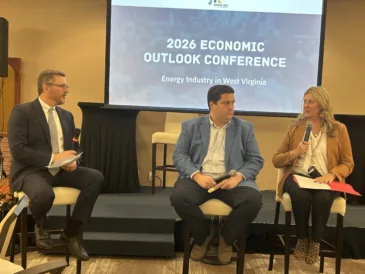
Data centers, a hot topic in the region, was discussed at length Tuesday morning at the annual Economic Outlook Conference sponsored by the Wheeling Area Chamber of Commerce. The conference was held at the Wheeling Island Hotel-Casino-Racetrack.
David H. McKinley, president and chief investment officer at McKinley-Carter Wealth Services, supported construction of data centers locally, pointing out the financial success in Loudoun County, Virginia.
There are 234 data centers located in the county, and the collective property tax on them comes in at $1.8 billion, according to McKinley. This accounts for 38-40% for the county's tax base.
"Technology investments are huge. We take them all for granted," he said. "The ramp up is significant and not to be overlooked.
"I'm disappointed there is so much negativity about data centers."
Former Delegate Erikka Storch, R-Ohio, now external affairs manager for American Electric Power, and James Bailey, a member attorney at Spilman, Thomas and Battle, participated in a panel discussion pertaining to the energy industry in the state that was led by John Deskins, assistant dean at the WVU John Chambers College of Business and Economics. both Storch and Bailey indicated support for data centers.
"From our perspective, data centers operating in our area would help our customers," Storch said. "It would give us a larger population in which to spread our costs, and we would welcome them.
"It would send the message that it would diversify the economy when there are opportunities, and it would increase tax revenue."
The money has been "very transformational” for counties that already have data centers or are building them, such as in Putnam County, she added. Google is developing a multi-billion-dollar hyperscale data center campus in Buffalo, West Virginia.
"There are incredible opportunities, but unfortunately there are tons of misinformation out there," said Bailey, whose law firm represents those wanting to build a data center in Ohio County. "The water use isn't nearly what you hear. These things are self-contained now."
Newer technology allows the water at the plant to be recycled and it uses about the same amount of water as any industrial facility, he explained.
"You never hear from people who are for something. You only hear from people who are against it," Bailey said.
Deskins provided a statewide economic outlook, and said that West Virginia needs more working-age adults in the workforce and a more diversified business climate if it is to grow economically.
Deskins predicts there will be economic growth in West Virginia in the coming years, though it will happen at a slower rate than is typical.
"We still have uncertainty ... over tariff policy, the war in Iran," he said. "Certainly, we have uncertainty around interest rates, but that uncertainty has diminished and that's a good thing.
"Here in West Virginia, we think the state is going to remain stable over the next five years. There will be growth in some regions, but stability overall statewide."
West Virginia has many successes, but they are "too concentrated geographically," Deskins noted. These are occurring in Jefferson and Berkeley counties in the Eastern Panhandle, and in Putnam County near Charleston and Kanawha County.
"We have a lot of regions that are stagnant, and we need to find ways to have growth in those regions that are healthy to broaden out geographically," he continued.
Despite the fact that West Virginia has low unemployment rates and people are working, the state continues to rank last in the number of adults actively participating in the workforce. The national workforce participation rate is 64%, while West Virginia continues to lag at 54.5%.
"It is the biggest economic challenge we face," Deskins said. "There is no way West Virginia can achieve the prosperity we hope for until we get more people in the workforce. It is virtually a mathematical impossibility to imagine that West Virginia would have some form of economic prosperity on par with the nation... and have mathematically the smallest share of adults in the workforce.
"It should be our biggest economic development challenge, and it should be our biggest priority. But fixing this is very hard."
Among West Virginia counties, Wetzel County has the lowest workforce participation rate at 47.9%, according to U.S. Census statistics. This reflects a measurement of people between the ages of 16 and 64 who are not in school.
Sharon Campbell, executive director of the Wetzel-Tyler Chamber of Commerce, suggested workforce participation in the region is lower because of a lack of any childcare facilities there and a lack of public transportation. These factors particularly affect women in the workforce, she added.
The area also has been hit hard with drug addiction issues, Campbell noted.
Deskins noted the years West Virginia has outperformed the nation in gross domestic product growth were when oil and gas industries performed strongly. The healthcare industry, led by WVU Medicine, also has been growing in the state, he added, as has the information industry.
More diversification among businesses located in the state would lead to more economic growth, Deskins said. He also suggested the state should make more effort to retain and attract people to increase population.
West Virginia Treasurer Larry Pack spoke about "how inefficient state government is," and how when a bad decision is made, "government keeps going on."
"West Virginia is at a crossroads, and this demand is being brought to us by the demand for electricity nationwide," he explained. "Most of it is needed by AI (artificial intelligence and data centers).
"America cannot produce that electricity for West Virginia. They have to have us."
Others addressing the conference included Kathy Ritz, executive director of the West Virginia Association For Young Children, who spoke about expanding employer-funded childcare in West Virginia.
Tucker Hase and Schuyler St. Germain, senior analysts for Advantage Capital, informed those present that the company would be looking to financially assist West Virginia small businesses facing banking issues with their investments starting next month.
There was also a discussion about career and technical education in public schools featuring Rick Jones, assistant superintendent for Ohio County Schools; Melanie Knutsen, career development counselor for Marshall County Schools; and Kyle Kull, organizer for the West Virginia and Appalachian Laborers District Council.