
SMART Centre discusses how nuclear energy and AI could go together
Trending
WHEELING -- Small modular nuclear reactors, the push for data centers and AI may not seem as though they have much in common, but a discussion at the SMART Centre Market looked to bridge the gap Friday.
Richard Pollack, who is in charge of energy projects at the SMART center and Robert Strong, director of the center, held the discussion and presentation Friday in hopes to educate the public and bring forth a conversation about what these three topics mean for the region.
The whole idea started because of a flyer Strong saw for an event at Undo's in St. Clairsville, which advertised how small modular reactors can "fuel the future of AI" and datacenters, Strong said.
Strong, who has a background in Nuclear Engineering, was initially confused because the three topics didn't seem related. But he said he then realized what might be getting proposed, given how much of the negative attention surrounding datacenters is how much energy is required to power them and how much water is needed to keep them cool.
"And gee, if there were only some way to generate enough power quietly, that doesn't use so much water? Hmm, interesting," Strong said.
He then made the point about West Virginia not having any nuclear reactors because laws prohibited the construction of one in the state. However, Strong said this has "quietly been changed," given how the ban on nuclear reactor construction was lifted in 2022.
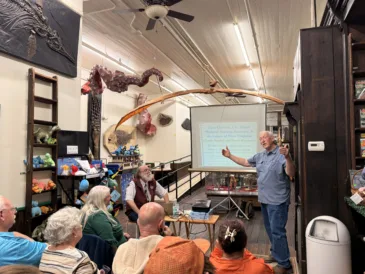
Roughly 16 people attended the discussion in the SMART Centre, with Pollack and Strong situated near the back of the store with a screen and people sitting close to each other and the presenters. Throughout the presentation, people asked various questions about the information they were hearing and chimed in with their own experience.
Two Belmont County residents detailed their experience about their electric bills tripling ever since datacenters arrived in Ohio. Several others discussed water problems and the persistent, jet-engine-like noise they hear if they're even within a mile of a datacenter.
In relation to the small modular nuclear reactors, Pollack also discussed a now-cancelled plan in West Virginia where the state applied for the Department of Energy's Nuclear Lifecycle Innovation Campuses (NLIC) program. These plans were first reported from documents revealed by a FOIA request from the Charleston Gazette-Mail, outlining uses such as having storage facilities to contain nuclear waste, research into nuclear fuel recycling, engineered caverns and advanced reactor deployment, as also reported in Nuclear Newswire.
"The idea is that you are to pursue a solution to nuclear waste that means we're going to reprocess it and use it again," Pollack said. "Now, the thing that was absolutely clear was, in order to start that process, somebody's going to deliver a bunch of nuclear waste to West Virginia."
Gov. Patrick Morrisey refuted the claims, saying the Gazette-Mail got it wrong. However, the newspaper stood its ground and published all the documents received via the FOIA request, which Pollack noted.
Pollack said out of 23 states which applied, five got into the program, with West Virginia originally not being one of them. Additionally, he said once this was all reported on, Morrisey and those pushing for the NLIC approval "yanked a chain somewhere" and said they won't let the state become a nuclear waste dump.
However, Pollack questioned how the government couldn't have known the goal was to bring nuclear waste to the state.
"Right up front, the whole point of the thing was -- and it was made clear in the proposal -- that you understood that you were going to be accepting nuclear waste as part of joining the campus," Pollack said. "The state of West Virginia really worked hard to be in that group. They knew exactly what they were doing and it wasn't until this leaked out they went, 'we had no idea.'"
But how does this tie into datacenters and AI? According to Pollack and Strong, small modular nuclear reactors are being touted as an alternative, better power solution for datacenters which would otherwise either use the electric grid where they're located or other, less energy-efficient and clean sources of electricity.
However, Pollack also said small module nuclear reactors are not more efficient than regular nuclear reactors, saying it produces "anywhere between three and 35 times more waste per kilowatt."
"Everything is so close to the radioactive core that the entire thing becomes radioactive," Pollack said. "And then you've got to dispose of not just the waste, but the container vessel, all the coolants, everything that comes into contact with the neutrons pouring out of this -- that all becomes radioactive."
As for Strong, he said he questions why the promotion of small modular nuclear reactors usually omit the words "radioactive" and "radiation," yet still mention waste.
"It's almost like they're whitewashing it," Strong said.
The two also had questions on why the U.S. needs so many datacenters in the first place. No other place in the world has as many datacenters as the U.S., including "surveillance capital of the world" China, Pollack said.
He told a story about a friend who visited China, jaywalked and the friend was automatically sent a video of himself to his phone before he was done crossing the street. Pollack said this is the norm there, but noted the country has 1/13th as many datacenters as the U.S and can employ this type of surveillance easily.
"What is the United States doing with these?" Pollack said.
While the two still aren't sure for now, they said they have reservations about all three being promoted at the same time, saying in part the push for datacenters, companies insisting people need AI in their daily lives and a renewed need for new power sources is worth questioning.
"We think we've seen everything, every underhanded, scaly deal that people could deal out," Strong said. "And it turns out no, there's some really good ones out there that just haven't been played yet and are being played as we speak."