
Story and Video: Data Center Opponents See Progress Made Through Ongoing Efforts
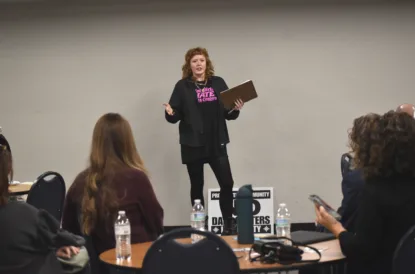 Photo by Eric Ayres
Trending
The Take Back Our City: Data Center Action Assembly was hosted by Upper OV United on Saturday afternoon at the Ohio County Public Library. Organizers leading the charge against data centers welcomed citizens who may be interested in taking part in this effort and others aimed at improving the city.
In the Warwood neighborhood of Wheeling, the company Silicon Foundation has acquired the former Centre Foundry & Machine Company property and plans to develop a data center and energy technology campus there.
"We’ve been fighting this data center since June or July," said Polly Barks, Warwood resident and member of grassroots collective Organized Residents of Ohio County. "Our request has always been to put a moratorium on data centers - which is no data centers in the city of Wheeling."
Groups have appeared before Wheeling City Council to express concerns about data centers. They have asked council to pass a resolution stating that the city is opposed to data center development and have requested that the city impose a moratorium on data center development in Wheeling. Those requests have not been met.
"The priorities of this administration are not always aligned with the hopes and dreams of the residents," Barks said.
In light of this, petitions are being circulated in the community to recall Mayor Denny Magruder, and the group has created a mid-term survey to gauge how the public feels about the job the current city council is doing half way through the current four-year term.
Barks mentioned these undertakings, but noted that Saturday’s gathering was primarily focused on the latest on data centers.
The vocal data center opponents have applauded Ward 1 Councilman Tony Assaro, who represents Warwood. At the request of passionate protestors, Assaro cast a lone vote against a memorandum of understanding that the city established with Silicon Foundation. Although the MOU was designed to limit the company’s ability to expand into a high-impact data center and maintains regulatory powers at the municipal level instead of on the state level, Assaro’s dissenting vote signaled his willingness to go against the grain and support the will of his vocal constituents.
Assaro was on hand during Saturday’s assembly to review some of the recent measures with which the city is moving forward to help regulate data center operation in the city. Assaro and other members of the Rules Committee of Wheeling City Council recently discussed with city leaders a draft ordinance that outlines numerous requirements for entities that wish to develop a data center within the city limits.
A copy of this working draft is available for public view on the city’s website.
"The ordinance is about 16 pages long with a lot of legalese in it," Assaro said, noting that there was no real precedent for this legislation related to data center regulations. "We’ve been taking advice from the public about what we should put in this. I think we’ve put together a very good ordinance here in order to keep things under control and protect our public."
The language proposed for the city code addresses everything from noise concerns to water and electricity consumption, a permitting process and other requirements. Assaro has been adamant that transparency and opportunities for public input have been included in the legislation.
"If there is any application for a permit or somebody is running under a permit and they want that to be modified, there has to be a 10-day notice put in the paper - to make it public - and it’s followed by a public hearing," he said. "If there is going to be any kind of change, the public is going to know about it, and the public is going to be able to say something about it.
"Public input is baked into this ordinance. And with the help from the public, we got some ideas for making this thing strong and making it have teeth. "
Assaro added that there have been a lot of concerns that fines imposed against multimillion-dollar companies may have little impact. People have worried that a data center could simply pay a fine and keep committing violations.
"It’s in here that fines can’t be used to continue doing what you’re doing," Assaro said of the proposal. "You’re going to be hit with a fine first, and if you continue, your permit can be pulled. If your permit is pulled, you can’t operate anymore."
A company has to meet a myriad of requirements in order to simply obtain a permit to operate a data center in town, Assaro noted.
Attorney J. Anthony Edmond Jr. also spoke during Saturday’s session, giving an update on the progress of a civil suit filed on behalf of Barks and several other Warwood residents against Silicon Foundation.
"We filed an injunction to stop the data center from happening in the first place back in July," Edmond said.
The company’s attorney, David Croft, filed a motion to dismiss the case, and Edmond indicated that he plans to file a response to that motion on Tuesday, the deadline to do so.
Edmond expressed appreciation for Assaro’s willingness to stand with the will of the group but also described the MOU and other proposed regulations as a step forward that can be attributed to citizens who make their voices heard and take action.
"Thank you for voting the way your people asked you to on that MOU," Edmond told Assaro Saturday, indicating that progress was being made in terms of finding out exactly what Silicon Foundation has planned for the Centre Foundry site. "They did come out with this MOU that didn’t exist before. They also came out with more information about what their plans actually are."
Although original plans posted on social media and online sites indicated that the operation would eye future phases that would top 90 megawatts or more, the Silicon Foundation is not expected to be that large, Edmond indicated, noting that the scale of the operation has been slimmed down in the wake of public concerns.
"I don’t think without public pressure and public input that that scale back would happen," Edmond said. "I don’t think it would have occurred at all if we didn’t have people coming out saying ‘we’re very unhappy about this, and we need you to do something with it.’"
Other speakers during the assembly discussed the availability of resources and outlined ways for the public to get involved. There are websites such as warwooddatacenter.com and social media pages like Upper OV United that share the latest on efforts by the group, which is reportedly led by a core group of about 30 local individuals who regularly communicate via the privacy-centered Signal app.
Group members are also involved in statewide and national efforts to fight against data centers, sharing information and working collaboratively.
Speaker Amanda McWhorter noted that she has become a part of a statewide coalition - the West Virginia Data Center Accountability Project - which meets remotely and shares resources. A focus of their fight centers on House Bill 2014, state legislation that was passed that strips local municipalities of regulatory powers over high-impact data centers.
"We do have a say, and people are listening," she said.
"Ordinary people are able to make a difference," said West Liberty University marketing student Aiden Kosol, who administers the Upper OV United page. "There have been a lot of wins across the nation because of community involvement, because people are speaking up and saying ‘hey, I don’t want this.’
"We want as many people involved as possible."
Kosol said moratoriums against data centers are possible and have been successfully implemented in communities in New Mexico and Pennsylvania recently.
Many other communities across the country have found out the hard way that failing to fight against data center development can result in lasting negative impacts to their quality of life, group members noted.
"It’s all about accountability," Edmond said. "In other places in the country, they haven’t been held accountable. I think that this fight has definitely been worth it. The journey has been worth it. I think that we still have more to push through, and I think that we’ve shown as a group - as a collective - that when we unite on a topic, we can make a real difference."