
Plitzuweit Leads WVU Women To The Big Dance
Trending
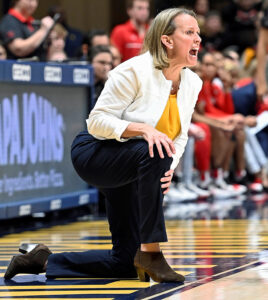
MORGANTOWN -- The words that came out of West Virginia's women's basketball coach Dawn Plitzuweit's mouth sounded as if she had lifted them from Yogi Berra himself.
You've all heard some of the Yogi-isms that earned him his Master of Malaprop degree:
"It ain't over 'til it's over," for one.
Or "No one goes there anymore. It's too crowded."
And, of course, "When you come to the fork in the road … take it."
Well, the subject for West Virginia's first-year coach was how she molded together a team with nearly every moving part new this year and got it a No. 10 seed in the NCAA Women's Championship, facing No. 24 and seventh-seeded Arizona at noon Friday at the University of Maryland on ESPN.
While expounding upon the challenges she faced she blurted out, "You don't know what you don't know."
Somewhere, Lawrence Peter Berra smiled.
Plitzuweit's coaching career goes all the way back to 1995, so she admitted that she didn't feel like a rookie as she moved on from South Dakota as she made not only the NCAAs last year but reached the Sweet 16, but when you are moving into a new situation in today's college basketball world it really can be like starting over again.
"When you start in a program, you don't know what you don't know. You are trying to learn what their tendencies are. You can do things in practice all you want, but when the lights are on it's always a little bit different. Players are going to play how they are comfortable and do what they do. How do you as coaches modify what you do to take advantage of it and fit in what they do naturally."
She thought about her All-Big 12 player JJ Quinerly.
"JJ's a great rebounder, for example, incredible. In a lot of systems, JJ should be the kid that gets back (on defense), but she's a great offensive rebounder and that doesn't match up very well. So, we have to modify what we do a little bit to fit her gifts and abilities and instincts.
"It takes us some time to realize, recognize in game action what that looks like for our team. What you don't know is how hungry are they, what are their abilities to fight through challenges, how resilient they are going to be when you face some losses or adversity. How will they bounce back? Will they bounce back? Who is going to take that initiative?
""You can't let it affect your next performance. All those things are things we've learned about ourselves through the course of the year. What's fun about this group is that we have continued to battle and we have continued to progress and we have continued to get better."
They toyed with .500 all the way through the Big 12 and were on the bubble when the conference tournament began, but they were all confident they would be in. What Plitzuweit had taught and built was coming together at just the right time and they finished the regular season winning five of their last seven games.
Just to make sure they wanted at least one win in the Big 12 Tournament and took a one-point lead over Oklahoma State to the final buzzer when the game's last shot hung on the rim for an eternity before falling through to give the Cowgirls the edge and add some suspense to Selection Sunday.
But the committee had seen what Plitzuweit had seen, her team improving in all areas as the season wore on, Madisen Smith emerging as a scorer whereas she had spent four years as the set-up point guard, finishing the last four games with 20 or more points each outing.
Smith's role had changed as Plitzuweit, as noted, found ways to make things work.
"It's been different having a new coaching staff and teammates, but I think we did a good job of gelling," Smith said. "We enjoyed hanging with each other off the court. The coaching staff has been great being able to bring a new group together and having that one goal throughout the year."
"Yesterday's practice we talked about a book we read over the summer and the message was 'the best do ordinary better than the rest,'" Plizoweit explained. "Did we look at last year's team, the returners, the kids coming in and say 'Boy, we should be in a position to do this or that?' No. How do you know any of that?
"Instead, we focused on what the process looks like … getting involved around the rim, taking care of the basketball, following and finishing plays and things like that and as the season wore on we kept getting better. That was really fun, it's fun to see that. When you achieve at a high level -- and we didn't always do that, even in the middle of conference season we had stretches where we didn't finish plays very well.
"So, we adjusted how we practice. We were doing drills to take care of that but they weren't working very well, so we had to find new ways to work on it. Maybe the new ways worked better, Maybe the film worked. How do you really know? All we knew was it was working so we kept doing what we were doing.
"The fun part of it is finding ways to either grow our knowledge base about what we were doing as well as the ability to go do it and then the comfort to say we do that all the time.
"So, yesterday's message was the best do ordinary better than the rest, Our job is to play basic, fundamental basketball, share the ball, take care of the ball, take good shots and limit opportunities for your opponents. It's not very complicated when you put it that way."
What really is happening is that this team now knows what it didn't know.