
What If Nick Saban Had Stayed At WVU?
Trending
MORGANTOWN -- If I may indulge you for a moment and ask you to allow me to take you off on a flight of fancy into a world that doesn't exist, but that we all wish did.
This is the world known as "If Only World," and we bring it up now after having been inspired by the career and now retirement of Alabama football coach Nick Saban and, by the time we reach the middle of this dissertation, you will understand why it is important to you.
Let us go back to the early days of Saban's career, days when he was still an incredibly intense, driven young football coach out of Monongah, West Virginia. He had been a good player in high school but wasn't physically gifted with enough of the tools to play major college ball, which sent him off away from home to Kent State.
But this was a born coach. You could see it in his approach to the game, his ability to analyze plays and defense, and mostly in his ability to inspire those around them and draw their best from within.
As he was making the rounds all young assistants do, he came at the end of Frank Cignetti's disappointing five-year stay as head coach, taking over the defensive backfield in 1978 and 1979.
When Cignetti, who had been ill, was dismissed, athletic director Dick Martin went on a search for a head coach. He had decided on Bill Mallory of Colorado but when that leaked out, he looked elsewhere and got a tip on an assistant at Michigan named Don Nehlen.
He hired him and you know the rest of that story, one with a happy ending.
But what if …
Here we go. What if Saban had stayed at WVU? Don Nehlen was willing to keep him as an assistant but Ohio State came calling and you don't say no to Ohio State when you are a young, ambitious coach.
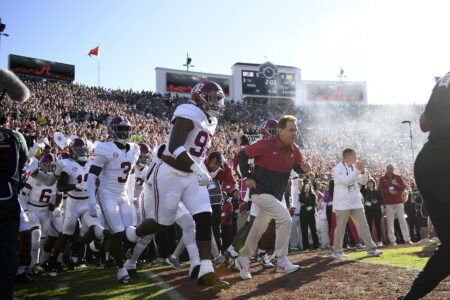
He left and wound up making a name for himself at Michigan State, winning a national championship at LSU and then six more of them - SIX - at Alabama.
What if he had stayed? Might history somehow have been distorted? It is certainly unlikely, considering that Nehlen used his opportunity to become a Hall of Fame coach here.
So we're not saying this for the sake of regretting that Saban never became WVU's coach because the 25 years after he left were the best years of WVU football history with Nehlen and Rich Rodriguez.
Instead, we are saying this for the benefit of the new athletic director at the school, Wren Baker.
He is currently involved in compiling a list of candidates for the basketball job, a list that may or may not include interim coach Josh Eilert.
It is a major hire and one on which he can't be wrong.
And, somehow you figure that somewhere down the line he may have to make the ultimate decision on a replacement for Neal Brown.
Football, you see, is the lifeblood of the WVU athletic department, but it is so much more than that, and we want to impress upon Baker just how important it is by looking at what he did for Alabama … not just the school or the city of Tuscaloosa but for the entire state.
Football coaches get salaries of $4 to $8 or so million dollars not because universities are football fans.
They help drive the economy of the school, the city, the county and the state and to look at what Saban did is also to look at what can be done at WVU, Tuscaloosa being a city that is virtually the same size as Monongalia County, which is the community in which WVU exists.
The Tuscaloosa mayor Walt Maddox has referred to it as "Sabanomics" and that is not an exaggeration of the effect he has had on the economy.
As of 2021, the University of Alabama's Center for Business & Economic Research's latest data showed that each home game for the Crimson Tide brought in $26.2 million for the state and $19.5 million for the local economy.
"Coach Saban is perhaps, if not the best single investment the university has made, he is one of the best," Robert E. Witt, professor and president emeritus of the University of Alabama, said to the local paper. "It's not just that coach Saban has been successful, it's the way he's been successful. He has never once brought this university's integrity or honor or values in to question."
The value of such a coach has been seen here. Saban's success in Tuscaloosa saw that city's population from 78,000 in 2000 to 90,000 in 2010 -- a jump of 16% -- and to 100,00 today.
In Mon County, with Rich Rodriguez as football coach and the team being a national contender while he also kept the team's integrity under control, the population went from 81,866 in 200 to 96,180 -- a jump of 17.5% -- in 2010.
As of 2020 the population rose to 105,822, another 10% jump.
The point to be made here is that this is the big leagues and Wren Baker has a huge responsibility in his role as athletic director to be right with all of the major hires he makes during his time here, beginning with the basketball one where the new coach will have a mess to clean up.