
Remembering Pete Rose, Baseball’s Banned Hit King
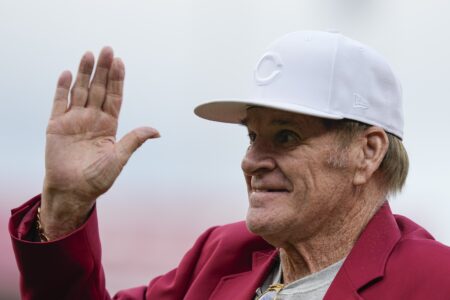
MORGANTOWN -- Going to tell you a story about Pete Rose.
It was winter in Cincinnati, the off-season, and we were both in our early to mid-30s. We were at Western Hills Indoor Tennis Club. Rose wasn't really a tennis player, but he was an athlete, and we had this match set up. It was him and his attorney, Reuven Katz, who was a friend of mine also, against me and a friend named Marty Blake.
Doubles. We both knew something about doubles in those days.
He hit 'em. I drank 'em.
Anyway, Marty Blake was a tennis professional, although Pete didn't know that. A good one, too, but we just wanted a nice, friendly, competitive game, Blake being thrilled just to be on the court with Rose.
And so we played. Marty and I won the first set. We — and I use the singular we as in Blake — let them win the second set.
Pete was being Pete, all over the court, running shots down, right up until we got to match point.
He had no idea Marty was holding back. It was Blake's serve and he came to me and said:
"I'd like to hit him one good serve. You think he'd be mad?"
"Nah," I answered. "He'll think it's funny."
So Marty cranked one up full speed, and this was Nolan Ryan plus. The ball was on Rose before he knew it and whizzed by him … a fast ball for strike three.
Game, set, match.
Pete Rose had been had and knew it. He didn't get mad, but he also wasn't about to let it end that way.
He kept Marty Blake out there for half an hour hitting his best serves until he could get one back across the net.
Imagine, if you will, what he put into hitting a baseball if that's what he did in a silly tennis game.
He had to be the best at what he did. Nothing short of it was acceptable.
So now you know why he ran over Ray Fosse at home plate in the 1970 All-Star Game to score the winning run, even though he had Fosse over to his house the previous night for dinner.
Didn't matter. That was friendship, this was baseball.
That's why he had more hits than anyone ever had in the big leagues. He was driven to be the best, so much so that he always liked to tell people that while he had more hits than anyone he also made more outs.
I always felt the pain he felt from the outs drove him more than the success that came with the hits.
That's why he won three batting titles, an MVP and three World Series. That's why he hit in 44 straight games, a streak second only to Joe DiMaggio.
You can't imagine how much he wanted to break DiMaggio's record. He honestly believed he was going to do it and that baseball needed him to do it.
That was why, on the night the streak ended in Atlanta, he was so upset, why he snapped at Gene Garber, the relief pitcher who struck him out on a changeup outside the strike zone in a game Atlanta led, 16-4, with two outs in the ninth inning.
All that was on the line was the hitting streak and Rose felt Garber owed it to him, to the fans, to history to challenge him in that spot.
But he didn't and this is the way I began my story in the Cincinnati Enquirer that night:
ATLANTA — On a night that the Atlanta Braves could get 21 base hits, Pete Rose could not get one and his hitting streak ended at 44 games, tied with "Wee Willie" Keeler for the longest in the history of the National League.
In truth, Rose should have had two hits in the game. A 24-year-old kid who become Larry McWilliams, a good left-handed pitcher but so unknown that Rose didn't recognize him when he came in to the post-game interview room, gruffly asking him to move over to make room, thinking he was TV or radio technician rather the starting pitcher who made a spectacular behind-the-back stop of hard-hit ball through the middle that on most nights would have extended the streak.
Rose was clearly upset, although he handled all the questions right up until they got to that last at bat. He could have graciously credited Garber but that was not part of DNA at the moment.
"I was a little surprised that in a game that was 16-4 he pitched me like it was the seventh game of the World Series. I guess he thought it was Joe DiMaggio up there," Rose said.
You could almost feel the heat radiating from Rose's body.
"It's easy to make pitches like that when you are winning, 16-4. I just hope to see him tomorrow in a one-run game, hit a rope up the middle."
Then he added, quite vindictively, "That would give me more satisfaction than a hit in my last time up tonight."
Pete Rose went from what should have been a Jack Armstrong tale for kids to instead a Shakespearean tragedy as he allowed the fatal flaw in his makeup, his competitiveness that led to a gambling addiction, to rob him of the one thing that drove him most in his life and career.
He wanted his final resting place to be in Cooperstown, N.Y., as a member of the Hall of Fame, not selling autographs outside the Hall of Fame as he was led to do when he was given a lifetime ban from the game for betting on baseball as a manager.
Whereas Ted Williams once articulated that all he wanted out of life was for people to see him walking down the street and say "there goes the greatest hitter that ever lived", all Rose wanted for people to say "there goes the man who had the most hits ever in the game of baseball."
Rose was a tough kid out of the Western Hills area of Cincinnati, brash and daring. Mickey Mantle and Whitey Ford had hung the nickname "Charley Hustle" on him during a spring training game when he drew a walk sprinted full out to first base, as became his custom.
This was the way he played the game, as evidenced by hitting 30 triples — count 'em — as a minor leaguer at Tampa during a season on his way to the big leagues. He arrived in 1963, beating out the popular Don Blasingame at second base and it was at second base that year when a left-handed hitter pulled a ground ball past him into right field late in the season.
That left-handed hitter was Stan Musial and it was his last hit, the one that held the National League record for career base hits until Rose came along.
The veteran Cincinnati Reds players were unhappy that he took Blasingame's job and shunned him. Remember this was 1963 and the only two players to take him in were roommates Frank Robinson and Vada Pinson. Locked out of his room one night by his own roommate, Rose wound up in their room.
"That was the first time I ever had room service in a hotel," he would admit later.
You couldn't help but be drawn to Rose, though. The way he played the game, the way he lived by the wise crack, the way he treated the young players as they came up to the Reds.
The Reds had brought great talent through their minor league during that time, including Robinson and Tony Perez and Johnny Bench and so many others, Dave Bristol guiding them through the minor leagues as their manager and then earning the job in Cincinnati.
But it wasn't until Sparky Anderson replaced Bristol that they got over the hump and won a pennant and it wasn't until Joe Morgan came to the Reds to reshape what had become "The Big Red Machine" that winning became a huge part of Rose's resume.
Both of them had a lot to do with that final step, for Anderson wisely put Morgan's locker next to Rose's, Rose setting an example for Morgan of playing hard every minute and Morgan's cerebral approach completing the package that was Rose.
Mix in Bench and Perez and Ken Griffey Sr. and Dave Concepcion and you had the engine of the Big Red Machine.
Rose, Bench and Morgan became celebrities and the team itself was an attraction wherever it went.
But there was a problem brewing that no one really put a finger on and that even today is not admitted to, but I have always theorized that A. Bart Giamatti, the former Yale President who was then-National League President and would become baseball commissioner, had this fairytale image of the game and the way it should be played, disliked Rose's brashness and style.
In his mind, baseball was a game for the poets. Rose played it like it was a demolition derby.
When Rose had a run-in with umpire Dave Palone, Giamatti handed him a record 30-day suspension for pushing the umpire. The suspension was the longest since manager Leo Durocher was suspended for the 1947 season for associating with gamblers.
Then, when Giamatti became commissioner, he handed down the lifetime ban on Rose for gambling. Rose felt he had an agreement to have the suspension reviewed and perhaps lifted, but Giamatti died of a heart attack a couple of weeks later and Rose remained on the restricted list to the day he died at 83.
Oh yes, by the way, baseball is gladly partnered with casinos and betting establishments in what has to be one of the most blatantly hypocritical decisions in the world of sports.