
WVU Basketball Coaches Weigh In On Early Impact Of New Review Rule
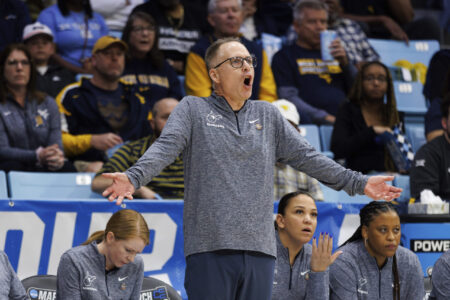
West Virginia head coach Mark Kellog reacts to a call during the second half against Columbia in the first round of the NCAA college basketball tournament in Chapel Hill, N.C., Saturday, March 22, 2025. (AP Photo/Ben McKeown)
MORGANTOWN — The idea of college basketball coaches being able to challenge calls is not exactly new. It’s an idea that’s been kicked around for a few years by the NCAA Men’s Basketball Rules Committee, like that dirty half-flat basketball hanging out in your garage.
When the notion first came into play, Bob Huggins was still the WVU men’s basketball coach and the original thought was hoops coaches would have similar red challenge flags that football coaches have in the NFL.
Huggins’ summation: He would be able to heave that flag a long way if the moment called for it.
Turns out men’s and women’s basketball coaches don’t have the challenge flag, but they do have the right to challenge certain calls this season for the first time ever, a rule that was passed by the committee in June.
“It obviously mirrors the NBA game, and there is a risk-reward benefit to it,” WVU men’s hoops coach Ross Hodge said.
That risk-reward comes inside a major time crunch and can involve a number of people factoring into the decision, including the players, who apparently lean toward wanting just about every call to be challenged.
“Players are kind of hard to trust in that situation,” Hodge admitted. “They never feel like they hit the ball last. They want you to review everything.”
Challenge this
In terms of what a college coach can challenge, it comes down to three basic plays:
–Goaltending/basket interference.
–Out-of-bounds plays (who touched the ball last).
–Whether or not a defender was inside or outside the restricted arc on a block-charge call.
Every coach begins a game with one challenge. In order to challenge a call, the team needs to have at least one timeout remaining, because if the call on the court isn’t overturned, the challenging team loses a timeout, thus the risk-reward.
“My thoughts are you can lose timeouts, and that’s the hardest part,” WVU women’s coach Mark Kellogg said. “In a close game and in the women’s game, you can advance (the possession to halfcourt), so those (timeouts) are gold.”
If a coach’s challenge ends with the call getting reversed, the team not only gets to keep its timeout, but is also rewarded with a second challenge.
According to figures released by Ken Pomeroy, the professor of college basketball analytics, college coaches, so far, have generally been right more than wrong when it comes to challenging calls.
On challenging goaltending calls, coaches have been right 60.4% of the time. On out-of-bounds plays, calls have been reversed just shy of 55% of the time.
The exception has been challenging the restricted area calls, which have only been reversed about 27% of the time. That’s also – by far – the least-challenged call, with out-of-bounds plays having a huge lead in the calls that get challenged the most.
At WVU, Kellogg is1 for 2 on his season challenges, while Hodge waited until the 12th game of the season to issue his first challenge. WVU was called for goaltending against Ohio State. The call was not reversed.
“They called a goaltend and from the look that we had on our replay, I didn’t think it was a goaltend, or else I wouldn’t have challenged it,” Hodge said. “It was kind of one of those ones where the calls stands and not the call was confirmed. I don’t think they had enough to overturn it all the way.”
So how does it work?
Technology comes into play in a major way, as does the instant replays shown on an arena’s scoreboard.
WVU assistant coaches and some graduate assistants are armed with iPads used to stream the game that’s being played live right in front of them. Whenever a questionable call is made, faces are buried into those iPads, as the play is quickly rewound and replayed in order to give the head coach a thumbs up or thumbs down on whether or not to challenge the call.
That decision has to be made almost in an instant, because once the referees have the ball marked ready for play and the next possession begins, the play can no longer be challenged.
“You have the technology on the bench,” Hodge said. “It just matters how quickly can you get the replay synched up.”
Kellogg joked he had a solution to giving his replay team a little more time.
“The hard part is we can’t get to our tablets quick enough most of the time,” Kellogg said. “I’m going to have to tell my players to fall down and lay there like you’re hurt or something to give us an opportunity to look at it.”
Pomeroy’s statistics also show that the majority of challenges have come in the final 10 minutes of games, which makes sense, because a coach may hold onto his challenge in close games. The problem there, according to the numbers, a successful challenge is more likely to occur earlier in the game than later. First-half challenges have been right 65% of the time. Challenges made in the final 10 minutes of games have only been right 45.7% of the time.
“I’m pretty hesitant with it,” Kellogg said. “You don’t want to lose timeouts. Unless it’s late, right in front of us and pretty obvious, if we need the possession, I’ll probably challenge it. If not, we’ve got to be a little careful.”
Those with the closest eyes on the play in question are the players, and both WVU coaches said they have had discussions with their athletes on being as honest as possible before asking the head coach to challenge a call.
“We’ve had that conversation, like, you’ve got to know if you say you didn’t touch it,” Hodge said. “Sometimes that can be hard for them in real time, as well.”
Top Sports
Alabama rallies from 17-point deficit to beat Oklahoma 34-24 in College Football Playoff
Los Angeles Dodgers to pay record $169 million luxury tax after winning 2nd straight World Series
REPORT: WVU Hires SEC Coach As Running Backs Coach
West Virginia has reportedly settled on its running backs coach for the future. The Mountaineers are reportedly ...
High School Roundup: Purple Riders Win Battle vs. Waterford; Cameron Dragons Fall To Panthers
ST. CLAIRSVILLE – Martins Ferry outscored Waterford 26-13 in the second half Friday night for a 51-45 victory ...
WVU Basketball Coaches Weigh In On Early Impact Of New Review Rule
Martins Ferry’s Defense Stymies Shamrocks
MARTINS FERRY - Derek Edwards was not happy with his team’s defensive effort in Tuesday night’s win against ...