Rich Rodriguez plans to utilize more tight ends at WVU for 2026
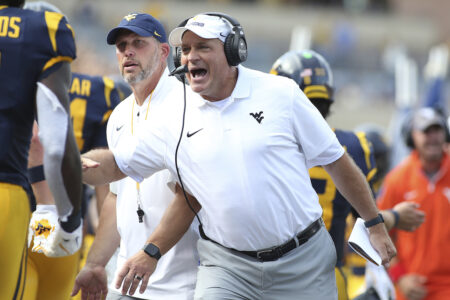
West Virginia coach Rich Rodriguez reacts after a touchdown against Pittsburgh during the first half of an NCAA college football game Saturday, Sept. 13, 2025, in Morgantown, W.Va. (AP Photo/Kathleen Batten)
MORGANTOWN — Around this time last year, Rich Rodriguez discussed a couple of positions in his offense and how important their roles are. One of them was tight end. Rodriguez talked about how, other than quarterback, tight end is the hardest position at West Virginia to play and learn.
The tight end has to be able to block on pass plays, get to the next level to throw a block on a run, and then be athletic enough to run for a pass. Sometimes offenses sub in tight ends who are better at one thing based on the play, but in Rodriguez’s tempo offense, there aren’t substitutions because that allows the defense to sub. So, they have to do it all.
WVU lost Grayson Barnes last year to graduation, who was the go-to tight end and had a couple of scores last year, including the game-tying one against Pitt in the Backyard Brawl. Barnes had 21 catches for over 200 yards last year, which was fourth on the team.
WVU did return some tight ends like Ryan Ward, who worked his way into the offense last season. But Rodriguez spent a lot of his transfer portal budget on adding some Power Four tight ends. He added Clemson tight end Josh Sapp, who played for the Tigers for four seasons and had 11 catches for 150 yards on 267 offensive snaps over 13 games in 2025. Rodriguez also scored Mississippi State veteran tight end Cam Ball, who has also played four years. At Mississippi State and Buffalo, Ball played 35 games and made 10 starts.
There are a couple of tight ends in the large 2026 high school recruiting class, too.
“We brought some veteran presence in there,” Rodriguez said. “Ryan is the most experienced guy, kind of the leader of the group.”
Ward, Sapp and Ball are all expected to have big roles in 2026, but Rodriguez mentioned that he wants to travel with five tight ends, which is a lot of investment in the room. That also leaves two spots up for grabs for maybe a freshman or some of the other returning tight ends.
“I want to have five,” Rodriguez said. “I want to travel five. We’re going to play three in every game, but we’ll travel with four or five of them if they’re ready to play.”
If last year is anything like 2026, depth is essential with all the injuries. A tight end at fourth or fifth on the depth chart could see some action.
Rodriguez wants to use the tight ends a whole lot more, too. He usually runs a spread offense with three to four receivers out wide, which fits with the offenses in the Big 12. But Rodriguez wants to be more physical up front and make sure the run game is still WVU’s identity.
Rodriguez said he’s using more 11 and 12 personnel than he has in the past, which means more tight ends on the field. So, it’s important to have more ready for action.
“We even did some 13 personnel, three tight ends,” Rodriguez said. “Part of it was by, we were getting running backs hurt, receivers hurt, so we had tight ends healthy. Part of it also, we thought it gives us a little bit of flexibility of what we want to do offensively.”
Through the first couple of weeks of practice, Ward has been the only real one to separate himself, which makes sense because he’s one of the few returning players in Rodriguez’s offense. The rest of the tight ends are still learning the scheme, and the challenge it is to be a tight end in Rodriguez’s offense.
“I like where we’re at right now,” Rodriguez said. “They’re still learning. The physicality of the tight ends is the next step. Coach (Michael) Nysewander does a good job with those guys.”
Top Sports

Mets rally past the Pirates 4-2 on a 3-run homer by Luis Robert Jr. in the 11th inning
Rich Rodriguez plans to utilize more tight ends at WVU for 2026

Belgium blows out United States 5-2 in World Cup warmup that exposes American defenders

Illinois powers its way to its first Final Four in 21 years, beating Iowa 71-59
Rantanaen scores in return from injured reserve, Stars top undermanned Penguins 6-3