
Trending
WHEELING - A preliminary draft of proposed amendments to the city of Wheeling's Planning and Zoning code to include rules and regulations specifically for data centers was reviewed by city leaders on Tuesday night.Members of the Rules Committee of Wheeling City Council met at length prior to Tuesday night's regular council meeting to discuss the proposed draft. Officials stressed the comprehensive document, currently 15 pages in length, is still a work in progress.
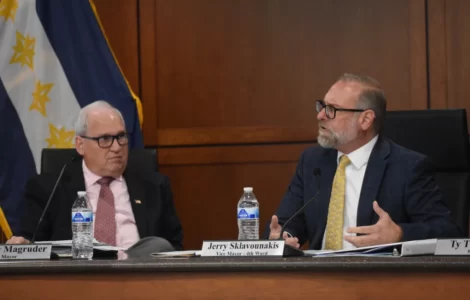
However, several language tweaks and suggestions for changes were offered during Tuesday night's session, and city leaders proposed the latest version of the draft be posted on the city's website today in order to give the public the opportunity to review it and provide input to council members as the proposed amendment moves forward."Put it out to the public with the understanding that this is a working draft," Councilman Dave Palmer noted. "That way, we can be contacted with suggestions from the public, listen more to ideas that are out there, and see if we thought we missed anything. It's going to change. But I think we do have to get it out there to the public."The discussion comes in the wake of concerns by city leaders and the public over the past several months about the looming development of a new data center in the Wheeling neighborhood of Warwood. The former Centre Foundry & Machine Company property was acquired last year by the Silicon Foundation, an energy and artificial intelligence compute infrastructure company with international roots which plans to develop a new data center and energy technology campus at the Warwood location.Mayor Denny Magruder and other city leaders thanked Wheeling City Solicitor Rosemary Humway-Warmuth for working to put together the proposed zoning amendments, along with help from Building and Planning Director Brenda J. Delbert, City Clerk Jessica Holloway and others. This included research stemming from within the city's own existing codes to municipalities around the country that have addressed similar situations."I know some folks thought that we weren't working on this, but those folks who have been working on it I think have been doing so for more than three months," Magruder said. "I think it's a good move in the right direction."
The city has already developed a memorandum of understanding with Silicon Foundation in which the company agrees not to apply with the state to expand and become what is considered a high-impact data center.Vice Mayor Jerry Skavounakis, chairman of the Rules Committee, said there was no previous example in the state of West Virginia on which legislation specific to municipal planning and zoning for data centers could be based."There's not a template that she was able to use," the vice mayor said. "There isn't one. This is something she had to do from scratch."I know you put a lot of time and effort into this, and I appreciate it," he told the city solicitor.The planning and zoning amendments to include language pertaining to data centers would first require a permitting process. A special use permit application would have to be submitted and approved, and the application process alone would involve a considerable list of requirements.
Permitting requirements address a checklist of issues related to the site plan, a utility impact review, anticipated electrical demand and expected peak demands, adequate electrical service without unreasonable burden to city services and public utilities, daily maximum water demands and consumption, wastewater discharges, description of proposed cooling and water conservation measures, location and specifications of backup generators, anticipated air emissions, anticipated noise-producing equipment, proposed storm water management, noise levels and other issues."There's a list of things that they have to provide the city," Councilman Ty Thorngate said. "I think that is, to me, the most important thing in this."The application fee alone is currently set at $5,000, according to the proposed language. A surety bond must be provided by the applicant, as well. Currently, the surety bond is set at $75,000, but Humway-Warmuth noted this can be increased."This is in case that applicant does not fulfill what they are required to fulfill," she said. "We're not wed to that amount. It may be something you may want to modify - that's at your discretion."The applicant must also cover the cost for industry experts the city will hire as consultants to review their application to make sure the company is meeting the requirements, to make any recommendations and to assure that industry standards are being met."This allows us to use experts within this field, rely upon them, and then pass the cost off to the application - which would be the proposed data center, not the citizens," Sklavounakis said.Proposed language also includes potential fines for violations, but city officials noted that financial punishment would not likely have much of an impact on a company involved in data center development."The big issue isn't just the fines, we want to make sure that if they are doing stuff that they're not supposed to be doing, we can revoke their permit in addition to the fines," Sklavounakis said. "If this data center wants to come here, the first thing they're going to have to do is they have to get a permit. They're not going to be able to operate without a permit."Humway-Warmuth noted the basic framework of the draft was based in part by language developed more than two decades ago when wireless communication boomed across the country and cell phone towers and infrastructure came to the city. The city created wireless telecommunication-specific ordinances to address issues related to these developments and several tweaks have been implemented in the city over the years, as well.The data-center language is expected to be described in city zoning codes related to industrial zoned properties, such as the Warwood location. State regulations in West Virginia have been passed to address data center development, but local rules and regulations can also be applied, the city solicitor noted."There are still things the city can still do in regard to the health, safety and welfare of our citizens and to provide that there are checks and balances in a fair application process for those who want to apply to get data centers," she said. "This is a working draft - it's not totally perfected at this time, but it's pretty close."Special use permit applications would be reviewed by the Wheeling Planning Commission. Rules Committee members indicated that they would like final approval to go through city council.Councilman Tony Assaro said he agreed with much of the provisions outlined in the draft, but he made a couple suggestions. One suggestion pertained to public notifications in the event a data center would seek variances or changes to their operation."It doesn't say exactly what the process is," Assaro said. "At the end of this I'd like to add what you have over on one of these previous pages about a 10-day notification to the public and a public hearing prior to council approval. If there's going to be modifications made or an exemption made, I want it to go through that public process."Assaro added generators used on site should be done so only during power outages or for specific purposes spelled out in the ordinance."That way it's defined what it's there for," he said. "I don't want anything open-ended."City leaders are expected to meet again in the coming weeks to review the draft again and make any suggested changes before moving forward to implement it. The city solicitor indicated the language has to be reviewed and deemed to be legally applicable before it is presented for approval."I'd like to get this on the books ASAP," Sklavounakis said. "We need to keep moving forward. We need to get it done. I don't want to see it sitting on the back burner."