
Wheeling Federal Courthouse Officially Named for Judge Stamp
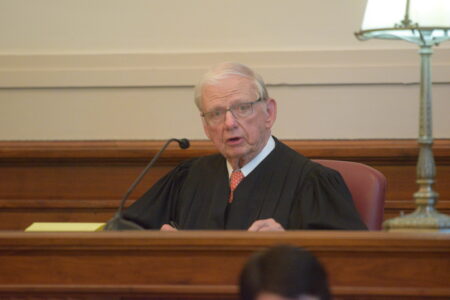 Photo by Derek Redd
 Trending
WHEELING – One by one, the speakers assembled in a packed courtroom stood and lauded Judge Frederick P. Stamp Jr. They said he was a judge's judge, a consummate gentleman's judge, a person of great intelligence, humility, love of community and respect for the law.
All those attributes were among the reasons for Friday afternoon's celebration - to officially name Wheeling's federal courthouse the Frederick P. Stamp Jr. Federal Building and United States Courthouse. They gathered in the building that now bears his name to offer their congratulations and reasons why such an honor was perfect for a judge of Stamp's talent and demeanor.
Stamp was nominated by then-President George H.W. Bush and sworn in as a United States District Court Judge for the Northern District of West Virginia in 1990. He served as Chief Judge of that court from 1994 until 2001.
The lifelong Wheeling resident - who was inducted in 2017 into the Wheeling Hall of Fame - has long been known as a calm, steadying force from the bench. Friends and colleagues all said he was someone that others in the legal community should and do want to emulate.
"He has consistently, over these many years, decided cases ... incisively, decisively, courteously, courageously and without any fear or failure, period," said Judge Robert B. King, Circuit Judge for the Fourth Circuit of the United States Court of Appeals. "I'm honored to have worked with him."
Friday's honor was 11 years in the making, said U.S. Rep. David McKinley, R-W.Va. McKinley, himself a Wheeling native, has spent that long in the halls of United States Congress trying to get Wheeling's federal courthouse named after his longtime friend. After years of being rebuffed, McKinley's resolution finally was passed in the U.S. House of Representatives last year. Sen. Shelley Moore Capito, R-W.Va., took it up in the United States Senate, where it was passed and sent to President Joe Biden for him to sign.
It was an honor that Stamp richly deserves, McKinley said, in part because it is an honor Stamp himself would never lobby for.
"He is particularly known for his humility and his committment to service above self," McKinley said. "His thoughtful silence and contemplation, I think, would make President Calvin Coolidge, old 'Silent Cal' proud. Judge Stamp is known for his community service and has been a steadfast pillar in this community."
A former member of the West Virginia Legislature, Stamp also has served as a trustee and member of the vestry at St. Matthew's Episcopal Church, chairman of the West Virginia Board of Regents and is an emeritus trustee at both The Linsly School and the University of Richmond.
There are many other ways that Stamp has made a mark in the community, said Judge John Preston Bailey, who currently sits on the federal court of the Northern District of West Virginia. Stamp started a training program for federal law clerks for the entire Fourth Circuit, which includes Maryland, Virginia, North Carolina, South Carolina and West Virginia. He also founded the court's Community Scholars program, which brought students from throughout the Northern Panhandle to learn about the legal system.
True to his nature, Stamp spent much of his time speaking to those in attendance thanking everyone who helped make Friday's ceremony possible, when he wasn't taking good-natured jabs at himself.
"Congressman McKinley, you mentioned my humility and I'll certainly accept that," Stamp said. "But it made me think about Winston Churchill's comment about, I think it was (then-Prime Minister Clement) Attlee, when he said Attlee was a very modest man with a great deal to be modest about."
Stamp mainly focused his comments on the people who helped him through his career, not just those who helped push the resolution through the halls of Congress, but those who made the federal courthouse go every day.
It's not just the judges, he said, but the law clerks, court reporters, deputy U.S. Marshals, courthouse security and so many others whose tireless work made it possible for him to carry out his duties every day for so many years.
"Ladies and gentlemen, it's a pleasure to be with you," Stamp said. "And it's going to be impossible to appropriately thank all of you for being here today and for this wonderful honor for me and my family."