
Trending
WHEELING -- The race to represent the West Virginia House of Delegates 3rd District is a contest among neighbors.
Voters will elect two members of the 100-member chamber when they go to the polls Nov. 6, and they will select from among four candidates.
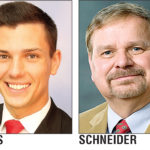
Seeking re-election are delegates Erikka Storch, R-Ohio, and Shawn Fluharty, D-Ohio. They are being challenged by Republican Dalton Haas and Democrat Ben Schneider.
Just one house separates Storch and Schneider homes on Edgwood Street in Woodsdale, and Fluharty lives close by on Walnut Avenue. Haas is a resident of Carole Avenue in Springdale.
Fluharty, an attorney, has served as a delegate since first being elected in 2014.
He said his "willingness to stand up to anyone at anytime for the betterment of the Northern Panhandle" is what sets him apart in the race.
"I've taken on Big Pharma, lobbyists and corrupt Charleston politicians," he said. "Silent representatives have allowed our state to be bought in sold to the highest bidder for decades, regardless of what party is in power. I refuse to be silent."
Fluharty said he has faith the right people in Charleston can change the state for the better.
"I've worked diligently with both sides of the aisle to fight for the Northern Panhandle," he said. "I've defended our Constitution and your property rights by helping to defeat forced pooling, and spearheaded the movement to get medical cannabis legislation passed -- which was specifically aimed to help our veterans and those seriously ill.
"I also took on leadership when they attempted to remove 1,700 jobs from our area by ending the greyhound industry," Fluharty said. "I want to continue this fight and I am honored to be in this position representing our area."
Fluharty pushed successfully for the passage of sports gaming legislation in West Virginia.
"With its passage, our state will see millions of dollars in revenue while adding hundreds of jobs -- all without raising a single tax on our residents," he said. "The Northern Panhandle in particular will see an increase in tourism. I am proud to see our state getting national recognition on this issue and proving to our neighboring states that we plan to compete with them in today's economy. It's about time!"
Haas is a December 2017 graduate of West Liberty University who works as an apprentice funeral director.
"What sets me apart from the other candidates is that I bring fresh and innovative ideas that promote a business friendly environment in West Virginia while also supporting our education system with the resources that it needs," he said.
"The reason I'm running for election is because this is one way I'm giving back to my community and state -- by working diligently to continue making West Virginia a place where our citizens want to stay and a place where people want to come," Haas said. "I want to spend time in Charleston because I believe the Northern Panhandle is forgotten about, and it is important to have a constant presence to make sure our voices are heard."
He said he sees himself bringing a strong work ethic to the Legislature and being involved in the community.
"I understand what our citizens want and need." Haas said. "The biggest challenges facing West Virginia is the opioid crisis and our judicial system. We also are facing the problems of PEIA, jobs and opportunity in our state and our crumbling infrastructure. All of which I will be working to fix."
Schneider is a photographer, business owner and member of the West Virginia Air Patrol.
He said his strength is he is not politically obligated to any entities. He subscribes to the teachings of Doris "Granny D" Haddock, who spearheaded a movement toward campaign finance reform.
"I am not taking any donations from anyone," Schneider said. "I am a 'Granny D' follower and believe that donations to political candidates lead to corruption in government, (and) that politicians trend to do the work for their donors -- and not the good of the country, state or its constituents. If elected, I would owe no one anything, and not owe anyone any favors."
Schneider also is a believer in public service. He served in the Army in the 3rd Infantry in 1968 and 1969 under presidents Lyndon B. Johnson and Richard M. Nixon. He also has been involved in community, church and civic organizations.
He presently is a member of the U.S. Air Force Auxiliary and works in the Civil Air Patrol as a scanner/photographer, finance officer, public affairs officer and aerospace education officer.
"Serving as a delegate will be another way I can further serve my community," Schneider said.
Schneider believes West Virginia needs to diversify its economy.
"One of the biggest hurdles we have as a state is a lack of well-educated individuals who can work in the jobs new technologies offer," he said. "The biggest step in entering these new high-paying jobs is to have an educational system that educates our young people from kindergarten through college at a level where they can compete in this new high-tech world in which we live."
Storch has served in the House of Delegates since 2010. She works as president of the Wheeling Area Chamber of Commerce.
She said she is running for re-election because she wants to make the state into a place where her children will find jobs live in the future.
"I am a mom and the only candidate juggling a full-time job, family and legislative service," she said. "I have made payroll. For all of my career, I have been responsible for providing jobs and making payrolls. No source of funding has ever been guaranteed.
"My success has been defined by building strong, solid relationships," Storch said. "Those I interact with in business, and the constituents I serve, know that I am available to listen and will give all my efforts to provide a resolution to whatever issues we are facing."
Storch said she enjoys being part of the legislative process in Charleston, but acknowledges "it is sometimes a frustrating process."
She said the biggest challenge facing West Virginia is its low workforce participation rate, which she reports is currently at 53 percent -- or 10 points below the national average of 63 percent.
"We need to encourage more of our able-bodied people to work," she said. "What goes hand-in-hand with our low workforce participation rate is the opioid crisis. We lead the nation. This needs to change.
"I have been serving on the select committee for the prevention and treatment of substance abuse, and we have gotten more dollars directed to deal with this crisis and have gotten more beds available," she said. "However, it is going to take more than just initiatives of government to combat this problem."