
Bank Representatives Hope Wheeling OKs Zone Change
Planning Commission denied building on National Road
Trending
From Staff Reports
WHEELING -- After the city's Planning Commission denied a zone change that would allow a bank to set up shop on National Road, attorneys representing the institution are hoping City Council will decide in their favor.
The attorneys argue the bank, to be built on 1154 National Road and 2 Laurel Ave., will benefit the neighborhood and is consistent with Wheeling's Comprehensive Plan. Residents, however, have expressed concerns about how the bank could change the area.
"What I believe is that if this project is allowed to continue, they'll have a better neighborhood in two years than if it's denied," said David Croft, a lawyer with Spillman, Thomas and Battle representing the bank. "That community would miss a really good opportunity to have a strong community supporter that is a good corporate citizen."
On March 11, the planning commission voted 4-1 to deny a zone change that would make the properties, which house former church buildings currently zoned for residential use, part of an EMO district. Such districts limit properties to educational, medical and office uses.
The decision was met by applause from the few dozen residents in attendance, several of whom spoke against the zone change at the meeting and at prior ones.
Wheeling City Council will have the final say on the zone change at its next meeting at noon Tuesday at the city building.
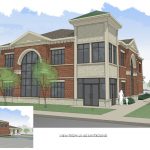
Plans for the bank include tearing down the existing church buildings and constructing a $2 million new facility with drive-thru service. The owner of the building, Thomas Tuttle, couldn't "make the numbers work" on redeveloping the building, which had problems with its electric systems, roof, HVAC and mold, Croft said.
"All of the decisions up to this point are advisory in nature," Croft said. "City Council will decide on whether this application, a petition for zoning amendment, is granted or not. We'll wait to see what the City Council does and hope and expect that they follow their own comprehensive plan."
A map included in Wheeling's 2014 Comprehensive Plan labels future land use for the the National Road and Laurel Avenue properties as "commercial or office." Tom Connelly, the city's assistant director for economic and community development, previously said the zone change is consistent with the plan and recommended approval of the change.
The matter dates back to December, when Croft first submitted the zoning request to change the current residential classification, R-1B, to commercial, C-2. The request was then considered at the Jan. 12 planning commission.
At that meeting, several residents expressed concerns that the bank would change the character of their neighborhood and increase traffic.
The bank's representatives then commissioned a traffic study and presented their findings at a Feb. 4 Zoning Committee meeting. The study, conducted by TMS Engineers, found that adding a bank would cause "minimal interruption" and delays.
Residents noted that the traffic study was conducted on a holiday when school was off, but Engineer Mike Schweickart said the study accounted for the difference in traffic that day.
After the Zoning Committee recommended a denial of the zone change, Croft and others changed the request to be for an EMO district rather than a commercial district.
"We were listening to the community," Croft said. "So we amended the request to an EMO with the idea that it's lesser in scope and has less impactful activities."
The change to the request prompted a second public hearing, which was held at the March 11 meeting. There, residents raised concerns that the bank could still increase traffic, present dangers to kids playing in the neighborhood and hinder the neighborhood's character.
Croft and Gerald Lofstead, another lawyer with Spillman, said the bank would present benefits such as 20 new jobs, increased property values, increased property tax and business and occupation tax. They also added that the bank typically gets involved in communities through car washes, bake sales and support of youth sports.
"There is not a more clear path on what we've set out on and we've had nothing but hurdles," Croft said. "If we embrace the idea of 'not in my neighborhood,' it'll be a hindrance to future development."