
Federally-Funded Road Repairs in Northern Panhandle Behind Schedule
Trending
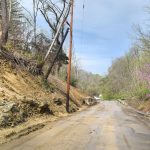
MOUNDSVILLE -- Work on a number of road repair projects in the Northern Panhandle has yet to begin more than a year after the federal government declared damage from flooding in West Virginia to be a disaster.
About 43 percent of federally funded projects to fix roads in the region damaged by flooding that occured in February 2018 haven't started, according to data from the West Virginia Division of Highways, District 6.
The district cites several reasons for the work's delay including that the 2018 flooding occurred shortly after a previous flooding disaster in July 2017.
"We were hit with disasters nine months apart," said Chuck Henry, a maintenance assistant with District 6. "We had that disaster, worked on it and then had to go into survival mode for the second disaster."
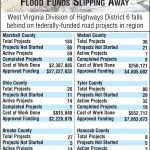
In total, out of the 361 planned and funded flood disaster assistance projects in the Northern Panhandle, 76 have been completed, 129 are active and 156 haven't seen any work done.
Another reason that many projects haven't begun, Henry said, is because the district lacks personnel, which makes completing road repairs a challenge.
"Our biggest problem is manpower," Henry said. "It's a shame that we have all this work to do and don't have all the people to do it."
Now, deadlines for completing the projects are approaching. The majority of the projects are being funded by the Federal Emergency Management Agency, or FEMA, which set a deadline of Oct. 16 this year for work to be completed.
The Federal Highway Administration also committed funding for the projects with a September 2020 deadline.
Though it's clear some of the projects won't be completed by that October deadline, Henry said it's "way too soon" to know just how many that will be. He also noted that FEMA often grants one-year extensions for projects, which the district will request as needed.
Meanwhile, of the $47.2 million approved by FEMA and Federal Highways for Northern Panhandle projects based on the February 2018 flooding, about $4.2 million in road repair work has been completed so far. That doesn't mean, though, that District 6 received a $47.2 million check, Henry explained, as the federal agencies will provide the approved money once projects are officially closed.
"We don't have those funds yet. Those funds are obligated (until) you do the work and finish it," he said. "For all large projects, we don't get any money up front."
The majority of the repair work, and in turn the majority of the approved funding, is for roads in Marshall County, according to data from District 6 based on last year's flood disaster. That involves 184 projects, 40 of which are completed and 85 that haven't started.
Earlier in April, the Marshall County Commission declared a state of emergency in the county due to the deteriorating condition of its roads, described by officials as dangerous for residents, school buses and first responders.
So far, about $2.4 million in repair work has occurred in Marshall County of the $27.2 million approved by FEMA and Federal Highways.
Other counties show similar numbers regarding project completion. In Ohio County, for example, of 26 total projects, only one project is completed, while 14 are active and 11 haven't started.
Planned and completed projects involve a variety of different construction work, the most common being soil nailing, which reinforces unstable slopes alongside roads. Other work involves fixing clogged culverts and scouring and rutting roads.
Data from the district also indicates the cost of each road project. For Marshall County, the most expensive project is $1.4 million for soil nailing on Reilly Hill, a FEMA-funded project that hasn't started yet.
In Ohio County, the largest project involves soil nailing on Gashell Run Road, an active job set to cost $419,000.
Brooke County lists a $365,000 project for soil nailing on St. John's Road that is currently active, and Hancock County lists a $754,000 project for soil nailing on Lyons Road that hasn't started.
In addition, the costliest work for Tyler County is a $454,000 inactive project and for Wetzel County is a $344,000 active project, both for slip repairs.
Henry, who also works as a disaster coordinator for the district, explained that the district has to balance different priorities for road work projects based on federal funding and deadlines.
"There may be a slip on a road that's been there for a year and a half," he said. "We come in and fix the slip that happened four months ago. That's because we have the funds for it and have to fix that by certain period of time."