
South Wheeling Preservation Alliance Working to Keep Neighborhood History Alive
South Wheeling Preservation Alliance seeks approval from state commission
Trending
WHEELING -- When Ginger Kabala first moved from Wellsburg to South Wheeling in the late '70s after marrying her husband, she became curious about the neighborhood's history.
"I kind of wondered about the brick buildings, about the back alleys, patch gardens," she said. "I didn't know any of this stuff."
A couple of decades later, Kabala started the South Wheeling Preservation Alliance with Brother John Byrd in 2007 with hopes to keep the area's industrial past and hardworking spirit alive.
"It's making a connection with all the generations," Byrd said of the group's work. "There's a continuity, and what am I doing to enhance it or move it forward? That's always my thing. Hopefully other people will see the same and want to be a part of that."
Recently, part of Kabala's and Byrd's initial plans were realized when the proposed South Wheeling Historic District was endorsed by a West Virginia state commission Feb. 21. The district now just needs approval by the National Park Service before it becomes a reality.
Once approved, the district will officially recognize South Wheeling as historically important and worthy of preservation and also provide various tax incentives for property owners.
"It gives recognition to the neighborhood and to the city again. It's all part of a whole," Byrd said. "But I hope it would spur people taking another look at the neighborhood and trying to take more pride in it."
As president and vice president of the alliance, Kabala and Byrd run a variety of projects and initiatives, from monthly meetings to a community garden to an in-the-works book cataloguing South Wheeling's history.
At its meeting Tuesday, for example, the group held a talk by resident Peg Brennan about the Irish immigrants who came to South Wheeling in the mid-19th century. Brennan spoke about the impact and legacy of the Irish who lived in the neighborhood and remain in Wheeling today.
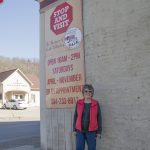
In addition to the meetings, held at Trinity Lutheran Church on the fourth Tuesday of every month, the group runs a museum and preservation center at 3501 Jacob St. The building features original tin walls and scaffolding and a myriad of memorabilia.
On Thursday, Kabala combed through pages of scrapbooks with old photos and newspaper articles chronicling South Wheeling's past at the center.
"I've always been fascinated and I don't even know why," she said. "I find these people and their ways so interesting, what they did."
Kabala explained how immigrants from Germany, Ireland, Poland, Ukraine and other countries fueled the many industries that boomed in the neighborhood from the mid-19th century to the 1960s. The area was known for its factories producing glass, pottery, steel, tobacco and beer.
"A lot of buildings today aren't built to last," Byrd added. "These buildings had character to them, they had beauty to them."
Kabala also spoke about the many talented people who came from South Wheeling, such as the labor leader Walter Reuther, the opera singer Eleanor Steber and glass innovator Michael Owens.
In the 80s and 90s, Kabala and Byrd both witnessed the decline of industry in the area and its impact on the neighborhood, they said, including blight and population decline. With that came negative perceptions about South Wheeling, something Kabala aimed to combat by forming SWPA.
"I personally just got really tired of the ridicule that came with talking about South Wheeling, because it wasn't true," she said. "The perceptions were all wrong."
The group has also advocated for saving historically significant buildings in the neighborhood from being torn down, often unsuccessfully. For example, the LaBelle Cut Nail Plant was torn down in 2017 to make way for the LaBelle Green apartments, Byrd noted.
Currently, the alliance is looking for help in saving the Eoff Street home of John L. Hobbs, the noted founder of Hobbs Brockunier Glass.
"That's the premiere property," Byrd said. "The history of that place too, one of the world's foremost glassmakers, that was his residence."
Another problem Byrd and Kabala take issue with are the many vacant buildings in the neighborhood that aren't kept up, often owned by people living elsewhere, they said.
In response, the organization holds initiatives such as its Golden Trowel Awards, which honors South Wheeling residents for making their yards look clean and beautiful. It also distributes American flags to homes in the neighborhood during the summer and works to restore old memorials and monuments.
On top of that, the group runs community gardens on Jacob Street across from Pulaski Field, with a watering system, plum trees and "good soil," Kabala said.
With the two now getting older, they're looking for help with SWPA and keeping South Wheeling's history alive. Many people in the neighborhood don't know much about the area's rich industrial past, Kabala said.
"That's been our trouble. And I think it's very typical of a lot of neighborhoods," she said. "If you don't teach it in school, how would you know?"
The two noted that the creation of the Historic District may change things, as might a book the organization is creating, spearheaded by member Donna Freter. Kabala said she hopes the book can be something that encapsulates all of the neighborhood's history.
"We want the world to know everything, a rounded out vision of South Wheeling," she said. "Because all these things, they're not in one place. There's no timetable anywhere. It's never been put together in one place."
Byrd echoed Kabala's thoughts on the book and SWPA's larger mission.
"We just kind of want to say, out of this working class neighborhood, a lot of interesting things happened," he said. "And some wonderful contributions."
The South Wheeling Preservation Alliance Center, 3501 Jacob St., is open 10 a.m. to 2 p.m. on Saturdays in April through November.