
Benwood’s Angelo Jafrate Was Among Troops Who Hit Utah Beach
Benwood’s Jafrate Was Among Troops Who Hit Utah Beach
Trending
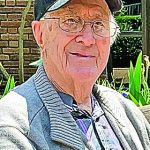
WHEELING -- Benwood native Angelo Jafrate remembers that day 75 years ago today when, at barely age 21, he was among the U.S. Army troops who hit the shores of Utah Beach at Normandy, France during the D-Day battle.
Jafrate, now 96 and a resident of Good Shepherd Nursing Home in Wheeling, was among the first soldiers to land on the beaches of Normandy on June 6, 1944 at the D-Day battle -- the infamous military operation which many view as the turning point in World War II.
Born and raised in Benwood, Jafrate enlisted in the Army days after Japanese Forces bombed Pearl Harbor and the U.S. entered the war. He served most of the war in Africa as part of the U.S. Fourth Infantry Division.
"We saw no combat in Africa, but we trained for invasions by sea," he said. "Our unit was among the best in the world."
On the night before the D-Day invasion, he remembers slipping silently from his destroyer into the cold sea around 1 a.m. He and his unit walked ashore at Utah Beach, the westernmost of the five beachheads of the Allied invasion at Normandy.
"The water was chest high, and our unit had to carry the bombs that we planned to detonate at daybreak," Jafrate recalled. "I had to carry a 40-pound tetryol (a bomb that was 70 percent tetryl, a booster explosive, and 30 percent TNT) and a 16-pound rifle."
He's proud to have been among the first troops landing at Normandy.
"We were the first to hit Utah Beach," he said. Jafrate's division was among 160,000 Allied troops that attacked the Nazi fortifications along the coast that day.
Upon reaching the beaches, the soldiers each dug a 3-foot hole in which they hid and tried to get some sleep before the battle. When they got the command to attack, Jafrate and his fellow soldiers were assigned to bomb German casement, concrete structures used to protect Nazi artillery from air strikes.
"It was up to us to blow a hole in the casement so the tanks could invade," he said. "Our bomb made a hole in the casement as big as a house. We blew it sky high."
While casualties at Utah Beach were not as high as those at Omaha Beach and the other attack sites, Jafrate lost several buddies in the attack.
Because the men had served together for three years, they had become close friends. It's a loss he still thinks about today.
By the end of D-Day, the Allies had established a foothold in France. In less than a year, the Allies declared victory in Europe.
As a result of his bravery in battle, Jafrate was awarded many U.S. medals. In addition, he received the elite Croix de Guerre, a French medal that honors feats of courage during wartime. Jafrate received this medal in June 2011 in Washington, D.C. It was bestowed on him by the French Ambassador to the U.S.
Upon his return to the United States after the war, Jafrate met and married his sweetheart, Teresa Skvarka, and moved to Bethlehem where they had three children, Valerie, Mark and Robert. He had distinguished career as a machinist and foreman at Wheeling Pittsburgh Steel's Benwood plant. Three grandchildren and three great-grandchildren are now in Angelo's family.