
‘Sunday Sit-Down’ With Circuit Judge David Sims, West Virginia’s First Judicial Circuit
TODAY’S GUEST: Circuit Judge David Sims, West Virginia’s First Judicial Circuit
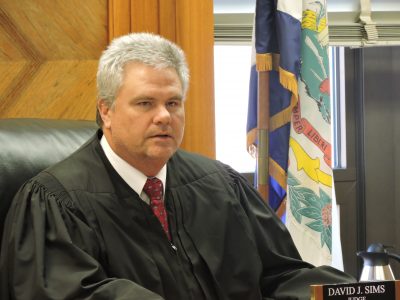
File Photo Ohio County Circuit Judge David Sims presides over a case in his fifth floor courtroom at the City-County Building in Wheeling.
Editor’s note: On Tuesday, members of the West Virginia Supreme Court of Appeals will visit Wheeling to launch the new Family Treatment Court, part of a larger effort to help families struggling with abuse and neglect issues stay connected. Ohio County Circuit Judge David Sims will help oversee the new court, which will operate in a similar manner to a drug treatment court. He discusses the new program and other issues with us today in the Sunday Sit-Down.
∫ Ohio County is one of three counties designated for a new Family Treatment Court. What role will the new court serve?
Sims: The new court is essentially for abuse and neglect families — moms, dads who are addicted. We’re going to put them in court — it’s essentially going to operate very much like the adult treatment courts, with some modifications and differences. It’s a voluntary program, parents have to be adjudicated to be in it. It’s intended to be about a nine-month program but can be a little less than that, a little more than that. What we’re trying to accomplish is to get families back together, get parents healthy, get them back in healthy environments, reduce the time children are in out-of-home placements, whether that be foster care, or with kinship placements. We’re trying to move the process and get people treatment.
Right now, when we have a parent come in and they’re adjudicated, they put on a proving period, and they’re left to their own devices. We give them a program and they’ve got to go do them, and a lot of aren’t capable. What I have is a case coordinator that works for me, and she is going to be essentially making sure all the parent’s needs are met, and then the Department of Health and Human Services has designated one of their employees who will work with the children — they’ll work together to make sure visits are taking place, parents are going to parenting classes, counseling sessions, drug testing … all the treatment they’re supposed to be at.
∫ This sounds very similar to the drug treatment courts — families would have benchmarks to meet.
Sims: Absolutely. We have benchmarks they need to meet in 30 to 60 days, and then hopefully graduation and reunification.
∫ So while parents are in the program, they’ll be without their children?
Sims: Well, potentially. It’s possible that they could still have their children, but that’s probably the exception, not the rule. The important thing is we want to make sure that they’re having visits with the children, that’s very important.
In the way we used to do it until this program started, if a parent tested positive, we stopped the visits. That harms the child more than it harms the parents. What we’re doing now is if they’re still testing positive, we’re allowing them to have supervised visits. If they show up for the visit under the influence the visit stops, it doesn’t take place. But if they’re doing OK, but they may still be positive on a prior drug test, we allow the visit to take place in a supervised setting, because we want to keep that bond. When you remove a kid, the damage is done. You’re taking a child away from their parent, even though they’re in a bad situation, that’s causing harm. We want to try to keep that bond, encourage the parent by telling them “Look, you’re child’s safe and healthy. Now we want you to get healthy.”
∫ Is this another step in understanding that the old rules — you do the crime, you pay the time, in essence — may not always work?
Sims: Exactly. We’re trying to get rid of the old thinking that drug addiction is a criminal problem. It’s not, it’s a public health problem. The old thinking — we’re going to lock them up and throw away the key — doesn’t work, because when they come out they have the same problem, and we’re not addressing the problem.
Addiction is a public health crisis. We’ve got to change the thinking. It’s hard — I’m trying to bring people along with me. Not everybody believes in this program, not everyone thinks it’s going to be successful. But I know from adult drug court that it is successful. We have probably about a 75 percent success rate from drug court — when people graduate and they don’t come back into the system. That’s pretty good. If you look at people who come out of prison and don’t have treatment, I bet the number is way lower. … The program works. It’s successful, and it’s based on a lot of years and a lot of courts doing this, and science, and public health, and medical research. We feel like we’ve got a really good program to be successful.
∫ With being one of the pilot courts, along with Boone and Randolph counties — does that add any pressure to make sure this works?
Sims: We have a treatment team that about 20 people, my team includes people from Northwood (Health Systems), from the (Lee) Day Report Center, we have some local psychologists who are part of the team, Ohio County Schools has a representative, homeless coalition has a representative. We have people on the treatment team from almost every piece of this community that can offer services. There isn’t any service that we won’t be able to provide. … We’re starting to utilize Serenity Hills. We also have job services available to help people get jobs, there’s even an organization that works with us that helps people with car repairs. We can do a lot of things.
∫ What has the drug crisis done to families in our region?
Sims: Destroyed them. We estimate that it probably more than 80 percent of our abuse and neglect cases have some underlying substance abuse problem. I deal with it almost on a daily basis — not just abuse and neglect, but juvenile court, criminal court. It’s everywhere, all the time.
It’s taxing the system. It’s costing the state and the community a lot of money. We’ve got to change the way we think about it, and this is the start of that.
∫ Legalization of marijuana — from your perspective on the bench, a good thing or a bad thing?
Sims: Great move. They ought to keep going. We’ve been fighting the war on drugs for how many years now, and have spent how many billions of dollars and lost how many lives? And it’s a failure. We have the same problems now that we have 30-40 years ago. … It’s like fighting a wildfire with a garden hose.
We’re spending the money in the wrong way. We need to look at decriminalization of drugs, and start treating drugs as a health crisis. Some countries have done that, and they see their criminal numbers go down. They see people with diseases from dirty needles go down. We’ve got to think differently — what we’re doing is not working.
∫ What percentage of your current caseload deals with drugs or drug-related crime?
Sims: Outside of civil cases, it’s 80-90 percent. … One of the things that has been done is from Betsy Jividen, from the Division of Rehabilitation. She’s been very instrumental in starting what’s called the GOALS program — Getting Over Addicted Lifestyles. That’s a program within the state prison system, a six to nine month inpatient, secure drug treatment program … apart from the general population. They’re taking inmates, putting them in that program, if they successfully complete it, they come out, we put them in our drug court program, get them after-care services and try to get them healthy and get them a job. That program is brand new, just started this year. I’ve used it a half-dozen times and think it will be very successful.
∫ You see the region’s drug problem from a different vantage point than most of us. From your view as a judge, what do you see the drug crisis doing to the local region, and what more needs to be done to address this issue?
Sims: It affects everyone — you can walk through this community and find just about everyone has been touched by it. Obviously the crisis creates crime … so people can get drugs. We have people who sell small amounts of drugs to support their habit, and then we convict them of a felony, and they have the “Scarlett F” for the rest of their lift. There’s a great article, it’s called “The Economic Death Penalty,” if you have a felony on your record, you’re branded for life when you go to get a job, when you go to get a certification, they do a background check and you have a felony.
I’m seeing the system start to re-think that. We have something available now called deferred adjudication, where someone comes in and pleads and we hold it, let them go through the treatment process and if they’re successful, they don’t get the felony. We have some new expungement statutes for people who commit non-violent offenses to come in after three years, and if you’ve successfully completed a program, we’ll remove the felony from your record.
We’ve got to stop criminalizing people with drug problems. That’s a public policy change we have to make, but it’s terrible politics. Anybody that stands up and says we want to decriminalize drugs, they’re branded a liberal. What we’re doing is not working; we’ve got to change our thinking.
∫ You mentioned those who sell drugs to feed a habit. How many such cases do you see locally?
Sims: The overwhelming majority of cases are those supporting a habit. I see low-level drug dealers — most of the larger dealers are in the federal system — I see low-level people, 80-90 percent are selling $50 to $100 of drugs to support a habit, not to make a living off it. In my personal opinion, those should be misdemeanor offenses and we should get them into treatment. If we’re going to stick a felony on some 20-year-old who’s selling $100 in drugs, we’re not accomplishing anything, we’re not helping that person down the road.
The thinking is changing on that. I’m encouraged by what I’m seeing.
∫ Outside of drugs, what are the main criminal issues you see in your courtroom?
Sims: Lot of property crimes, drugs and property crimes are the biggest things we see. Some violent crime, but in this community it’s not a lot. A lot of it’s tied to drugs and addiction. If you could take drugs out of the community, I probably would not have a lot to do.
∫ Do you think it’s been this way for the past few decades, and we’re just now better understanding and dealing with the drug issue?
Sims: Yes. The whole war on drugs … back when I started prosecuting, crack cocaine was the drug then. We wiped out an entire community and put them in prison long term. Not sure what we accomplished there.
First it was crack, and when I came on the bench it was pills, opioids. Then they cracked down on opioids and they went to heroin, very similar, cheap to get. Now we’re seeing a lot of methamphetamine. I would say the majority are methamphetamine.
We’re also battling the suboxone, subutex, the medically assisted treatment. We’re seeing a lot of abuse of that, people buying and selling it on the streets. I had one young lady in here and she said I was addicted to heroin and I get on Suboxone, and I’ll tell you it was harder to withdraw from suboxone than it was from heroin. That shocked me. I’m not a huge fan of the suboxone and subutex treatments. There’s a drug called vivitrol, it’s a once-a-month shot, they can’t abuse that, and it’s been very successful for us. I try to push people in that direction, but I can’t tell people to get off Suboxone if their doctor prescribes it. It’s an appropriate treatment; I don’t like it, but it’s part of the deal.
∫ The changes the Legislature has made to the court over the past few years — are they helpful?
Sims: I don’t really have any opinions on an intermediate court, I don’t know how necessary they are. I understand the reason why some people want them, but I don’t have real strong opinions one way or the other.
The past few years have been very difficult for the judiciary because of some things that have gone on outside of our control up here. It had an effect on all of us, not just what was going on in Charleston. But one of the things I’ve seen — what we now call the “new” Supreme Court, even though only three of them are new members — they have worked very hard under Justice Walker’s leadership to try to start restoring the integrity and confidence in the court, and I’m really impressed with what I’ve seen. Justice Hutchinson, who is a former circuit court judge, I’ve gotten to know him really well, and I’m really impressed with what they’re doing to restore confidence in the judiciary.
∫ Let’s move away from judicial matters. Prior to becoming a judge, you served for more than a decade as a member of the Ohio County Commission. About 20 years ago, this phrase became well-known in the local area: “Sims’ Folly,” which was used by some to describe what is now known as The Highlands. When you look at the development now, and the role you played in helping to facilitate it, what do you say to those doubters?
Sims: Just go up and drive around, and tell me what you think. I’m amazed — it’s not exactly what I envisioned when it was just dirt, but I’m very proud of what it is. And it’s still growing.
When they get the second interchange, and I’m confident they will — I’m proud of it, I’m proud of the work that we did … but when you’re in politics, there are going to be naysayers. I know it’s created a lot of jobs, and it’s good for the community. I don’t second-guess any of it.
∫ What are one or two things West Virginians should know about the circuit court process and how judges handle their courtroom that you believe they currently don’t?
Sims: I think our court system — prosecutors, defense attorneys — we have very high-quality attorneys in this area. When cases get litigated in front of me, they’re well tried, I get great lawyering, briefing, and the system is fair. I think some people think the system is rigged — the system is fair. Are there some areas where it could be more fair? Yes. People in the lower economic strata probably are going to have a harder time in this system by the nature of its design; that’s not something I’m happy about. … The people who are in the system — we appoint attorneys who are very qualified, experienced, and try to make sure the system is fair to them. The government has awesome power in prosecutions, at all times. I always try to balance that and keep the playing field as level as possible. … That’s the important thing.
Community
Annual Soccer Camp Back On Schedule After Flooding Disruption
WHEELING – Christ Community Church in Wheeling hosts its 18th annual soccer camp this weekend, with about 300 ...
Wheeling University Gets Provisional Reauthorization From HEPC
The West Virginia Higher Education Policy Commission granted Wheeling University provisional reauthorization to ...

Red Carpet Sizzles at Wheeling Fashion Week Runway Show
2026 Fostoria Glass Show & Sale On Tap In Moundsville
Flanigan Sworn In As W.Va. Supreme Court Justice
Not Guilty Plea Entered In Child Death-Related Case
ST. CLAIRSVILLE — Kaitlyn Kuhn pleaded not guilty to one count of endangering children. She was arraigned in ...