An Inexact Science: WVDOH Juggles Major Road Projects in Wheeling Area
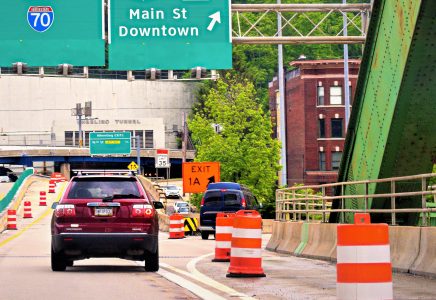
Photo by Scott McCloskey The West Virginia Department of Highways is who plans road projects, closures and detours, and those plans are created in a detailed process.
WHEELING — The blossom of orange barrels around area roadways won’t wither anytime soon. Highway and infrastructure projects throughout the area — some massive and some smaller — have closed and narrowed roads and sent drivers on plenty of detours.
How all those projects fit together — and the mission to keep roadways as open as possible — falls mostly on the West Virginia Division of Highways. DOH officials say that process is an inexact science, but the department does its best to keep motorists moving
While it may seem that some of those closure and detour decisions might fall on the City of Wheeling — especially with the current water and sewer line projects affecting Main and Market streets downtown — the majority of those decisions ultimately are made by the West Virginia Division of Highways simply because those projects fall on the DOH’s right of way, according to West Virginia Division of Highways District 6 Engineer Tony Clark.
Clark said there is a collaboration and planning process between the DOH and cities any time construction affects a road that falls in the DOH’s right of way.
He said while it’s not always an exact science, the DOH does the best they can when it comes to the decision-making process concerning closures or detours.
Clark said that, with any city infrastructure project that falls in the DOH’s right of way, the city is in that right of way by permit. Clark said in addition to long term road or bridge repair or replacement projects, the other major reason for long term road closures and detours come about as a result of utility or infrastructure projects that fall in the DOH’s right-of-way.
“They have to be permitted to be there both to protect our (DOH) interests on the road, and because of the traffic control involved,” Clark explained.
The ultimate goal, Clark said, is to move traffic through the area. The DOH wants traffic control and signage to meet code and have flaggers where required, among other things.
“That’s why we make sure they (the city) include a certain traffic control plan, whether it’s for a detour, whether it’s for flagging traffic or doing a lane closure,” he said. “They just need to follow the current guidance.”
DOH has many sections of I-70 between the Ohio state line and the Middle Creek area under construction, including the on and off-ramps in Ohio County. It also is currently working on two other Ohio County projects, Clark said — replacing the Bear Rock Bridge on National Road in Valley Grove and the Clinton Bridge on W.Va. 88.
One significant road closure did get moved to later. What was supposed to be the more than year-long closure of the historic Stone Bridge on National Road in Elm Grove was recently postponed until next spring. That will alleviate traffic problems in that area in regard to the I-70 Bridges project and ultimately shorten the time the Stone Bridge will be closed to traffic.
Clark said anytime the DOH is planning any sort of large project with the city, such as the Wheeling Streetscape project, the city is included as a stakeholder from the very beginning with the concepts and through the design phase.
“We take the city’s requests and accommodate as best that we can so it’s mutually beneficial for both,” Clark explained. “Sometimes there are requests we can’t accommodate for one reason or another but we try to mitigate that as best we can.
“We try to do the best we can in the planning stages,” he added. “Sometimes there are unforeseen issues. Like on (the I-70 Bridges project) we tried to do the best we could on the detour, but nothing is going to be perfect. So once we get out there and see how things are working, we tweak it as best we can to make those adjustments. There’s a lot of science involved and traffic engineering … but it’s not always an exact science.”
Clark said while city officials can obviously detour traffic on their own streets, the DOH is not permitted to detour traffic from the DOH’s system to city streets — with the exception of emergency situations.
Echoing Clark comments, Public Works Director Russell “Rusty” Jebbia said DOH officials oversee many of the road closure and detour decisions affecting streets within the city of Wheeling because those streets fall on the DOH’s right-of-way.
While the city schedules the large renovation projects in the downtown area, like the nearly year-long water line replacement affecting Main and and Market Streets, Jebbia said the DOH makes the final decisions concerning closures and detours on those streets. He said the DOH has inspectors check the work sites and they ultimately make the decisions on what closures and detours must be made in relation to the project and surrounding projects.
“It’s a city water line project, but it’s under the state’s inspection because it’s considered Route 2,” Jebbia explained. “We’re coordinating that with the state. … everything was approved by them, so they approved the detours.”
Jebbia said the City of Wheeling’s public information officer also attends DOH meetings and receives updates from the DOH office that affect city streets and roads and that information is shared with his office. Currently, Jebbia said the only city streets closed by authority of the city are several neighborhood streets the city is paving such as Woodsdale.
“They finished the sewer project in Woodsdale, so the Bedillion Lane job is done,” Jebbia said. “So right now we are just waiting for paving, that’s pretty much the only thing we have going on.”
Top Headlines
National Guard Troops To Remain on Streets of Washington, D.C. Through 2026
Senators Worry Postal Service Changes Could Disenfranchise Those Casting Ballots by Mail
PORTLAND, Ore. (AP) — A group of mostly Democratic U.S. senators sent a letter Thursday to the U.S. Postal ...

Feds Investigating Whether Minnesota’s Walz and Frey Impeded Immigration Enforcement

New Research Bolsters Evidence That Tylenol Doesn’t Raise Risk of Autism

Trump Administration Delays Plan To Withhold Wages for Student Loan Borrowers in Default