
WVU To Eliminate 143 Faculty, 28 Majors in Wide-Ranging Cuts
Trending
CHARLESTON -- Despite outcries from students, professors, and academics from around the country, the Board of Governors of West Virginia University voted Friday to approve a slate of program eliminations and faculty cuts meant to help reduce a $45 million budget deficit.
The WVU Board of Governors met at the Erickson Alumni Center on the Morgantown campus to consider the recommendations made by the WVU Provost's Office as part of phase two of its Academic Transformation.
"We know that it was hard, and we know that it's not been easy, but we believe it was necessary," WVU Board of Governors Chair Taunja Willis-Miller said after Friday's vote. "Opinions on how to move forward have varied. However, the board endeavored to be respectful of differing views. And the one view that we all share is that we love WVU."
The Provost's Office recommended eliminating 28 programs, 10 undergraduate programs and 18 graduate programs, and the merging of three other programs into existing degrees. Another 13 programs will see reductions in faculty.
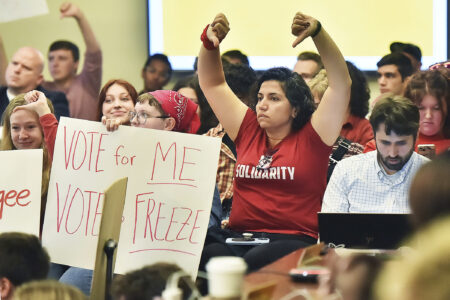
Board members voted on each recommendation by raising hands, though the vote was interrupted at the start by protests by students and other attendees.
The board approved each of the recommendations, though the votes were not unanimous with three board members voting against many of the individual recommendations. The board approved motions amending the recommendations increasing the number of foreign language faculty from five to seven and for WVU's schools of Music and Art/Design to add back one faculty member to each school.
"When it comes to the arts and the music departments, I think maybe we've been a little bit dramatic in those cuts," Vice Chair Richard Pill said.
The chopping block included most of the world languages programs except for Spanish and Chinese programs, master's and doctorate programs in mathematics, the master's program for public administration and master's and doctorate programs for higher education administration, among others.
Among programs seeing reductions in faculty include the College of Creative Arts, the School of Public Health and the departments of English, Communications Studies, Chemistry and Computer Science. The recommendations come from WVU's Academic Transformation. While the reviews began in 2016, phase two of Academic Transformation was accelerated this year, including the use of third-party consultants, program self-studies, and an appeals process.
"I also want to assure the board that even with the accelerated timeline, this was a thoughtful, professional and data-informed process," WVU Provost Maryanne Reed said. "I'm proud of the work done by the members of our team who have spent the last six months entirely focused on this effort. They did so, as did I, believing that this was the right thing to do to preserve our beloved WVU for the future."
The recommended program eliminations and faculty cuts will affect 143 faculty members, or more than 5% of all faculty at WVU. The university will notify affected faculty by Oct. 16, with layoffs to begin by May. Students affected by the program cuts were to be notified by the end of the day Friday.
University officials say WVU will still offer more than 300 undergraduate and graduate degree programs. They also say the proposed program will only affect 329 undergraduate and graduate students, or 1.35% of the student population.
"We believe we are forging the university of the future," WVU President E. Gordon Gee said during a Friday afternoon press conference following the Board of Governors meeting.
"We are not concerned with our public image. We are concerned about having a great university. That is what we are doing," Gee said. "We are making decisions now, and we are making them very assiduously in looking forward so that we preserve the qualities of this institution and also make certain we have an institution that is really forward-looking."
WVU is filling a $45 million hole in its fiscal year 2024 budget approved earlier this summer. After the Board of Governors approved a $1.2 billion budget in June, the university cut 135 positions, including 38 faculty members. Gee said depending on enrollment for the remainder of the school year, the program and faculty cuts will address the budget hole, plus provide additional funding to reinvest into the university. A specific dollar amount was not provided.
"For me, it was important to get the (budget deficit) behind us so we didn't have this overhang all the time," Gee said. "So many times in higher education you keep kicking the can down the road. It was a structural deficit that the longer you kick it down the road, then it would have grown to $75 million."
A decade's worth of decreases in total enrollment, a decrease in state funding during that same time period that has only modestly increased over the last several years, premium increases in the state's Public Employee Insurance Agency that provides health coverage to WVU employees, the COVID-19 pandemic and a budget that has grown by 37% since fiscal year 2013 has led to WVU's budget hole, which could grow to $75 million by 2028 unless the university makes changes, officials have said.
The university has made several moves prior to this fiscal year to cut costs, including being granted greater freedom over its budget from Higher Education Policy Commission oversight; employee furloughs during the pandemic; shared services between its many schools and departments; outsourcing services, such as dining; voluntary employee separation programs, spending restrictions, and updated procurement procedures. According to Willis-Miller, the university has cut more than 509 non-faculty positions since 2016.
Fall headcount enrollment across WVU's three campuses has gone down from 32,839 for the 2012-2013 school year to 27,467 during the 2022-2023 school year, a 16% decrease. Per-semester undergraduate tuition for West Virginia residents at WVU rose by 58%, from $3,045 per semester for state residents in fiscal year 2013 to $4,824 per semester for in-state students this fiscal year, a more than $1,700 increase over the last 12 years.
WVU officials have predicted a demographic cliff, with a smaller pool of high school graduates expected over the next decade. The university estimates that it could have 5,000 fewer students by 2033, at an estimated cost of $72.5 million.
"We have to continually work to make WVU relevant in today's and tomorrow's society and today's and tomorrow's students," Willis-Miller said. "We have to illustrate the role a degree can play in the quality and success of our students' lives as they face an ever-evolving educational landscape as well as new workplace realities. Ultimately, the path that the Board of Governors approved today will help keep WVU accessible, affordable, and relevant."
Program and faculty cuts at WVU are opposed by students, employees and alumni alike. The WVU Student Government Association passed two resolutions opposing the academic transformation program. WVU's University Assembly passed last week a resolution of no confidence in Gee in a 797-100 vote. And during a Board of Governors' meeting Thursday, about 60 people spoke against the proposed cuts with no one speaking in favor.
"While we are not surprised by the outcome of today's vote, we are nonetheless shocked by the disregard for the overwhelming opposition demonstrated at every stage of this process," said a group called West Virginia Campus Workers and the West Virginia United Students Union in a joint statement Friday. "At every possible opportunity for input, the WVU faculty and student body have rejected both the administration's explanation of how this financial situation arose and their proposals for how to fix it. This vote confirms, publicly and indelibly, the complete capture of West Virginia University by highly-paid administrators who neither teach nor do research, as well as their political overlords."
On Thursday, the American Association of University Professors wrote a letter to Gee and members of the Board of Governors raising concerns about the due process used in determining what programs to cut and the elimination of protections for tenure.
"We must reiterate that tenure is inseparable from the due-process protections," wrote Michael DeCesare, a senior program officer for AAUP's Department of Academic Freedom, Tenure, and Governance. "Absent such protections, tenure, and by extension academic freedom, cannot be said to exist at West Virginia University."
WVU officials acknowledged Friday afternoon that there is a morale issue on campus that needs to be addressed going forward.
"This is really, really hard," Reed said. "We know that emotions are high right now, and I think we're all just going to have to settle with that or sit with that for a little while because we are going through this process. We do care very much about our faculty and our students. We will be reaching out. We will be engaging in conversations and meetings in the future to communicate that we do care about our people, that we do believe we will have a robust academic portfolio when we're done with this, and there will be opportunities for our faculty and our students."