
Environmental Factors Come Into Play With Gateway Center Construction
Trending
WHEELING – Just as the results tabulated from the Wheeling Gateway Center survey will shape the design of the building, designers and architects will consider the environmental factors of the construction site while drawing up blueprints.
Brad Frankhouser, lead architect for the Gateway Center, explained a geotechnical report of the site has revealed environmental elements, such as soil composition, that will shape the design and location of the building.
Montrose Environmental Geoscientist Leah Mistick, the project's environmental consultant, explained that nothing was found in the geotechnical report that would "prevent any kind of dream wish item from going anywhere." A contaminant found on the site that will impact construction is arsenic in the soil, which Mistik noted is "very, very common" in West Virginia.
"You want to make sure if there are higher concentrations of arsenic in one area as opposed to another, so maybe that helps decide where the parking lot goes as opposed to the green space of a playground," explained Mistick. "There are different plans and designs for different capping options or different types of buildings, so there's no limit on what can go there environmentally."
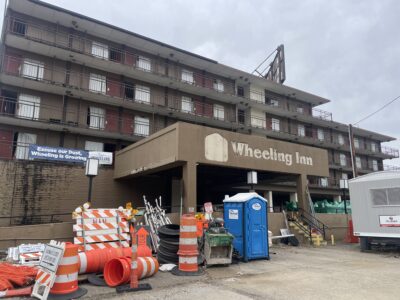
Another environmental consideration is the asbestos abatement that must be performed in the former Wheeling Inn building before the structure is demolished to make way for the center. Mistick noted that with "a lot of asbestos" in the structure, the substance would need to be disposed of properly to avoid contamination of the environment.
Since the site is in the West Virginia Department of Environmental Protection's Voluntary Remediation Program, Mistick explained this will "ensure that the site is safe from asbestos contamination."
Apart from what contaminants must be avoided or abated, the geotechnical report also evaluated the safety of neighboring buildings and structures during demolition and construction. The neighboring structure that the report revealed will need the most attention is the Wheeling Suspension Bridge.
Ambrose explained that when the bridge was built in the 1800s, the structure was anchored to several surrounding properties. To ensure no vibrations from construction or demolition impact the stability of the structure, the environmental and demolition contractors will use vibration monitoring equipment to observe seismic activity as they work.
"This is done so that in future meetings about the center years from now, there can never be any sort of accusation that the construction comprised the structural integrity of the bridge," explained Ambrose.
Frankhouser added that since the design of the building will be centered around the Suspension Bridge, they want to make sure the "star of the project" continues to shine. This means where the building will be located will not impact the view of the Suspension Bridge.
"The development will be something super, but it’s never intended to be the main focal point," said Frankhouser. "Wheeling has already made the main focal point the Suspension Bridge."
The geotechnical report also unveiled there is a "lot of feel" in the site's ground, according to Ambrose, which he noted is "not untypical for a site next to a river." He explained that the land of the construction site does not have "much load-bearing capacity."
Ambrose explained that the bedrock beneath the site will provide the best foundation for the build. With bedrock between 80 and 85 feet beneath the site, Frankhouser explained that the architects will most likely need to use "a deep foundation system," which he noted is not "untypical for this type of project."
"Most definitely, there is an additional cost, especially in this instance, when bedrock is so deep below the surface," added Frankhouser. "I would say that any significant development we do will require those deep foundations."
How deep the foundation of the building needs to be also comes into play when considering how tall the building will be. Mistick explained that the taller the building, the deeper the foundation has to be in the ground to increase stability.
"If you want to put a tall building there, it would cost more because you would have to go deeper," she added.
For Ambrose, the deep bedrock will come into play when considering how much square footage is needed to "maximize the positive experiences on the site."
"From Tipping Point's perspective, we want to ensure that we're building a very unique experience in both the visitor center as well as a historical and heritage building," explained Ambrose. "We may have to go more vertical in the building design to accommodate all of the uses wanted from it, including the complementary ones the community identified. That would create a different foundational structural system we’d have to build from than if we were to have to build a one-story structure compared to a two-story structure."
"The question then becomes, 'Is it worth the expense to build higher to get more experiences that everybody voiced that they wanted on this site?'" continued Ambrose.
The question of how much square footage is required to check those boxes of elements surveyors want for the building is one the design process will answer.
Moving forward in the project, Ambrose explained the design team will be creating "several iterations" of possible designs for the center. Initial renditions will consider what the over 4,000 Wheeling residents surveyors want for the building. Later design iterations will apply "general high-level costs and budgets" to evaluate the design from a cost perspective.
"When applying general high-level costs and budgets, we do that in partnership with ... general contractors that will be building it and evaluating it from a cost perspective," explained Amrbose. "We can make it all happen with the available sources of public and private capital."