
Boreman Statue Dedication Highlights West Virginia Day Festivities in Wheeling
State’s Birthplace Now Features a Monument to Its First Governor
 Joselyn King
 Trending
WHEELING -- West Virginia Day saw a statue of the state's first governor, Arthur I. Boreman, unveiled outside West Virginia Independence Hall, and current Gov. Jim Justice -- known as a larger-than-life character, himself -- couldn't help but make an observation.
"This is the neat part for me," Justice told those gathered in the yard. "It's 8 feet tall, and it weighs 2,000 lbs. It's bigger than me. That is going to be a governor bigger than me."
Fundraising and planning for the project had been going on for the past three years. The cost of the statue, designed by Morgantown sculptor Jamie Lester, was $178,000. Boswell Monuments designed the base for another $32,000.
It depicts the moments prior to Boreman's inauguration as the state' first governor, Lester said.
The statue's unveiling event had been set for 4 p.m. Thursday, but Justice arrived at about 4:45 p.m.
The event attracted a large crowd, and those attending sought ways to keep cool from the oppressive sun coupled with 90 degree heat. They stayed in the shade near the building or went to drink the water or lemonade that was available. Justice remained in his Chevrolet Suburban until he took the podium at about 5 p.m.
"How are you people still breathing?" he asked those seated in front of him.
During the ceremony, historian Joe Laker spoke of Boreman's background.
Boreman was born in Waynesburg, Pennsylvania, in 1823 and raised in Middlebourne. He was self-taught but managed to become a lawyer who would practice in Parkersburg before West Virginia became a state.
He was elected to the Virginia House of Delegates, where he served on the Secession Committee. Boreman, however, was a Unionist who opposed secession, Laker noted.
When Virginia later seceded from the Union, Boreman championed the western counties of Virginia forming their own state. He served as president of the Second Wheeling Convention that resulted in the formation of the Restored Government of Virginia.
President Abraham Lincoln would later make the decision and provide the proclamation recognizing the Restored Government of Virginia, the first step in permitting West Virginia's statehood.
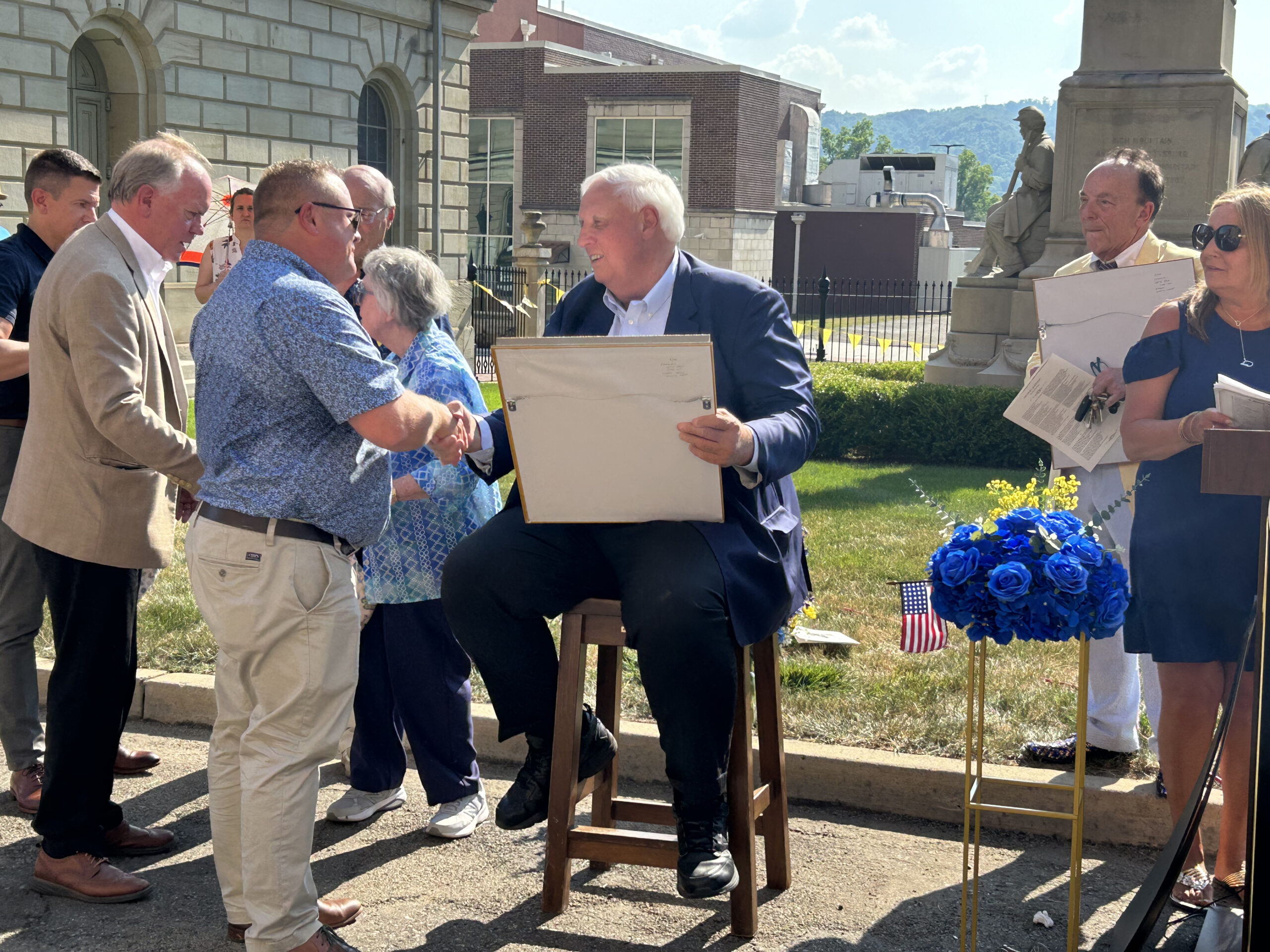 Joselyn King
West Virginia Gov. Jim Justice, center, speaks with Scott Schenerlein, executive director of Wheeling Heritage, prior to the statue unveiling.
"This man (Boreman) had it right a long, long time ago -- that West Virginia needed to be a state," Justice said. "And Abraham Lincoln, can you imagine Abraham Lincoln making this all become a reality?
"I've got six months left as your governor, but it's been an honor beyond belief for me. Absolutely keep doing the right stuff. We want to perpetuate this unbelievable community and keep it going."
Others speaking briefly during the ceremony were Debbie Jones, manager of West Virginia Independence Hall; John King as Abraham Lincoln; Wheeling City Manager Robert Herron; and Randall Reid-Smith, cabinet secretary for the state Department of Arts, Culture and History.
Wheeling historian Margaret Brennan was credited by many of the speakers as being the driving force behind the statue project.
"It's truly an honor to make this happen," she said from the podium. "But I'll be happy when tomorrow comes."
Justice's popular pooch Babydog didn't make the trip to Wheeling with the governor on Thursday.
"Forgive me for not bringing her, but Babydog is out of gas," Justice told the crowd. "It's unseasonably warm, and Babydog absolutely can't stand it when it's unseasonably warm.
"She passes on her best and loves you with all of her soul," he said.