
West Virginia Legislature Trying Again on Elementary School Discipline
 W.Va. Legislative Photography
 Trending
CHARLESTON -- For a second year, a bill that would address student discipline in elementary school grades for some of the most disruptive and violent children is moving.
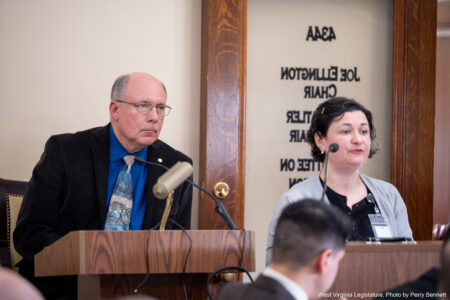
The House Committee on Education met Monday afternoon and took up House Bill 2515, relating to elementary behavior intervention and safety, hearing testimony and public comment.
The lead sponsor of the bill -- House Education Committee Chairman Joe Ellington, R-Mercer -- provided an explanation for the bill, which is similar to a state Senate Bill introduced last year by Senate Education Committee Chairwoman Amy Grady, R-Mason. That bill, Senate Bill 614, died in the final hours of the 2024 legislative session over disagreements between the House and the state Senate.
"This is pretty much the same thing," Ellington said. "It aims to address concerns over students that exhibit violent, disruptive, or threatening behavior in West Virginia classrooms. Teachers are struggling to manage students who display this behavior, which creates unsafe conditions in the classroom. A lack of standardized behavioral intervention programs leads to students not receiving the appropriate level of discipline and also leads to the continuation of this behavior."
Ellington said that HB 2515 addresses student behavior and disciplinary actions within the state's schools by focusing on interventions for students in grades Kindergarten through sixth grade that display violent or disruptive behavior. The bill also amends a similar law passed by the Legislature two years ago addressing student discipline in middle and high schools.
The bill mandates specific steps when a teacher determines a student's behavior is violent, threatening, or creates an unsafe learning environment. These include immediate removal from the classroom away other students, parental notification, and a three-day suspension,
The bill requires an evaluation of the student using Child Find, which determines whether the student has "developmental delays or exceptionalities and may need special education and related services."
The Child Find evaluation could result in a referral for Functional Behavior Analysis under the federal Individuals with Disabilities Education Act (IDEA). A risk assessment is also required before the student could return to school.
It also discusses alternative learning environments as an option. The bill advocates for alternative learning centers in counties or expanding their capacity, subject to funding, to address the behaviors of chronically disruptive students. The bill allows multiple counties to share use of an alternative learning center.
HB 2515 mandates that the state Board of Education develop a statewide disciplinary policy for legislative approval and allow for other forms of education for the student if necessary, such as virtual learning or alternative learning programs. Counties without access to such programs would have to send the students home, sometimes to bad circumstances.
David Gladkosky, executive director of West Virginia Professional Educators, told committee members that teachers are concerned about provisions regarding the alternative learning centers, which many counties do not have.
"Many counties do not have intervention centers or any kind of behavioral centers. And if they do, they're staffed by a small number of people, and they only can take in so many students," Gladkosky said. "If there's no place to send them, then you send them home. How effective is that?"
Jim Brown, the executive director for the West Virginia School Board Association, said the bill does solve the issue of removal of violent students for classrooms. But he said the bill does not address the issue of increasing mental health support in public schools.
"The bill talks about student discipline, but in fact, the real issue here isn't student discipline. It is really about the mental health issues," Brown said. "A lot of these kids come to us as early as preschool with these behaviors.
"The difference is the prevalence rate that we're seeing is exacerbated across the state, and the severity is significantly different," Brown continued. "These aren't incorrigible elementary students that are in kindergarten and first and second grade. These kids, more often than not, are kids that have been subjected to some level of abuse."
A similar bill introduced by Grady, Senate Bill 199, is pending before the Senate Education Committee. HB 2515 now moves on to the markup and discussion phase.