
Nebraska passes version of ‘Raylee’s Law’ inspired by W.Va., where it still divides lawmakers
Trending
A high-profile bill known as Raylee's Law, which West Virginia lawmakers have struggled with for years, has inspired legislation passed by the Nebraska Legislature.
Nebraska has a conservative supermajority, similar to West Virginia's GOP supermajority. Their Legislature recently passed a bill that will pause a parent's request to homeschool their child for 14 days if the parent or guardian is under investigation for child abuse and neglect.
Bill sponsor Sen. Megan Hunt, an independent, said she was inspired to sponsor the legislation after reading media coverage of Raylee's Law in West Virginia.
"Upon learning that Nebraska still had this 'loophole' in which parents (and) guardians can withdraw a child who is a potential abuse victim from school with virtually no oversight, we decided it would be appropriate to give it a try," Hunt told West Virginia Watch.
"The bill will help prevent children who are vulnerable to abuse or neglect from being further isolated with an abuser and removed from contact with school staff or child welfare investigators," she said.
Nebraska is the second state to pass this type of legislation.
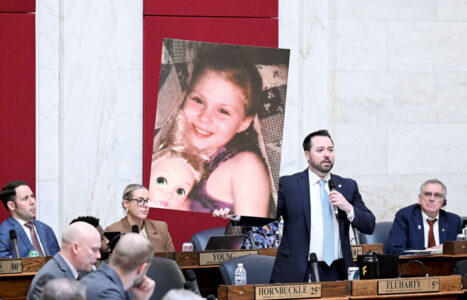
In West Virginia, the highly-debated bill is named for Raylee Browning, an 8-year-old girl who died of abuse and neglect in 2018 after her teachers notified Child Protective Services of potential abuse, prompting her abusers to move her to homeschooling.
"I'm honored that we are inspiring lawmakers throughout the country ... to take up Raylee's story and understand the importance of having guardrails in place to protect children," said Del. Shawn Fluharty, D-Ohio, who has championed the legislation in West Virginia. "It's sickening to think that we couldn't protect children in our own state from a story that happened in our state, and on the other hand, I think it shows just how important this law is, how valid it is."
West Virginia lawmakers have debated the bill during multiple legislative sessions, where it faced extreme pushback from homeschool advocates and families, who said it would unfairly restrict them without addressing the state's longstanding CPS shortfalls.
Hunt said that homeschool advocacy lobbies in Nebraska in recent years have successfully whittled down state standards for and oversight of homeschooling or other private unaccredited schools. Meanwhile, Nebraska state leadership chipped away at funding, oversight and administrative support for Child Welfare Services, she added.
"Since introducing the bill, we also heard of instances that have happened in Nebraska that this bill could have hopefully prevented, notably a case in the news in Lincoln recently in which a 12 year old boy was tortured, starved and almost killed by an abusive guardian who "homeschooled [him] with no social contact," Hunt said.
The West Virginia House of Delegates has passed versions of Raylee's Law in 2024 and 2025.
This year, the Senate for the first time approved Raylee's Law in March with strong bipartisan support, overriding Senate President Randy Smith in a rare move to do so.
The next day, In the final hour of the legislative session, the House devolved into chaos as lawmakers debated the measure, with a small group of opposition attempting to filibuster and amend the measure, saying it was targeting homeschoolers rather than addressing the problem.
The House signed off on an amended version of the bill in the last remaining minutes of the session, meaning the Senate didn't have enough time to accept the changes and send it to the governor's desk for signature.
On the final night of session, Fluharty screamed at House members on the floor, calling it "disgusting government."
"My feelings haven't changed at all. I'm still (angry)," he said on Friday in a phone interview. "I did not envision this being a political issue. This is purely about protecting kids."
Fluharty is running for state Senate against Sen. Laura Chapman, R-Ohio in what is likely to be a high-profile race; Chapman is backed by Gov. Patrick Morrisey.
If elected, Fluharty plans to work with Sen. Amy Grady, R-Mason, and Sen. Ryan Weld, R-Brooke, to get the bill through the Senate; Grady and Weld have already vowed to push the legislation again in 2027. The GOP-heavy Senate is deeply divided following fallout from a contentious primary election season and the vote on Raylee's Law.
"I am fully aware that the same people opposing Raylee's Law will be spending a hell of a lot of money against me in November," Fluharty said.