
Outnumbered West Virginia Senate Democratic Caucus Lays Out Session Priorities
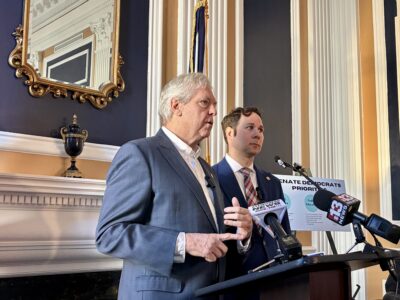
photo by: Steven Allen Adams
State Senate Minority Leader Mike Woelfel, left, and Assistant Senate Minority Leader Joey Garcia, right, brief statehouse reporters on their legislative priorities Tuesday afternoon in the Senate Reception Room.
CHARLESTON — State Senate Minority Leader Mike Woelfel and Assistant Senate Minority Leader Joey Garcia know that they are outnumbered by Republicans in the West Virginia Senate, but they believe their legislative agenda could have some bipartisan support.
“We are small in number, but we are fairly nimble and active,” said Woelfel, D-Cabell.
The two lone Democratic members of the 34-member Senate held a press conference Tuesday afternoon in the Senate Reception Room at the State Capitol Building to lay out their agenda and legislative priorities for the remaining 53 days of the 60-day legislative session that began on Jan. 14.
Woelfel said his and Garcia’s bills would be introduced over the next several days focused on improving child welfare, public education, and addressing affordability issues, such as rising electric utility prices. Garcia said there are already some bills introduced by the Republican supermajority that are similar to bills he and Woelfel plan to introduce.
“Even though we are the minority, although we don’t set the agenda, we are going to be talking about what we think is important all year,” said Garcia, D-Marion. “We can find common ground with the supermajority. We have in the past; I believe we will again.”
Woelfel will introduce bills requiring a full-time homeless student education coordinator in urban counties and part-time in rural counties, a child care tax credit, requiring Child Protective Services to either do formal investigations or family assessments based on the severity of child abuse and neglect reports, and requiring sexual abuse and violence training in public schools. Woelfel also called on Senate President Randy Smith, R-Preston, to appoint a special committee to study child welfare issues.
“My focus is mainly on our foster care crisis, which has gone on for too many years,” Woelfel said. “We have over 6,000 foster care children that are at risk through no fault of their own, and it’s time that we took seriously their plight. They have no business living in hotels or Airbnbs. This is a crisis.”
Garcia’s children and families proposals include a paid parental leave pilot program for state employees; Raylee’s Law, which would allow county boards of education to reject a request for homeschooling by a parent if there is a pending child abuse or neglect investigation against a parent, guardian and or a person serving as a child’s instructor; creating a foster care facilities improvement fund to provide funds to non-profits operating residential facilities, treatment facilities, and emergency shelters; a housing stability fund to help low-income families with rental and utility assistance.
“What we need to do is build capacity for shelters, emergency shelters, psychiatric facilities. That’s going to come from the people that are already doing that in the State of West Virginia,” Garcia said. “When it comes to Section 8 vouchers, when it comes to just having funds and helping people maintain their home, that’s part of what we want to set up with the housing stabilization fund.”
Gov. Patrick Morrisey’s general revenue budget proposal for fiscal year 2027 includes a 5% cut in personal income tax rates retroactive to the beginning of January, which – if approved by the Legislature – would return $125 million to taxpayers when fully implemented. But Garcia said there are needs now for that $125 million, such as a $10,000 per year raise for teachers and a 25% pay raise for school service personnel over a five-year period.
“Part of that, with public education, is making sure that teachers and school service personnel have the raises they deserve … we’re competing with Maryland, Pennsylvania, and Kentucky, and Ohio,” Garcia said.
Woelfel also called on reforms to the state school aid formula, including smoothing county enrollment on a three-year rolling average to prevent sudden drops in state funding to county school systems due to declining enrollment, authorizing rural county school systems to be funded at levels higher than their actual enrollment numbers to cover certain fixed costs, and authorizing grant funding for special education and other essential school personnel positions not covered by the formula.
“You know that the school aid formula needs adjustment and it needs adjustment for a variety of reasons, but the one I’d like to highlight today is special needs students and the extended cost,” Woelfel said. “They’re going to be upside down in their budgets because of the declining student enrollment. And there are a lot of reasons for that. But the state is going to need to step up and I haven’t heard anything about that from the majority caucus.”
Garcia called for implementing the recommendations from a recent RAND Corporation report to lawmakers, including a recommendation that future eligibility for the Hope Scholarship, the state’s educational voucher program, be income-based to maximize the program’s impact on student achievement.
“We’re putting that into a bill format to make sure that it’s means tested, families earning $100,000 or less … so it’s not just going to pay for something that people that have the need to put their kids in private school are already going to do,” Garcia said.
Garcia and Woelfel are also pushing for a year-long moratorium on electric and gas utility rates; ethics reforms at the Public Service Commission, requiring financial disclosure reports from PSC members, a code of ethics to abide by, and requiring members to act in the public interest; and the election of PSC members.
Top Headlines
Finance Committee Advances First Bill From GOP’s ‘Jobs First’ Agenda to West Virginia House Floor

Forecasters Warn of ‘Potentially Catastrophic’ Weekend Winter Storm From Texas to the Carolinas
U.S. on the Verge of Losing Its Measles Elimination Status
Capito Files Paperwork To Seek Third Term in U.S. Senate

Renovations to 1400 Block of Market Street in Downtown Wheeling Could Begin In March