
Candidates Question Outside Influence Behind West Virginia Primary Mailers
Trending
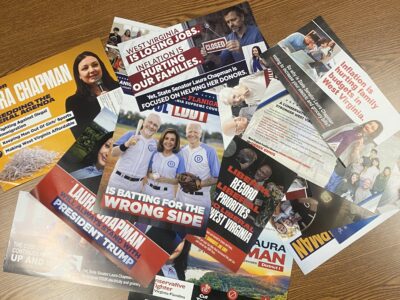
WHEELING -- Republican Joe Eddy said he was shocked when he found a political mailer in his mailbox claiming he backed a "$140 million tax hike that increased the state gas tax, jacked up the tax on buying a car" and raised car registration fees.
Eddy is making his first run for office and is seeking the District 1 West Virginia Senate seat this year. The measure he was accused of supporting was passed in early 2017.
It is one of many mailers seeking to influence voters this year, primarily in the GOP primary elections in West Virginia on May 12. Their appearance in West Virginia voters’ mailboxes have many connected to this year’s elections on both sides of the aisle lamenting that outside money is able to exert too deep of an influence in the process in the Mountain State.
Eddy took notice of who sent the mailer. Most of those mailed against him have come from the School Freedom Fund, affiliated with the Sugar Maple political action committee supported by West Virginia Gov. Patrick Morrisey.
Both PACs are tied to TikTok billionaire Jeffrey Yass of Haverford, Pennsylvania.
"The first thing I did was look up who the Sugar Maple PAC was," Eddy said. "The disconcerting part was seeing me effectively portrayed that way as a Democrat -- which is not true, and never has been true.
"It is really a concern that can happen, because I've never even been a candidate before."
Eddy later discovered the mailer was based on an op-ed piece he wrote nearly a decade ago.
"It referenced tax increases the Legislature already had approved in January and February of 2017," he said. "And of course I've never been in the Legislature. I just made a reference that infrastructure spending would be good for our area because we needed the bridges and the roads."
When he looked up the Sugar Maple PAC, Eddy discovered it had connections to Morrisey. Morrisey has endorsed Eddy's primary opponent, incumbent state Sen. Laura Wakim Chapman, R-Ohio, in the primary election.
"The governor has openly been against me from Day 1 in this race," he continued. "When you look, (contributors) are billionaires from Long Island and New York, it makes you wonder who is controlling what.
"When they spend that much money on my opponent, what do they expect in return for that?"
Eddy added that Chapman has been open about having "a great relationship" with Morrisey.
"That's fine. I used to have a good relationship with the governor until he went against me," Eddy continued. "But now other advertising campaigns have now picked it up, and they are using it against me in a text message.
"It's all misleading to say the least. It's all lies, and my opponent knows they are lies."
Chapman said she also has had to deal with misleading political mailers. Those mailers say they were paid for by the West Virginia Leadership Fund and Mountaineer Freedom Alliance, both established by Wheeling businessman David H. McKinley.
The mailers claim she voted to increase utility and grocery prices, which she denies.
"I actually introduced a bill wanting a one-year moratorium on utility rates," Chapman said. "Had it passed, it would have put a moratorium on rate increases while the (Public Service Commission) studies why our rates are going up fastest in the nation while we have the most energy in our nation under our feet."
The measure died in the Senate Rules Committee late in the session, she said.
Chapman said the flyers do serve an important role in encouraging voter participation.
"They go directly to people's houses," she said. "They don't always listen to radios, watch television or newspapers. And candidates going door to door can't always get to everyone."
Chapman also acknowledged the flyers can be misleading, but said she trusts voters to do their own research and ask questions about what they are reading.
She suggested voters call candidates directly with concerns about claims made in the mailers. She encouraged those wanting to reach her to call her cell phone number at 304-280-2765.
One question voters might ask is whether groups spending large amounts of money to promote a candidate expect something in return.
"I sure hope not," Chapman said. "That is illegal. We are not allowed to do quid pro quos. (The PACs) have a First Amendment right to say what they are saying. These groups exist to get who they believe is best for the state."
Among those listed as officers for the West Virginia Leadership Fund targeting Chapman are former state Sen. Ed Gaunch, R-Kanawha, and current senators Tom Takubo, R-Kanawha, and Ryan Weld, R-Brooke.
"We have seen an unprecedented amount of money going into political mailings from organizations in Washington, D.C.," Weld said. "The money that was raised by our governor in Connecticut, New York and New Jersey (for the Sugar Maple PAC) is flooding West Virginia, and there are some pretty nasty campaigns happening against West Virginians."
He said Morrisey has traveled across the country and raised $600,000 for the Sugar Maple PAC, with "very little of the money coming from West Virginia."
Weld added the School Freedom Fund is affiliated with the Club for Growth PAC.
"I remember in 2022 when those two organizations spent $700,000 against (the late former U.S. Rep.) David B. McKinley. So now you are seeing them come back with hundreds of thousands of dollars against state senate candidates, or trying to prop up several incumbents," he continued.
"By and large, if you look at the candidates that are being supported by the out-of-state money, they have raised very little support in West Virginia in terms of their campaign finances compared to their opponents," Weld said. "The organizations came in because they were unable to raise it and do it themselves.
"West Virginians deserve an answer to what was asked for in return for the money to be spent on their behalf."
Campaign finance reports filed by both Chapman and Eddy in early April show little disparity in fundraising totals. Chapman reported raising $13,750 in contributions, while Eddy reported $19,000.
"Another thing is that none of the mailers talk about actual issues that change the trajectory of the state, or change West Virginia's workforce participation rate," Weld said. "I've yet to see one that talked about substantive issues that address moving West Virginia forward to economic prosperity, and how we should change the business environment for job opportunities in the state.
"That's not what they are talking about. It should be about the cost of living, and there is very little discussion on that."
Delegate Mike Pushkin, D-Kanawha, who also serves as chairman of the West Virginia Democratic Party, said he has not personally seen many of the more extreme mailers this year because they are targeting GOP primaries and Republican voters.
But he said he is aware of one flyer targeting independent voters that was paid for by the West Virginia Republican Party. According to Pushkin, the flyer states only Republicans can vote in the May 12 primary election.
To clarify, the Republican Party this year is allowing only registered Republicans to vote in its primary. It is encouraging independents to change their affiliation and vote on the GOP ticket.
Pushkin said the West Virginia Democratic Party believes the flyers are misleading and meant to discourage unaffiliated voters from going to the polls. The party filed a complaint this week with the West Virginia Secretary of State's Office.
"The Republicans have been attacking us for years," he said of attack mailers. "These are the tactics they have used on us. Now they are turning on each other.
"But this is an effort to keep independents from going to the polls. While it is true they (Republicans) did close their primary, independent voters can still go to the polls. There are nonpartisan races for Supreme Court, intermediate court, board of education and other nonpartisan races."
Independent voters also can request a Democratic or Mountain Party ballot at the polls, he said.
Pushkin blamed a 2010 U.S. Supreme Court decision for issues involving political mailers in West Virginia and elsewhere.
In the landmark Citizens United v. Federal Election Commission case, the court held that corporate and union funding of independent political broadcasts in elections could not be limited, citing First Amendment free speech rights. The ruling allowed corporations and unions to spend unlimited amounts advocating for or against candidates.
"This is the reason why we have negative ads and such high expenditures from outside groups slinging mud," Pushkin said. "It has worked. And that is why they keep doing it. We're seeing the effects of it, and it is getting worse."
He also noted the mailers are linked to groups tied to Morrisey.
"He is trying to influence the legislature, and he has not been able to do so," Pushkin said. "He has a bad relationship with some legislators."
Attempts to reach Morrisey for comment were unsuccessful this week.