
Capitol Building Commission Re-Approves Capitol Murals In Special Meeting
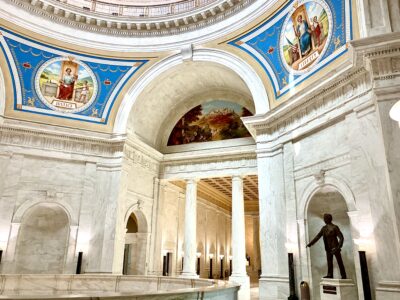
Murals at the State Capitol Building depict representations of Education, Justice, and the Civil War Battle of Philippi. (Photo by Steven Allen Adams)
CHARLESTON – Members of the commission that oversees changes to West Virginia’s Capitol Complex held a special meeting Tuesday required under the terms of a settlement in a legal case involving the installation of murals in 2024.
The Capitol Building Commission and voted to re-approve the murals after retroactively approving the murals in a 4-1 vote in October 2024. Only commission member Brent Boggs, who participated remotely, voted no.
According to an agreed settlement order submitted last November by the parties in a lawsuit brought by Gregory Morris and Tom Acosta against the state in Kanawha County Circuit Court, the Capitol Building Commission was required to hold a special public meeting regarding the eight murals painted and installed in the upper rotunda, and the commission’s contract with Connecticut-based John Canning and Co.
“I will say as the chair of this commission I want to note that the rationale for the settlement was to address questions related to process,” said Chelsea Ruby, cabinet secretary for the Department of Arts, Culture and History and chairwoman of the Capitol Building Commission. “As the body responsible for stewarding the history integrity of the West Virginia Capitol Building and its grounds, we will prioritize both transparency and process moving forward.”
“We’re happy to have this matter behind us and look forward to restoring the important work this group is supposed to do at next month’s regularly scheduled meeting,” Ruby continued.
Morris and Acosta filed a lawsuit on Aug. 30, 2024, in Kanawha County Circuit Court against Randall Reid-Smith, the former chairman of the Capitol Building Commission and former cabinet secretary of the West Virginia Department of Arts, Culture and History, which has since been absorbed by the Department of Tourism. Also named in the lawsuit was an ad hoc committee appointed by Reid-Smith involved in the mural project.
The original lawsuit asked the court to declare the contract for the murals between Reid-Smith and John Canning and Co. null and void and issue an order directing the Department of Administration’s General Services Division to remove the murals, prohibit any further work, prohibit any further payments to Canning, and require Reid-Smith and Canning to repay the state for the cost of the murals.
“The murals are going to be here long after we’re gone, and people will look back, and they’ll read the history of how it came about and think … that the whole state was kind of tricked into having something in their statehouse that may or may not belong there,” Acosta told commission members.
“This was just ramrodded through. But you now have a chance to correct it and to amend it,” Morris said. “If you decide you want to put something out that is really worthy of the State of West Virginia one day, do it. This is not just a rubber stamp meeting … It is a chance for this Capital Commission to take personal and professional responsibility in correcting a mistake. And it was a mistake.”
The first four murals – unveiled in conjunction with West Virginia Day on June 20, 2024 – were painted and installed in the half-moon lunettes surrounding the upper rotunda. Those murals depict historic Harper’s Ferry and the John Brown fort; the battle of Philippi during the Civil War; an allegorical scene based on the state seal; and artists, musicians and wildlife at the base of Seneca Rocks.
The final four murals were painted and installed in the pendentives, the curved triangular sections between each lunette. These murals depict the incarnations of commerce, education, liberty and justice. The murals are supposed to be based on ideas and concepts that famed Capitol architect Cass Gilbert had wanted to include in the building but was unable due to costs during the start of the Great Depression.
The artist selection process for the murals was first approved on April 14, 2010, by the Capitol Building Commission. Multiple companies participated in the pre-bid process at the time, including John Canning and Co., but the project was scrapped due to lack of funding.
Reid-Smith, who was first appointed as commissioner of the Division of Culture and History by former Gov. Joe Manchin, had served as chairman of the Capitol Building Commission since his appointment in 2005. He held that chairmanship since the former Department of Education and the Arts became the Department of Arts, Culture and History and he was elevated to curator by then-Gov. Jim Justice. The Legislature changed his title to cabinet secretary in 2024.
In previous statements, Reid-Smith argued that since he had been chairman of the Capitol Building Commission since 2005, he had authority to resume the 2010 mural project nine years later without a new vote. Reid-Smith also claimed there was already a contract with Canning, though that contract was not finalized after the project was halted due to cost issues.
Reid-Smith began reviving the project as early as 2019, using the 2010 vote by the Capitol Building Commission to move forward. The commission was not consulted on the look of the murals and no votes were held by the commission to approve the murals prior to the murals being installed. The commission held a retroactive 4-1 vote to approve the murals in October 2024. According to the State Auditor’s Office, the project cost more than $509,000.
Steve Canterbury, a former administrator of the West Virginia Supreme Court of Appeals, was a member of the Capitol Building Commission in 2010. He said Reid-Smith went beyond his authority.
“I said specifically that this was a motion to begin the process, and that process should include a panel of experts, historians, architects, artists, engineers,” Canterbury said. ” The fact is that that commission, that special panel, was never appointed. And later, when this flunky panel was appointed, it was way after the fact, and they were never approved, as far as I know, by the Capitol Building Commission. They just were an ad hoc group to kind of tell the secretary what he wanted to hear. I was very disappointed.”
According to the state Purchasing Division, the project was not put out for competitive bid, citing Section 9 of the Purchasing Division Procedures Handbook’s “impossible-to-bid list,” which includes artwork and historical items. Reid-Smith reapproached Canning as the contractor, which agreed to a price for the project similar to what the company offered in 2010.
The Governor’s Office released the artist renderings of the murals in April 2024, but an ad hoc committee made up of Reid-Smith, former Department of Administration Secretary Mark Scott, two officials representing Justice, and the director of the State Museum recommended changes to the murals, including adding a dog similar to Justice’s popular English bulldog Babydog to the Seneca Rocks mural.
As a condition of the settlement last November, the Capitol Building Commission through the Board of Risk and Insurance Management agreed to pay $18,500 in attorney fees to the Peyton Law Firm and Harvey Peyton, the attorney who represented Morris and Acosta.
Peyton, who spoke Tuesday in his capacity as a citizen and not Morris and Acosta’s attorneys, urged commission members to either remove and replace the murals or at least remove and replace the mural containing Babydog and replace it with the original rendering of the mural that was released to the public in April 2024 that did not include Babydog.
“These changes were made after the public had been shown that what was represented to be … without any involvement of the public or any notice,” Peyton said. “Certainly, if it’s the position of the Capital Building Commission with an opportunity to ratify, approve, disapprove, or modify what has taken place, you can do that.”
Top Headlines
Trump Says The U.S. Will Extend Its Ceasefire With Iran At Pakistan’s Request
Capitol Building Commission Re-Approves Capitol Murals In Special Meeting
Candidates pitch economic ideas, youth retention at ‘Voting For Business’ forum
Old Debt From Arena Improvements Paid Off Early
A Century of Faith and Fellowship: Cathedral Of St. Joseph Marks Historic Milestone
Morrisey Orders Flags At Half-Staff To Honor Former U.S. Rep. David McKinley
Governor Patrick Morrisey has ordered United States and West Virginia state flags at the Capitol Complex and at all ...