
Indoor Eden: Wheeling Woman Teaches STEM With Stems
Trending
WHEELING -- Laurie Ruberg had been hustling, getting her multitude of potted plants that were outdoors for the summer back inside as nights dropped into the 40s, a temperature she said tropicals in particular do not like.
"I was watching the weather and, as long as the low was 51, 53, it was OK," explained Ruberg, motioning to plants now stationed throughout her Wheeling home. In addition to tropicals such as palms, cacti and succulents were nestled in for the winter. "I love indoor plants."
Ruberg -- who has a Ph.D. in curriculum and instruction and has researched and taught at the former Wheeling Jesuit University as well as serving as visiting faculty at West Virginia University -- wasn't using the word "love" lightly, as a sunny spot just off a stairway landing revealed.
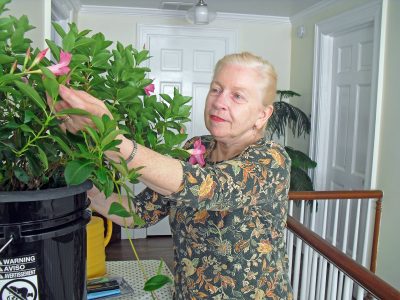
There, a pink-flowering tropical called Dipladenia sat on a makeshift potting table. It was taking part in one of Ruberg's frequent experiments. The plant, a gift, was doing rather well in soil, she said. But, could it do as well in, say, water? Ruberg -- who has done this kind of thing before, to the point she can take a scientific lab show on the educational road through her PLANTS, LLC business -- suspected it would.
So, the soil shaken free from its roots, the Dipladenia was now in a pot filled with water and clay pellets intended to help it stay upright.
That lot was inside a plastic bucket and Ruberg was ready to install a pump to bubble air into the system. The tropical -- an ever-bloomer Ruberg said is beloved by Canadians trying to keep their homes lively through long winters -- was now full-on hydroponic.
STEM WITH STEMS
The Dipladenia is really just a larger version of a hydroponic starter kit of sorts that Ruberg uses in PLANTS classes conducted for area students in grades 4 through 8, she said. The mini model involves a Styrofoam cup with holes poked in the bottom, a scrap of plant bedded in the same mix of water and clay pellets and a plastic-cup surround.
No pump is needed -- aeration is accomplished by pulling on two yarn straps on each side of the inner cup, Ruberg explained, demonstrating by bobbing the inner cup up and down.
The kids are technically supposed to aerate the plant this way once a day, she said with a grin. But, close to a decade into bringing the tech of hydroponic growing into regional schools, she knows that's a mere suggestion.
"Kids like to take care of things," Ruberg said of the in-person and online labs she has developed to introduce the possibility of a new kind of STEM (Science, Technology, Engineering and Math) careers to area youth. She has also worked with the STEM Club at Wheeling Park High School. "We bring nature into the home … It's just part of our genetic makeup."
Ruberg suspects youth involved in the enrichment classes often don't realize just how science and math oriented they really are. But, as fun as the plant-and-water systems are to mess about with, she said the STEM is always there.
It's in the gloves students use to avoid introducing bacteria that can take down such contained systems, in the monitoring of water's nutrient levels and electrical conductivity, in the setting up of webcams to record plants' growth.
"There's so much STEM learning in this," Ruberg said. "It's always learning. It's always a challenge."
FUTURE FARMERS?
And, for some, it might eventually be a career, she added. "They don't have to be a farmer," she said, although that is a newly viable possibility for even the landless as hydroponic agriculture done inside buildings and metal containers as big as train cars begins to supplement soil-borne produce.
Students might, alternatively, be inspired to become an agricultural researcher, a chef growing his own greens literally on site or even an environmental scientist using the same technology in a non-food way to pull toxins such as heavy metals out of contaminated water, she said.
Hydroponics, a method of growing that goes back to ancient Egyptians planting herbs and greens in water from the Nile, has that kind of breadth and depth, Ruberg said. Such plants can grow any time of year, use water that is continually recycled, can be fed with only such exacting nutrients as they require, and, ultimately, help feed a growing global population while using fewer resources and less space.
Here and now, students working with Ruberg and her multitude of non-profit partners -- including Ohio County Extension Service, Grow Ohio Valley and NASA West Virginia Space Grant Consortium -- learn that the growing method can range from herbs or greens in small kitchen systems to full-on farms, where plants such as lettuce grow on floating Styrofoam rafts.
They also learn about the economic and environmental realities of the larger end of this type of food production. An example? Ruberg told of a utility company in western Pennsylvania that decided to grow hydroponic tomatoes using the extra heat its energy production generated.
The idea initially worked, she said. The tomatoes were healthy and good tasting enough to sell before they were even planted. But, there wasn't enough natural daylight to keep the system in the black. A need for extensive artificial lighting -- too pricey, ironically, for even a utility -- eventually shuttered that operation.
Given that hydroponic farms may also require fans, heaters and aeration units -- all consumers of electricity, Ruberg considers such experiments part of the hydroponic learning curve. But, she pointed to another operation in Cleveland that is working well -- growing greens and herbs on a commercial scale right in the same location as the population that will eat them.
It's an environmental win given the low need for transportation and a culinary win as fresh, local greens are available all year long in an area that experiences serious winter weather, she noted.
The Cleveland farm-scale operation works in an urban center, but Ruberg said it wouldn't really work in a city Wheeling's size. Not to say that regional entrepreneurs aren't already tinkering with models that could, she added.
A Pennsylvania meat farm, she said, recently converted a single barn there into a hydroponic growing site for herbs and salad greens. Both food streams are being delivered to the same customers at the same time, adding a new revenue source without increasing transportation costs, she said.
Will Ohio County School children -- and 4-H participants, if Ruberg's hopes come to fruition -- someday use what they are learning today to push the agricultural envelope even further? Maybe. Already, Ruberg said, a handful of students she has worked with have chosen college majors toward that end.